Climate Changed: Canadian arenas adapting and improving to combat temperature changes
Advertisement
Read this article for free:
or
Already have an account? Log in here »
To continue reading, please subscribe:

Digital Subscription
One year of digital access for only $205*
- Enjoy unlimited reading on winnipegfreepress.com
- Read the E-Edition, our digital replica newspaper
- Access News Break, our award-winning app
- Play interactive puzzles
*First annual payment billed as $205.00 + GST for one year. This annual subscription will automatically renew at $233.00 + GST every 52 weeks (10% off the regular annual price of $259.35). Offer available to new and qualified returning subscribers only. Cancel any time.
To continue reading, please subscribe:
Add Free Press access to your Brandon Sun subscription for only an additional
$1 for the first 4 weeks*
- Enjoy unlimited reading on winnipegfreepress.com
- Read the E-Edition, our digital replica newspaper
- Access News Break, our award-winning app
- Play interactive puzzles
*Your next Brandon Sun subscription payment will increase by $1.00 and you will be charged $17.95 plus GST for four weeks. After four weeks, your payment will increase to $24.95 plus GST every four weeks.
Read unlimited articles for free today:
or
Already have an account? Log in here »
Hey there, time traveller!
This article was published 16/10/2022 (1423 days ago), so information in it may no longer be current.
It’s getting harder to make ice in Winnipeg, a city known for its frigid winters.
Warmer summers and sudden shifts in temperature in the spring and fall have made it difficult for the older refrigeration systems in Winnipeg’s municipal arenas to get the cement slab sufficiently cold. Todd McDonald, the supervisor of arena and aquatic assets for the City of Winnipeg, explained how one of the older Freon-based cooling systems he oversees is struggling to keep up with Manitoba’s changing climate.
“We used to open it up probably in the third week of September going back 25 years ago, then about 10 to 12 years ago, we had to push the opening date to Oct. 1, because we’d start the plant at the same time, but it would take so many more days and weeks to remove the heat from the slab,” said McDonald, noting that refrigeration is not the creation of cold but rather the removal of heat.
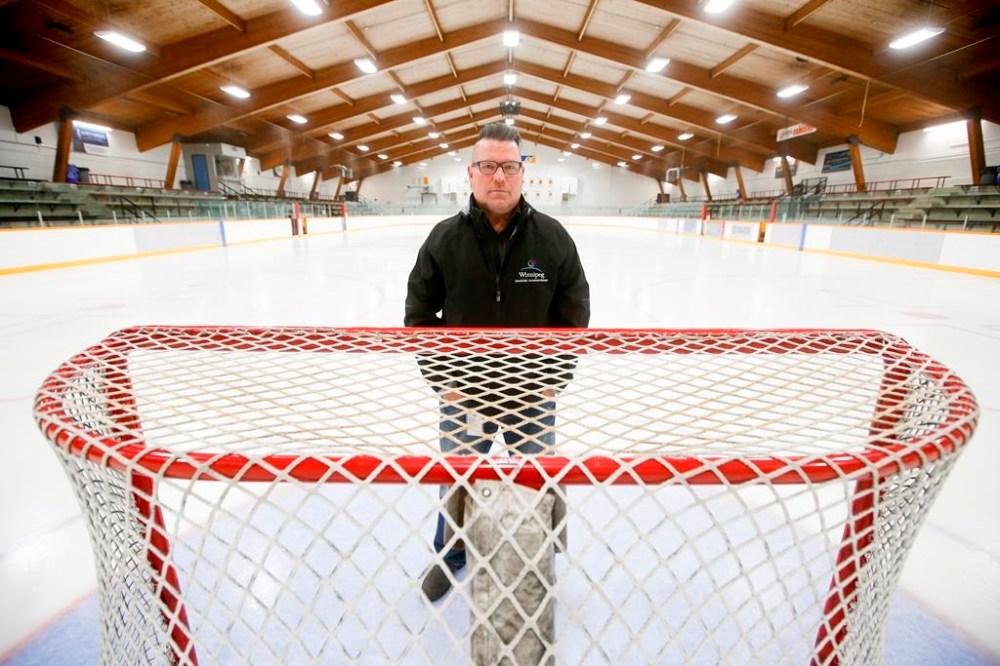
“We’ve pushed it to Oct. 15 the last several years. This year in particular, we had an Oct. 15 opening date that had to be pushed back one week due to the fact the plant is running at 100 per cent efficiency, but we just can’t remove the heat as quickly as we used to be able to.”
In the case of ice rinks, refrigeration has historically meant moving the “waste heat” outdoors through a coolant system. That’s an increasingly big challenge as Canadian arena operators have to run their ice plants longer and at higher power to counteract warmer outdoor temperatures while also trying to reduce greenhouse gas emissions and not add to the warmer environment.
Ammonia-based coolants are the most common in North American arenas. Although ammonia is highly toxic in confined spaces it has zero carbon emissions. Freon-based systems are being phased out as that chemical has a 100-year global warming potential of 1,810 or nearly 2,000 times more potent than carbon dioxide. Carbon dioxide refrigeration systems are also in use in some arenas, but they are not as widespread as either ammonia- or Freon-based systems.
Winnipeg operates 12 rinks, with 10 using ammonia-based cooling systems. The other two use Freon, which is being grandfathered out of arenas and other larger refrigeration systems across North America because of its global warming potential.
McDonald said that lowering the temperature in an ice rink — especially with the older Freon-based systems — is becoming harder each fall and during the winter when there are more warm spells than in the past.
“As the ground warms up more and more each year, it takes more and more energy to release that heat come the fall time,” he said. “As the shoulder seasons become more unpredictable that’s where we’re finding we’re struggling.
“(Winnipeg’s) cool weather in the spring was advantageous towards us but then the fall being warm wasn’t, so there’s trade offs. And engineering is all about trade offs.”
Several Canadian cities are finding new, inventive ways to create those trade offs at their arenas.
Winnipeg has a lengthy list of energy and carbon reduction measures that it’s considering. Sealing leaks, installing radiant heaters in seating areas, heat reclamation on compressors, LED lighting, and collecting rainwater for ice surface floodwater are just some of the innovations the city is examining.
The cities of Ottawa, Calgary, and Vancouver all exclusively use ammonia-based coolant at their municipally operated rinks. All seven Canadian NHL teams use ammonia-based coolants in their arenas.
A spokeswoman for the City of Toronto confirmed that the majority of its 119 ice surfaces use ammonia-based systems or will be upgraded to ammonia during ongoing state-of-repair upgrades. College Park’s Barbara Ann Scott rink, an outdoor skating trail, was completed in 2018 and uses a carbon-dioxide based system that is non-toxic, non-flammable, and has zero net carbon emissions.
Steve Glass, manager of facility operations for the City of Calgary, said that the trope of an old, dingy refrigerator plant at a local arena is simply not a reality anymore.
“Everything’s very high-tech now and heavily designed, heavily maintained,” said Glass with a laugh. “The movies don’t depict exactly what’s happening, that’s for sure.
“We’re not banging wrenches on pipes to make things work.”
Like his counterpart in Winnipeg, Glass said his team is always finding new ways to make Calgary’s rinks more energy and cost efficient. That includes installing low emissivity fabric under ceilings that reduces solar heat seeping down from the roof and therefore the load on refrigeration systems. The city has also upgraded its ice plant condensers to be adiabatic, which means there’s no exchange of heat from the system to the building, among other improvements.
“(Our goal) is to reduce our environmental footprint, reduce our carbon footprint,” said Glass. “There’s also a sustainable operating cost reduction, which helps keep the tax base down.
“Anything that we can do with new technology that benefits Calgarians.”
Vancouver and Ottawa have both started using heat redistribution systems that take the energy produced by the ice plants and redistributes it to other parts of the arena or adjacent buildings. Craig Edwards, manager of energy and utilities with Vancouver’s real estate and facilities management department, said that the heat redistribution technology has made municipal arenas very efficient.

“You can heat entire community centre buildings easily with all the waste heat from the ice rinks,” said Edwards, who noted that all the ice rink compressors are electric and therefore low in greenhouse gas emissions. “So we’re not producing any greenhouse gas emissions to operate the ice rinks and then we also offset the emissions from all the adjacent buildings.”
Edwards said that Vancouver is in the process of using the heat waste from an arena to warm a greenhouse at the city’s Sunset Works Yard, where the parks department grows all its plants and flowers before the spring.
The City of Ottawa has also made use of the large amount of space that its arenas and community facilities occupy, installing solar panels on 12 of its large flat roofs, including four of its arenas, to produce green energy.
Toronto has also begun to install solar panels, LED efficient lighting and controls systems, as well as reflective ceiling material to reduce refrigeration operation.
This report by The Canadian Press was first published Oct. 16, 2022.