Minn. governor trusts energy law will survive ND suit threat

Advertisement

Advertise with us

ST. PAUL, Minn. (AP) — Democratic Gov Tim Walz signed a bill Tuesday that requires Minnesota utilities to get 100% of their electricity from carbon-free sources by 2040, saying he's confident it will stand up against a threatened lawsuit from coal and gas producing North Dakota.

Read this article for free:


or

Already have an account? Log in here »

To continue reading, please subscribe:

Subscribe and receive a limited-edition Free Press branded hat or tote.

Digital Subscription

One year of digital access for only $205*

  • Enjoy unlimited reading on winnipegfreepress.com
  • Read the E-Edition, our digital replica newspaper
  • Access News Break, our award-winning app
  • Play interactive puzzles

*First annual payment billed as $205.00 + GST for one year. This annual subscription will automatically renew at $233.00 + GST every 52 weeks (10% off the regular annual price of $259.35). Offer available to new and qualified returning subscribers only. Cancel any time.

To continue reading, please subscribe:

Add Free Press access to your Brandon Sun subscription for only an additional

$1 for the first 4 weeks*

  • Enjoy unlimited reading on winnipegfreepress.com
  • Read the E-Edition, our digital replica newspaper
  • Access News Break, our award-winning app
  • Play interactive puzzles
Start now

*Your next Brandon Sun subscription payment will increase by $1.00 and you will be charged $17.95 plus GST for four weeks. After four weeks, your payment will increase to $24.95 plus GST every four weeks.

Hey there, time traveller!
This article was published 07/02/2023 (1333 days ago), so information in it may no longer be current.

ST. PAUL, Minn. (AP) — Democratic Gov Tim Walz signed a bill Tuesday that requires Minnesota utilities to get 100% of their electricity from carbon-free sources by 2040, saying he’s confident it will stand up against a threatened lawsuit from coal and gas producing North Dakota.

Republican North Dakota Gov. Doug Burgum this week renewed his threat to sue his neighboring state over the requirements. He unsuccessfully tried to persuade Minnesota lawmakers as the bill took shape to make changes to ensure that North Dakota utilities — which export electricity produced from coal and natural gas to Minnesota — would not be harmed.

“I am not a lawyer but I am surrounded by very good ones,” Walz told reporters after signing the bill into law. “I trust that this bill is solid. I trust that it will stand up because it was written to do exactly that. And just to be clear, Minnesota’s not staking our future on coal and carbon.”
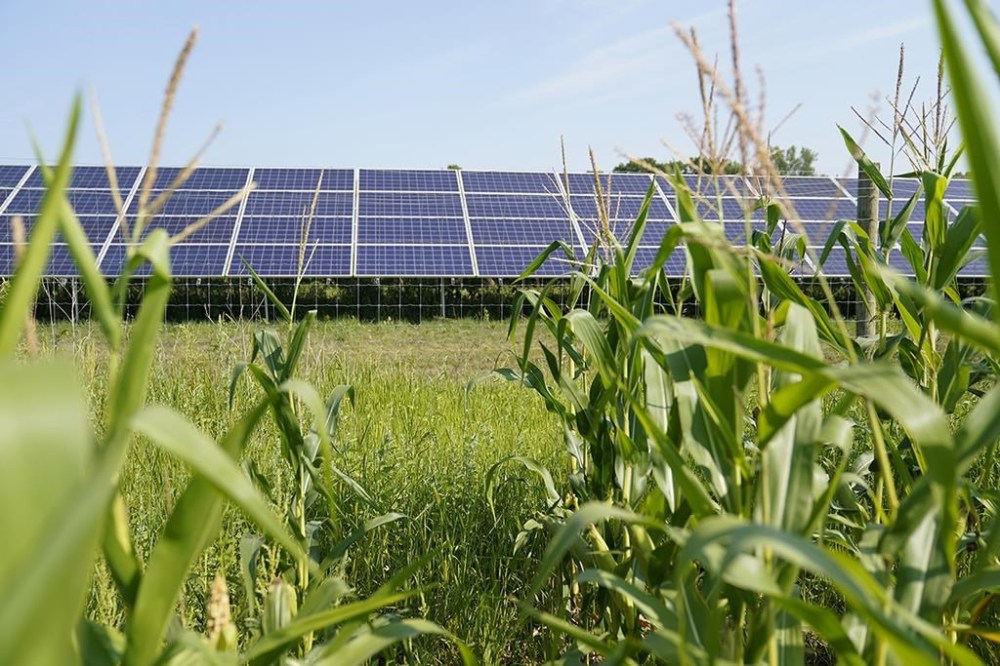
FILE - Solar panels stand near corn growing on Barb and Gerald Bauer's farm on Aug. 20, 2021, near Faribault, Minn. Minnesota utilities would be obligated to transition to 100% carbon-free electricity by 2040 under a bill slated for a vote on the Senate floor Thursday, Feb. 2, 2023. (AP Photo/Jim Mone, File)

Walz added that he thought it was “unfortunate” that Burgum is ready to litigate, and that it would be more productive if North Dakota joined Minnesota and the rest of the country instead.

“The fact of the matter is, Minnesota is moving into the future and they’re going to have to come sometime,” Walz said.

The Minnesota Senate passed the plan 34-33 along party lines Thursday after the House approved it 70-60 the week before. Republican lawmakers said it would raise costs for consumers while undermining the reliability of the power grid. Rural utilities said they’ll have trouble complying.

According to the Clean Energy States Alliance, 21 other states have already established 100% clean-energy standards or goals, most with target dates between 2040 and 2050. Minnesota’s previous standard, set in 2007, aimed to cut overall statewide greenhouse emissions to 80% by 2050.

“The adoption of 100% clean energy goals by an increasing number of states has been one of the most important energy policy developments of recent years,” Warren Leon, the alliance’s executive director, said in a statement. “Minnesota’s addition to the ranks of those states is especially noteworthy, because the state has historically been a leader in clean energy policy and its new goals are ambitious and meaningful.”

At a meeting of the North Dakota Industrial Commission on Monday, Burgum said the Commerce Clause of the U.S. Constitution and other laws bar Minnesota from having a say over how North Dakota businesses operate.

“By regulating the percent of electricity sold, they’re essentially overreaching and affecting North Dakota companies,” the Bismarck Tribune quoted Burgum as saying. The commission allocated $1 million to pay for any litigation and voiced support for asking legislators for $3 million, the newspaper reported.

But Burgum also told the commission — which is made up of him, North Dakota Attorney General Drew Wrigley and Agriculture Commissioner Doug Goehring — that officials from their state would continue trying to reach an agreement with Minnesota to avoid a lawsuit, the Tribune reported.

In a letter to their Minnesota counterparts last month, Burgum and the other commissioners said Minnesota’s plan threatens the tax revenue stream from North Dakota’s energy industry that they’re counting on to fund their state’s carbon-capture,hydrogen power and other initiatives to “decarbonize” their energy sources

They also noted that federal courts ruled against Minnesota when North Dakota and its utilities challenged a part of the 2007 Minnesota Next Generation Energy Act that tried to ban importation of power that would increase statewide carbon dioxide emissions from the sector. The 8th Circuit Court of Appeals said in 2016 that Minnesota could not do that without congressional approval.

San Francisco-based Climate Cabinet Action, a political action committee that backs candidates who support fighting climate change, said Burgum’s threat is part of a new trend of fossil-fuel industry backlash against states or communities that pass pro-climate measures.

“States suing other states for passing pro-climate policy is just another tactic by fossil fuel lobbyists to protect their special interests and their bottom line,” Caroline Spears, the group’s executive director, said in a statement.

The group said those court challenges don’t work, citing a lawsuit by the state of Utah and fossil fuel companies against a San Francisco Bay community that banned the handling and storage of coal and petroleum coke. Under a 2021 settlement, a private port operator in the city of Richmond, California, that handles the fuels was given until 2027 to continue those operations.

And it pointed to a 2012 U.S. Supreme Court decision to bar Wyoming and Montana from suing Washington state for denying a key permit to build a coal export dock that would have sent coal to Asia. The two major coal mining states have sought to boost exports to prop up an industry that’s in decline as U.S. utilities switch to gas-fired power and renewable energy.


Report Error Submit a Tip

More Stories

Small businesses outline election priorities

Robin Bezte 5 minute read 2:00 AM CDT

Since moving to Winnipeg earlier this year, I have come to know the city through its small businesses. As a new Exchange District resident, grabbing coffee at Little Sister, walking through The Forks Market and stopping at Pho Hoang for lunch have become part of my routine. These are the places that give Winnipeg’s neighbourhoods their character and have helped make a new city feel like home.

That is why an empty storefront never feels like just vacant real estate. It represents someone’s investment and hope. When a small business disappears, the community loses a piece of itself.

On Oct. 28, Manitobans in most municipalities will choose their next mayors, reeves and councillors. While city councils may not set interest rates or negotiate global trade agreements, they do have some control over many of the barriers entrepreneurs encounter day to day, from property tax bills and permit applications to public safety and construction disruptions.

Ahead of the upcoming elections, the Canadian Federation of Independent Business (CFIB) surveyed Manitoba small business owners to get a sense of their municipal priorities and concerns.

Man who killed two Indigenous women, was accused of killing third, back in prison less than year after statutory release

Erik Pindera 4 minute read Preview

Man who killed two Indigenous women, was accused of killing third, back in prison less than year after statutory release

Erik Pindera 4 minute read Yesterday at 4:06 PM CDT

A Winnipeg man convicted of killing two First Nations women more than a decade ago — with charges stayed in a third slaying — has been sent back to prison less than a year after he left under conditions.

Parole Board of Canada officials revoked 67-year-old Shawn Lamb’s statutory release after a hearing last week.

“Your actions are not beyond your control, yet you continue to wilfully make poor decisions that place the public at risk,” board member Arun Kundu-Thomsen wrote in a decision released this week.

Lamb gained statutory release — a legislated conditional release most federal inmates automatically qualify for after serving two-thirds of their sentence — in November last year and lived in several Ontario facilities for federal offenders.

Read
Yesterday at 4:06 PM CDT

Port of Churchill signs agreement with Dutch port

Aaron Epp 2 minute read Preview

Port of Churchill signs agreement with Dutch port

Aaron Epp 2 minute read Tuesday, Sep. 29, 2026

Arctic Gateway Group, operator of the Port of Churchill, has signed an agreement with the Port of Rotterdam in the Netherlands to attract business and strengthen supply chains linking Western Canada and Europe.

The agreement enables the two ports to work together to develop new trade in critical minerals and energy products, connect Canadian producers with European buyers, and identify opportunities to improve the supply chain from Western Canadian resource projects through Churchill and into European markets.

The Port of Rotterdam is Europe’s largest port and home to more than 3,000 businesses across its industrial complex, serving as a major gateway for critical raw materials and energy.

Meanwhile, the Port of Churchill has been identified as a transformative national strategy for Canada and is emerging as a northern trade corridor connecting Western Canada’s resources to global markets.

Read
Tuesday, Sep. 29, 2026

Nearly four in 10 Manitobans hope Canada restarts trade talks after U.S. midterm elections, poll reveals

Gabrielle Piché 4 minute read Preview

Nearly four in 10 Manitobans hope Canada restarts trade talks after U.S. midterm elections, poll reveals

Gabrielle Piché 4 minute read 7:00 AM CDT

Disorganized — that’s what Marcus Langlois calls recent United States tariffs.

He expects suppliers’ prices to increase — on mugs, pens, hoodies — for his employer, Dreamcatcher Promotions, if the United States–Canada trade war persists.

Still, he’s not pining for a quick trade deal.

“I think it should wait,” said Langlois, Dreamcatcher Promotions’ vice-president. “Let’s hope that it’s later on with proper negotiations happening.”

Read
7:00 AM CDT

Jets new backup Stevenson ‘stoked’ to be in tandem with Skinner

Mike McIntyre 6 minute read Preview

Jets new backup Stevenson ‘stoked’ to be in tandem with Skinner

Mike McIntyre 6 minute read Wednesday, Sep. 30, 2026

It didn’t take long to get the dirt on the newest member of the Winnipeg Jets.

Meet Clay Stevenson, who has no problem if you prefer to refer to him by his long-standing nickname of “Mud.”

“You know, Clay is in the mud, and there you go. That’s it, right there,” Stevenson said Wednesday with a laugh. “I got it in juniors when I was playing in Coquitlam, and kind of stuck ever since.”

Stevenson is now hoping to make a name for himself in a city that, quite fittingly, translates to “muddy water” in Cree. The 27-year-old from Alberta was placed on waivers by the Washington Capitals and claimed by the Jets, who were looking to clarify a goaltending situation which was as murky as the Red River.

Read
Wednesday, Sep. 30, 2026

Who protects collegiate athletes?

Brian Ramsay 4 minute read 2:00 AM CDT

College athletes need advocacy, before another life is lost.

They need an independent voice because, as the system stands, athletes speaking out for personal safety would end their positions on their teams. They need an advocate when their voices cannot be heard — and, more importantly, when they are being ignored or silenced.

What happened on Aug. 20 — when Arizona State University hockey player Matthew Mayich collapsed during a high-intensity outdoor workout — was not an accident. Mayich is still in hospital in critical condition.

When established processes and safeguards are alleged not to have been followed, the response cannot begin and end with the institution investigating itself and declaring nothing went wrong. Serious incidents demand transparency, accountability and independent scrutiny.