Earth’s warriors, young and old, keep battling and hoping
Advertisement
Read this article for free:
or
Already have an account? Log in here »
To continue reading, please subscribe:

Digital Subscription
One year of digital access for only $205*
- Enjoy unlimited reading on winnipegfreepress.com
- Read the E-Edition, our digital replica newspaper
- Access News Break, our award-winning app
- Play interactive puzzles
*First annual payment billed as $205.00 + GST for one year. This annual subscription will automatically renew at $233.00 + GST every 52 weeks (10% off the regular annual price of $259.35). Offer available to new and qualified returning subscribers only. Cancel any time.
To continue reading, please subscribe:
Add Free Press access to your Brandon Sun subscription for only an additional
$1 for the first 4 weeks*
- Enjoy unlimited reading on winnipegfreepress.com
- Read the E-Edition, our digital replica newspaper
- Access News Break, our award-winning app
- Play interactive puzzles
*Your next Brandon Sun subscription payment will increase by $1.00 and you will be charged $17.95 plus GST for four weeks. After four weeks, your payment will increase to $24.95 plus GST every four weeks.
Read unlimited articles for free today:
or
Already have an account? Log in here »
Hey there, time traveller!
This article was published 21/04/2023 (1253 days ago), so information in it may no longer be current.
They fight for Earth.
Young and old, famous and not so well known, there are many people from around the globe who make it their mission to try to save the planet, especially from the ravages of climate change. They find themselves often pitted against powerful forces.
One group is the generations that will live for decades with what Earth will become and are trying to keep it from getting overheated. Another is from a generation partly responsible for what’s happened and trying to clean up what they are leaving behind for those younger generations that they helped teach.
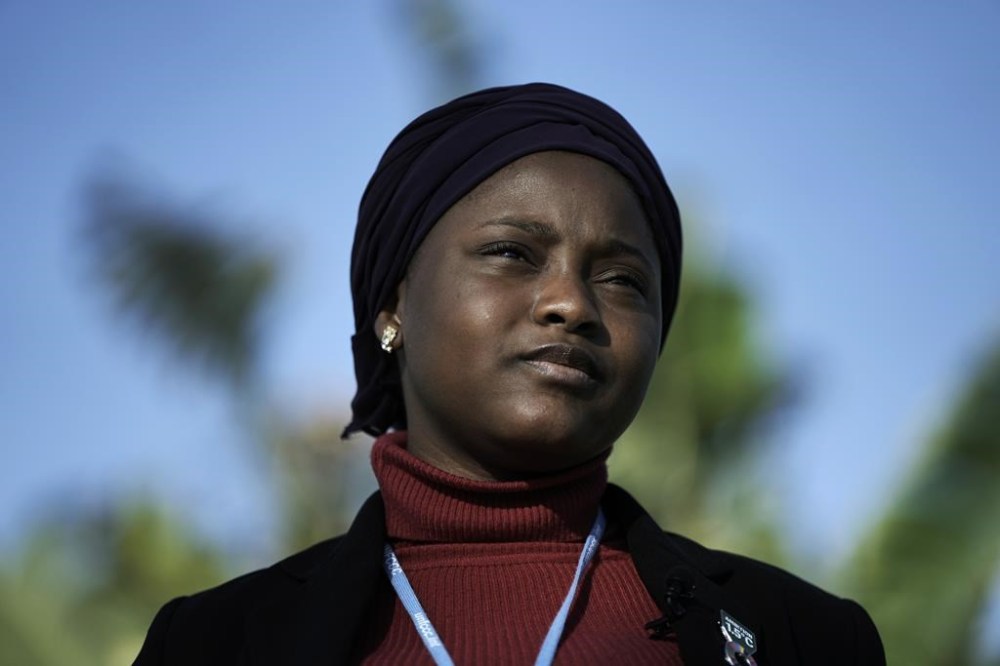
Here are some of those planetary warriors as people commemorate Earth Day. Even though 40, 50, 60 and even 70 years separate them, they have something in common: Hope. It keeps them battling.
ERIC NJUGUNA
“I became a climate justice activist out of necessity,” the 20-year-old from Kenya says. “Having seen first-hand the impacts of the climate crisis, I joined the youth climate movement.”
“As I get older, the impacts of the climate crisis will be even worse,” Njuguna says. “I am doing this work because it must be done.”
Njuguna admits to getting dejected frequently, pointing to failed efforts to get countries to agree to halting new oil and gas exploration and investment.
When looking at the oldest generation, Njuguna says it’s not really about age or blame for those who were in charge before – even though heat-trapping emissions are at their highest. Instead the activist says it is often about richer North countries that caused the pollution and poorer South countries that get hit.
“As the climate crisis gets worse and its impacts become even more devastating, it’s hard not to lose hope,” Njuguna says. “But I get hope from being in the movement to see young people, Indigenous people who are on the frontlines of the climate crisis lead the fight for justice.”
BILL NYE
“I’m so old. I was at the first Earth Day. I grew up in the city of Washington, D.C.,” says engineer-turned science communicator-turned climate activist Bill Nye, 67. “I rode my Schwinn bicycle to the Washington to the National Mall.”
Despite government and industry scientists knowing, predicting and warning about the dangers of human-caused climate change, “we haven’t done anything about this problem in 60 years, 50 years. So let’s get to work. Yes it’s frustrating,” Nye says.
“There’s certainly plenty of things to be doomy about,” Nye says. “I mean just look around at just how lame global efforts have been to address climate change the last few decades.”
Nye says he’s borrowing a page from the playbook of “conservative media” and “so we made six one-hour things to scare people so that people might do something about things” in a streaming TV series called The End is Nye.
Yet Nye says, “you have to be optimistic. If you are not optimistic, you’re not going to get anything done. … When young people are running the show, they’re not going to put up with this stuff. They’re going to make changes.”
DISHA RAVI
“Hope is a sewer rat,” says Disha Ravi, a 24-year-old Indian climate activist with Fridays for Future and a vocal proponent of linking various environmental and people’s rights issues in India with climate-related activism.
Quoting Ohio-based poet, Caitlin Seida, Ravi says she feels the same. “I don’t think hope is some flowery thing. Like the poem, I believe it is a sewer rat that fights against all odds even if it gets ugly.” Ravi said, “We are all like sewer rats, fighting for a better world.”
Ravi was in the spotlight in 2021 when she was arrested on sedition charges by Indian police but released on bail soon after. She was purportedly arrested for supporting secessionists, but Ravi asserted that she was helping spread the word about the large scale protests by farmers in India.
For Ravi, it started with an Instagram post about climate change saying, “Hey, I want to do something. I don’t know what to do. Does anyone else want to do something with me?”
Ravi feels Earth Day has become a greenwashing exercise in recent years. “But the positive aspect is that people remember there is something called the Earth and they connect with nature to some degree,” she says.
DAVID SUZUKI
For more than half a century, David Suzuki has advocated for Earth, but looking back he fears “the environmental movement has fundamentally failed.” And what’s worse, he says, “my message at the end of my career is that we’ve run out of time.”
Suzuki, 87, was studying the smallest of things as a professor in 1962: the genetics of fruit flies. Then he read Rachel Carson’s “Silent Spring” and he asked himself, “but what about the bigger picture?”
And that bigger picture is where he says society has gone astray, thinking Earth is there to serve humans instead of people being part of an intricate web of life, where plants, animals, humans, air, water and soil are connected. Suzuki says he and other environmentalists have been too focused on “incremental change that doesn’t threaten the system. … We’re all trapped within the system now.”
Over the decades, “I’ve said to my wife ‘that’s it; forget it; it’s too hard; we can’t do it’,” Suzuki recalls, but he never quit. “You have no choice. If you have children or grandchildren, you can’t ever talk about giving up.”
He tells the younger generation that “however despairing the situation, you have no choice but to fight and try. We don’t have time to despair. That’s a luxury.”
VANESSA NAKATE
At 26, Vanessa Nakate of Uganda is one of the older and better known of youth climate activists. She’s spoken at international climate negotiations, written a book and won awards.
What really has been the high point of her activism is concrete results she can see. In 2019, she started the Vash Green schools project to bring solar electricity to schools in Africa. She’s got installations in 45 schools, helping about 16,000 children.
“For me, seeing the joy of children and teachers and parents being able to study and have access to clean sources of electricity, being able to access clean cooking, I think that is one of the things that is a huge highlight and really a place of transformation,” she said.
Nakate said her activism has been compared to prostitution and she has been accused of attention-seeking to find a husband by “people who carry so much negativity and so much hatred,” but then Nakate looks back at the schools. “If that was the price I had to pay to reach more schools with solar and ecofriendly stoves, then I guess it was worth it.”
“I really don’t care what kind of negativity comes in,” Nakate says. “I’m really looking at what I would say is the bigger picture.”
MARIA MARSHALL
Environmentalism came naturally to Maria Marshall.
She grew up with her grandmother’s farm, her mother’s garden in Barbados and her parents talked about taking care of the planet and acted accordingly. So Marshall decided to join in. She was 11.
She made a video on recycling and reuse, “Little Thoughts on Big Matters,” that became a series, and then she was chosen as a UNICEF youth advocate, the youngest at the time she was appointed. And when two years ago she met Barbados Prime Minister Mia Mottley, herself a force in trying to change the world financial powers deal with climate change, the prime minister gave her what may be one of the highest compliments possible on the island nation. Mottley compared her to superstar Rihanna.
“When my message is shared with so many people around the world that makes me feel very happy that people are inspired by what I’m doing,” Marshall, now 14, says. It’s “not like I’m an attention-seeker or anything along those lines, but because I like when good things happen, especially for something as important as our planet and the environment.”
“The fact still remains,” she says as she gets ready to go, “we still have only one environment we’ve got to protect.”
DOROTHEE HILDEBRANDT
Dorothee Hildebrandt found the inspiration to focus her lifelong activism toward the climate change effort because of the younger generation, and in particular the 20-year-old activist Greta Thunberg.
“She was talking about climate change, and I was thinking she is so right,” says the 72-year-old. “We have to care about stopping climate change … it’s not only personal, my children, I’m thinking about the children of the world.”
She started by striking on Fridays in the town of Katrineholm in Sweden, where she lives, with just a handful of others.
Since then, Hildebrandt has cycled – only occasionally taking the necessary ferry – to the last two international climate conferences in Scotland and Egypt.
She hopes her cycling journeys can set a good example, believing that she needs “to do all I can, and if I don’t do that, I won’t have a good conscience.”
Younger and older generations carry the climate fight, Hildebrandt says, with middle generations too “occupied by daily life.”
Despite a lifetime of activism for various causes, she doesn’t have much hope for the future, but she does maintain a bit. “I don’t know what I would do” otherwise, she says.
NICKI BECKER
The 22-year-old from Argentina started her journey in climate activism after she was struck by the youth-led movement, Fridays for Future, back in 2019.
She realized then that climate change was not off in the distance but already affecting her daily life, she says, but very few people in her country were paying attention to the issue.
“A country like Argentina should not be indifferent to it just because it is facing an economic crisis, but rather the opposite. We have fewer resources to deal with a crisis that is already attacking us today,” she says.
Becker co-founded Youth for Climate, a movement of over 200 young people from across Argentina who are pushing for laws to combat climate change and support “cartoneros” who gather and recycle waste.
She believes that activism is essential, even when it can be frustrating.
Becker says her generation’s activism is not just a fad, and will remain with them as they grow older.
“Many business partners say that young people of my generation, when looking for a job, don’t just look for the salary, but also consider many other factors that influence their decision,” she says. “They look for companies that are at the forefront of environmentalism.”
NAKEEYAT DRAMANI SAM
At just 10 years old, Nakeeyat Dramani Sam made a name for herself when she gave a powerful speech about who pays for climate damages at last year’s United Nations climate conference.
She says the experience was “a high point” because “the climate message reached all the world.” However, she acknowledges that campaigners’ calls sometimes fall on deaf ears.
Now 11, Sam is critical of the older generation, saying that “when they had all the power and authority, they didn’t do much to stop global warming,” but “at least some of them have listened,” she says. In her native Ghana, some have contributed to tree-planting efforts, which is how Sam’s climate activism began four years ago.
Sam has written a children’s book on trees and has planted “so many trees that I have lost count,” she says.
She says the younger generations are “the future leaders and there are others coming after us. We must protect the Earth for them.”
___

Follow AP’s climate and environment coverage at https://apnews.com/hub/climate-and-environment
___
Follow Seth Borenstein, Wanjohi Kabukuru and Sibi Arasu on Twitter at @borenbears,@WanjohiK and @sibi123
___
Associated Press climate and environmental coverage receives support from several private foundations. See more about AP’s climate initiative here. The AP is solely responsible for all content.