UBC students construct one of Canada’s first ‘carbon-minimal’ hempcrete buildings.

Advertisement

Advertise with us

VANCOUVER - It has been two years, but University of British Columbia architecture student Katie Theall can vividly recall the"surreal moment" when their team learned it had received a site on the Vancouver campus to build a "carbon-minimal" student space.

Read this article for free:


or

Already have an account? Log in here »

To continue reading, please subscribe:

Subscribe and receive a limited-edition Free Press branded hat or tote.

Digital Subscription

One year of digital access for only $205*

  • Enjoy unlimited reading on winnipegfreepress.com
  • Read the E-Edition, our digital replica newspaper
  • Access News Break, our award-winning app
  • Play interactive puzzles

*First annual payment billed as $205.00 + GST for one year. This annual subscription will automatically renew at $233.00 + GST every 52 weeks (10% off the regular annual price of $259.35). Offer available to new and qualified returning subscribers only. Cancel any time.

To continue reading, please subscribe:

Add Free Press access to your Brandon Sun subscription for only an additional

$1 for the first 4 weeks*

  • Enjoy unlimited reading on winnipegfreepress.com
  • Read the E-Edition, our digital replica newspaper
  • Access News Break, our award-winning app
  • Play interactive puzzles
Start now

*Your next Brandon Sun subscription payment will increase by $1.00 and you will be charged $17.95 plus GST for four weeks. After four weeks, your payment will increase to $24.95 plus GST every four weeks.

Hey there, time traveller!
This article was published 21/04/2023 (1255 days ago), so information in it may no longer be current.

VANCOUVER – It has been two years, but University of British Columbia architecture student Katie Theall can vividly recall the”surreal moment” when their team learned it had received a site on the Vancouver campus to build a “carbon-minimal” student space.

“That was sort of a big moment being like, this is our site, this is going to happen,” said Theall.

As the project’s architecture lead, Theall guided a team of 60 university students from engineering, architecture, business and arts to fundraise $1.85 million and build the hempcrete building on campus — from plans to plaster — all within two years.
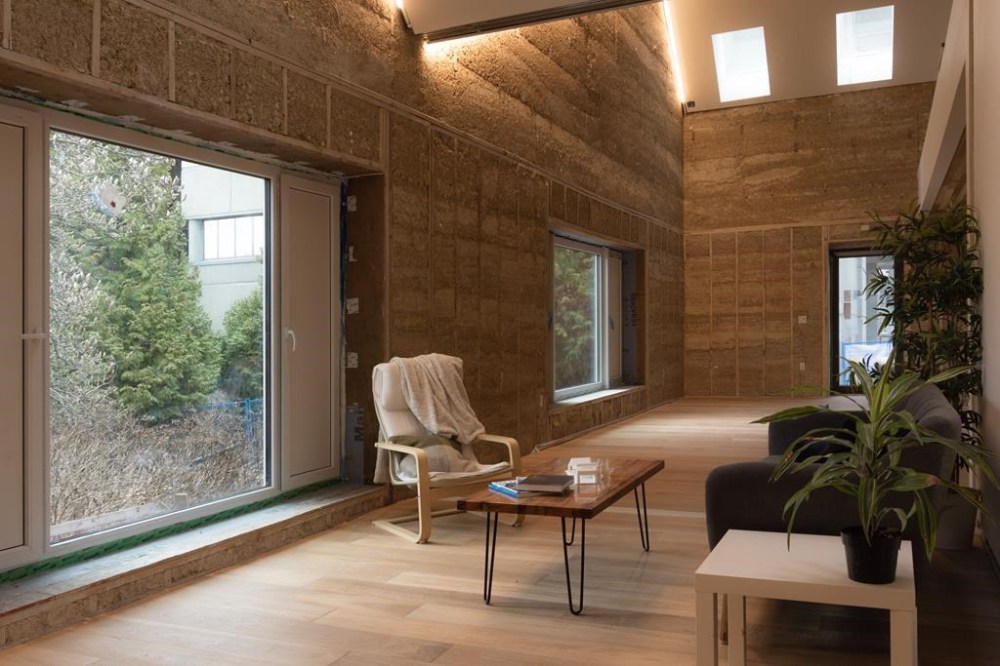
A room inside a 'carbon-minimal' building is seen in an undated handout photo. One of Canada's first 'carbon-minimal' buildings made with hempcrete is officially open this week and it's located on the University of British Columbia's Vancouver campus. THE CANADIAN PRESS/HO-UBC, *MANDATORY CREDIT*

Construction workers are putting the final touches on the building this week.

The 222-square-metre building, called Third Space Commons, is one of Canada’s first such institutional spaces designed to be near-zero carbon and features a seminar area, a meeting room and a kitchen.

The building is wood framed, while the thermal insulation is made of hempcrete, a mixture of hemp fibres, lime and water, which produces a much smaller carbon footprint than concrete construction, Theall said.

She said the students mixed the hempcrete in a drum, bringing it to the consistency of oatmeal. They then used buckets to pour it into the two-by-four wood frame.

The hemp fibre remains visible inside the building, creating a decorative effect on the wall, although Theall said they will be putting a layer of plaster over the lower portion for protection.

Hempcrete captures carbon from the atmosphere as it sets and eventually turns to a concrete-like material.

“The difference between concrete and hempcrete is pretty distinct. Hempcrete uses agricultural byproducts, it’s a biocomposite. So, it uses agricultural materials rather than things like aggregate,” said Theall.

The University of B.C. said in a statement the foundation of the building is made of reusable steel piles and the team chose light wood framing instead of engineered wood, which is considered more carbon-intensive because of the glues used.

The choice of hempcrete as a building material was deliberate. Theall said her team has been passionate about carbon minimization since the beginning of the project, and they all shared the same mission to reduce the carbon footprint in the construction process.

“Through our research and investigating different materials, we discovered that hempcrete is supposed to be at least carbon neutral or carbon negative, which is why we decided to try to build with it,” said Theall.

Adam Rysanek, an assistant professor at the UBC school of architecture and landscape architecture, said they have had welcome reviews from the public with some calling it “amazing” and “strange.”

“I think virtually, there is no concrete in the whole project,” said Rysanek, who advised the team on the build.

Hempcrete takes several weeks or months to cure compared with the curing time of days or weeks for concrete, but it comes with advantages such as being highly insulating, fireproof and zero-carbon, said Rysanek.

He said the team worked hard to account for the carbon impact of every element of the project.

The group also recently won an inaugural B.C. Embodied Carbon Award for small building construction by showing how the project will be responsible for up to 80 per cent less carbon emissions than had it been built with traditional materials and techniques.

The B.C. government said it is committed to reducing greenhouse-gas emissions to 40 per cent below 2007 levels by 2030, with one of its goals to identify opportunities in construction.

Switching to low-carbon building materials, or even looking into other alternatives, is an important step to ensure that we are heading toward the net-zero goal, said Ryanek.

“The step you have to take to get from concrete to no concrete or from high-carbon materials to low materials changes everything,” he said. “It’s an area of discussion that we haven’t yet started.”

Ryanek said it has only been in the last few years that they have realized how much needs to change to get to a zero-carbon building.

Theall said hempcrete might not be the ideal solution for every building, but she hopes it inspires more low-carbon designs, and that industry leaders can start cultivating innovation by using more carbon-negative materials.

I think ultimately our goal is we want industry and construction and people to be really cognizant of the environmental impact of the materials they choose, she said.

This report by The Canadian Press was first published April 21, 2023.

This story was produced with the financial assistance of the Meta and Canadian Press News Fellowship.

Report Error Submit a Tip

More Stories

Unhappy Dynacare staff refuse OT shifts; doors could be closed at clinics with Saturday hours

Carol Sanders 3 minute read Preview

Unhappy Dynacare staff refuse OT shifts; doors could be closed at clinics with Saturday hours

Carol Sanders 3 minute read Friday, Sep. 25, 2026

Some Winnipeg Dynacare sites normally open on Saturday were closed last week, and may continue to be because staff are refusing to pick up overtime shifts after they were forced back to work amid a labour dispute with the company.

Read
Friday, Sep. 25, 2026

Signs of local neo-Nazi recruiting efforts spark concern

Conrad Sweatman 7 minute read Preview

Signs of local neo-Nazi recruiting efforts spark concern

Conrad Sweatman 7 minute read Yesterday at 2:00 AM CDT

A far-right canvassing push in Manitoba this month is raising concerns among Winnipeg residents.

Stickers promoting Nationalist-13, a men’s-only neo-Nazi group also known as NS-13 based primarily in Hamilton, Ont., have appeared in Winnipeg and parts of southern Manitoba. The stickers bear national socialist branding and messages such as “White Man, Fight Back” and “White Community, Political Action, Training and Fitness.”

Winnipeg writer Jess Woolford recently encountered an NS-13 poster on Pembina Highway.

“It was appalling,” Woolford said. “It has the Nazi death heads covering people’s faces. It was pretty disturbing to come across this … I just didn’t expect to see it so blatantly displayed in my neighbourhood.”

Read
Yesterday at 2:00 AM CDT

Special teams woes hurt Bombers in loss to Argos

Ken Wiebe 7 minute read Preview

Special teams woes hurt Bombers in loss to Argos

Ken Wiebe 7 minute read Yesterday at 8:06 PM CDT

They’ve been the most consistent of the three phases in the Winnipeg Blue Bombers arsenal this season.

A port in the proverbial storm, throughout this topsy-turvy campaign of ups-and-downs, the special-teams units have been supplying strength to a group that is still searching for consistency with only four games left in the regular season.

That’s what made this momentary lapse so costly in a 30-28 loss to the Toronto Argonauts on Friday at Princess Auto Stadium.

“We didn’t keep up our end of the bargain. And that hurts our football team, hurts our chances of winning games,” said Blue Bombers special teams ace Tanner Cadwallader. “And if we want to win close games. we’ve got to be a whole lot better than that. And we will. We’re going to come in (on Saturday for the film session) and go through it with a fine-tooth comb and just work a little bit harder.”

Read
Yesterday at 8:06 PM CDT

Flammable gas culprit of 2024 Transcona home explosion: police

Malak Abas 2 minute read Preview

Flammable gas culprit of 2024 Transcona home explosion: police

Malak Abas 2 minute read Friday, Sep. 25, 2026

Flammable gas is believed to be the cause of a 2024 house explosion in Transcona that damaged neighbouring homes and displaced residents.

“As a result of the investigation and upon Crown review, the explosion is believed to be an isolated incident,” Winnipeg Police Service Const. Dani McKinnon said in an email Friday afternoon.

“There are no public safety concerns connected to this incident, and no criminal charges have been laid.”

The sudden blast happened in a bungalow on Camrose Bay on June 26, 2024. It levelled the home and caused significant damage to 22 other houses. At the time, it was described as “catastrophic” by the fire chief at the scene.

Read
Friday, Sep. 25, 2026

Letters, Sept 26

7 minute read Yesterday at 2:01 AM CDT

Important lessons lostRe: Parents still in charge amid health curriculum overhaul: premier, Sept. 23

The premier’s assurance that parents could continue to “opt-out” their children from health education classes on the premise that specific topics clash with their “personal beliefs” is, at once, disappointing and concerning.

To be blunt, such an approach is Trumpian. It condones “othering.”

The new curriculum content is intended to provide students with factual information that will help keep them safe from myriad physical, emotional and mental harms while also providing opportunities to develop understanding, respect and compassion for their fellow humans.

Nuit Blanche ready to wow in city’s core

Conrad Sweatman 5 minute read Preview

Nuit Blanche ready to wow in city’s core

Conrad Sweatman 5 minute read Friday, Sep. 25, 2026

For one night each September, downtown Winnipeg becomes an art gallery — an amusement park, even.

During Nuit Blanche, which takes place tonight, 3D projections spill across the Exchange District, The Forks and St. Boniface, and thousands flood the city core to take in live music, DJs and installations.

“There really isn’t anything like it. I know every promoter probably tells you that, but we are the only event that works at this scale in the fall,” says Nuit Blanche general manager Kurt Tittlemier.

“Culture Days Manitoba is run with the mission statement to make free, accessible artistic programming to all,” he adds, referring to the multi-week national festival, “and Nuit Blanche is our flagship event.”

Read
Friday, Sep. 25, 2026