Panel: Climate change, not wind prep, is threat to whales
Advertisement
Read this article for free:
or
Already have an account? Log in here »
To continue reading, please subscribe:
Digital Subscription
One year of digital access for only $1.44 a week*
- Enjoy unlimited reading on winnipegfreepress.com
- Read the E-Edition, our digital replica newspaper
- Access News Break, our award-winning app
- Play interactive puzzles
*Billed as $5.77 plus GST every four weeks. After 52 weeks, price increases to the regular rate of $19.95 plus GST every four weeks. Offer available to new and qualified returning subscribers only. Cancel any time.
To continue reading, please subscribe:
Add Free Press access to your Brandon Sun subscription for only an additional
$1 for the first 4 weeks*
- Enjoy unlimited reading on winnipegfreepress.com
- Read the E-Edition, our digital replica newspaper
- Access News Break, our award-winning app
- Play interactive puzzles
*Your next Brandon Sun subscription payment will increase by $1.00 and you will be charged $17.95 plus GST for four weeks. After four weeks, your payment will increase to $24.95 plus GST every four weeks.
Read unlimited articles for free today:
or
Already have an account? Log in here »
Hey there, time traveller!
This article was published 24/04/2023 (1273 days ago), so information in it may no longer be current.
LONG BRANCH, N.J. (AP) — Climate change, spurred by the burning of fossil fuels, is the biggest danger to marine life including whales, a panel of Democratic officials and environmental groups said Monday.
The gathering, held in an oceanfront conference room as a half-dozen dolphins frolicked in the ocean behind them, also strongly criticized a bill in the House of Representatives containing numerous incentives for oil and gas companies, and which eliminates several environmental protections currently in effect.
It also was a retort to opponents of offshore wind development, who claim that preparation for wind farms off New Jersey and New York are killing whales along the U.S. East Coast. Numerous federal and state agencies say there is no evidence that the deaths are related to offshore wind survey work.
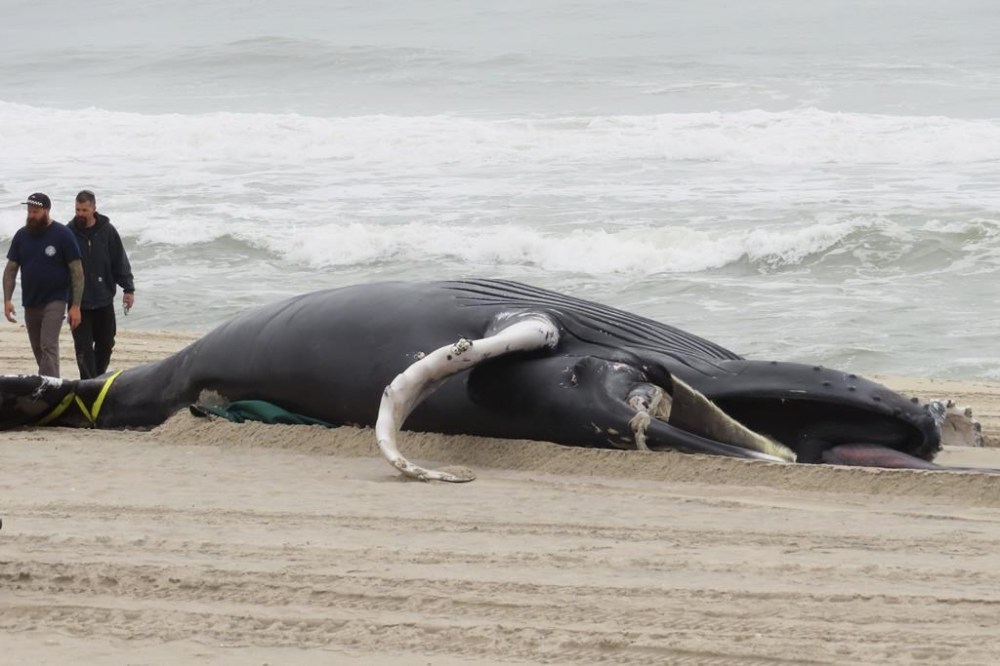
The event came a week after U.S. Rep. Frank Pallone Jr. and other New Jersey Congressional Democrats wrote to the White House Council on Environmental Quality “demanding real solutions in response to the death of marine mammals off New Jersey’s coast.”
But the letter did not seek pause in offshore wind projects as many Republicans demand. Chris Smith and Jeff Van Drew, two Republican Congressmen from New Jersey, want the work stopped at least temporarily. Neither responded to a request for comment Monday. No Republican elected officials were at Monday’s event.
Earlier this month, Republican New Jersey state senators Declan O’Scanlon and Ed Durr introduced a resolution calling on the federal and state governments to enact a moratorium on offshore wind preparation, saying “We cannot ignore the surge in marine life deaths that has occurred while offshore wind project preparation activities have been conducted along the coast.”
At Monday’s event, Pallone said, “The science has not linked the whale deaths to offshore wind activities. Climate change is the biggest threat to marine mammals.”
Pallone and others said that as water temperatures rise, fish species that whales prey upon have been moving into different areas, bringing whales more frequently into the path of heavily traveled shipping lanes off the East Coast.
Shawn LaTourette, New Jersey’s environmental protection commissioner, said the migrating bait fish are “bringing marine life into direct contact with the shipping superhighway that sits off our coast.”
As Ed Potosnak of the New Jersey League of Conservation Voters put it, “They’re having a picnic in the Parkway; they’re getting hit.”
Of the 32 whales that have died off the East Coast since Dec. 1, many have shown signs of being struck by ships or being entangled in discarded fishing gear, according to the National Oceanic and Atmospheric Administration.
In an interview with The Associated Press earlier this month after a speech at Monmouth University, NOAA’s administrator, Richard Spinrad, said ship strikes are a common cause of recent whale deaths.
“We study the fisheries, where the fish are, what the populations are, and there is some thought as to the whales following a change, a shift in where the prey is that the whales feed on, which may be a consequence of a change in the ocean itself,” Spinrad said. “By moving further inshore these whales are then more vulnerable to things like ship strikes. The science that we have conducted suggests there is not a link between the activities of offshore wind and the strandings we’ve seen along the East Coast.”

U.S. Sen Cory Booker said burning fossil fuels “is causing our house to be on fire, and we have been supplying the matches.”
Capt. Paul Eidman, of the group Anglers for Offshore Wind Power, said climate change is already affecting commercial and recreational fishing by changing where bait fish — and their predators — travel.
“Offshore wind energy offers a clean, economical, beneficial opportunity to combat the climate crisis and an alternative to continuing to burn fossil fuels,” he said. “We cannot ignore the fact that the impacts of climate change are disrupting species migration and holding patterns, posing serious risks to the long-term future of recreational fishing and the species we rely on.”
Panelists sharply criticized HR1, a bill being pushed by House Republicans to lower energy costs by giving incentives to fossil fuel industries, rolling back many environmental laws and protections, and limiting the power of a president or government agency to limit or prevent energy projects on federal land.
The bill has been attached to legislation the Republicans support in return for increasing the nation’s debt limit and avoiding a government financial default.