Spain’s April heat nearly impossible without climate change

Advertisement

Advertise with us

MADRID (AP) — Record-breaking April temperatures in Spain, Portugal and northern Africa were made 100 times more likely by human-caused climate change, a new flash study found, and would have been almost impossible in the past.

Read this article for free:


or

Already have an account? Log in here »

To continue reading, please subscribe:

Subscribe and receive a limited-edition Free Press branded hat or tote.

Digital Subscription

One year of digital access for only $205*

  • Enjoy unlimited reading on winnipegfreepress.com
  • Read the E-Edition, our digital replica newspaper
  • Access News Break, our award-winning app
  • Play interactive puzzles

*First annual payment billed as $205.00 + GST for one year. This annual subscription will automatically renew at $233.00 + GST every 52 weeks (10% off the regular annual price of $259.35). Offer available to new and qualified returning subscribers only. Cancel any time.

To continue reading, please subscribe:

Add Free Press access to your Brandon Sun subscription for only an additional

$1 for the first 4 weeks*

  • Enjoy unlimited reading on winnipegfreepress.com
  • Read the E-Edition, our digital replica newspaper
  • Access News Break, our award-winning app
  • Play interactive puzzles
Start now

*Your next Brandon Sun subscription payment will increase by $1.00 and you will be charged $17.95 plus GST for four weeks. After four weeks, your payment will increase to $24.95 plus GST every four weeks.

Hey there, time traveller!
This article was published 05/05/2023 (1227 days ago), so information in it may no longer be current.

MADRID (AP) — Record-breaking April temperatures in Spain, Portugal and northern Africa were made 100 times more likely by human-caused climate change, a new flash study found, and would have been almost impossible in the past.

A group of international scientists did a rapid computer and statistical analysis of a late-April heat wave that stretched across the Iberian peninsula into Algeria and Morocco. The four countries experienced temperatures as high as 36.9 degrees Celsius (98.4 degrees Fahrenheit) to 41 degrees Celsius (105.8 degrees Fahrenheit) degrees.

Study lead author Sjoukje Philip of the Royal Netherlands Meteorological Institute said in a briefing that a weather event this extreme “would have been almost impossible in the past, colder climate,” adding: “We will see more intense and more frequent heat waves in the future as global warming continues.”
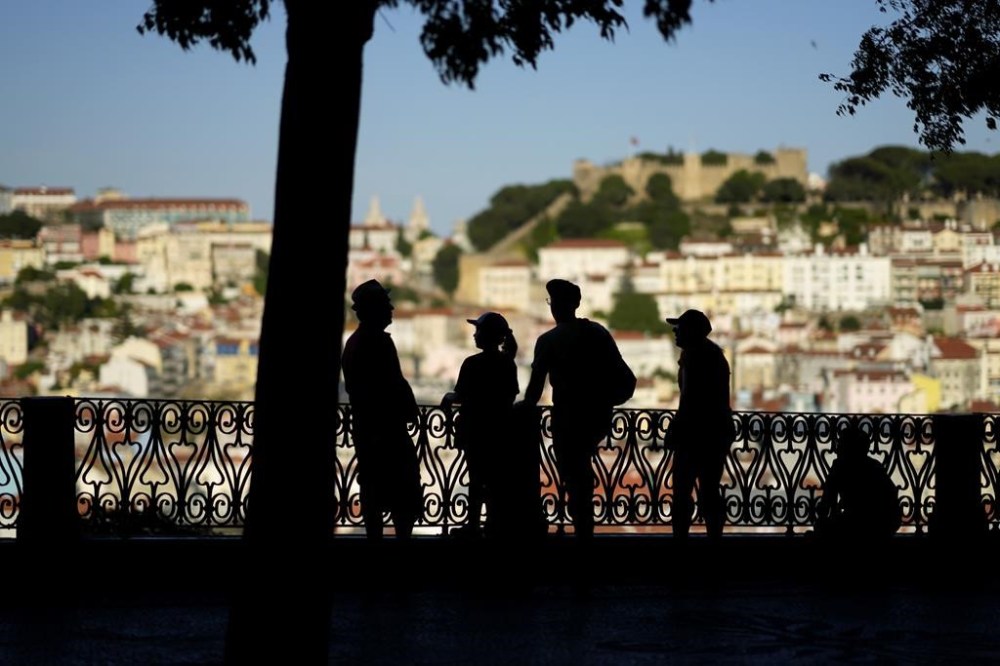
FILE - People stop to look at the view from a public garden in Lisbon's Bairro Alto, or High Quarter, April 17, 2023. Record-breaking April temperatures in Spain, Portugal and northern Africa were made 100 times more likely by human-caused climate change, a new flash study found. (AP Photo/Armando Franca, File)

Because the analysis released Friday was one of the quickest ever — the heat still hasn’t subsided much — the study by World Weather Attribution is not peer reviewed, which is the gold standard for science. But the team of WWA scientists do these quick studies using scientifically accepted techniques and often get them published later in peer-reviewed journals.

The regions in the study are all suffering from a multi-year drought, which can exacerbate high temperatures, the scientists said.

Currently, 27% of Spanish territory is in either the drought “emergency” or “alert” category and water reserves are at 50% of capacity nationally. The average dam storage in Morocco is at similarly low levels, and in Tunisia many homes have water cuts during the day.

Farmers across the Western Mediterranean have warned that poor harvests are likely, in some regions for the sixth year running.

The study also said the extreme heat in Europe is rising faster than computer models had projected. The same thing happened in the Pacific heat dome, so scientists who create computer models need to go back and rethink their overly conservative projections, said University of Washington’s Kris Ebi, who wasn’t part of the study, but praised it.

The scientists compared real life April temperatures to a simulated world without climate change. They found that a heat wave like the one the Western Mediterranean suffered in April would have been more than two degrees Celsius (3.6 degrees Fahrenheit) less severe in a world without coal, oil and gas pollution trapping heat.

The study will also help inform governments preparing for the earlier onset of extreme hot weather, with the aim of preventing deaths and unrolling heat awareness campaigns. Last year, at least 15,000 people died in Europe because of extreme hot weather, according to the World Health Organization, with Spain one the countries worst affected.

“When we can send out warnings with calibrated messaging, that allows people to accurately perceive their personal risk, that can lead to personal behavioral changes,” said Roop Singh of the Red Cross Red Crescent Climate Centre, another of the study’s authors.

Changes include access to air conditioning in schools, monitoring heat-related hospital admissions and advising citizens to avoid outdoor sports at certain hours of the day, she said.

The results of the study make sense and are important, according to three outside climate scientists.

“The world is approaching the moment when nearly all heat waves will have a climate change fingerprint,” Ebi told The Associated Press in an email. “In the meantime, these kinds of analyses are valuable for moving policymakers and justifying investments.”

Studies like these are important, but “’it’s also now like asking if the dog with berries on its face got into the pie cooling on the counter,” said North Carolina State Climatologist Kathie Dello, who wasn’t part of the study.

While some scientists question the value of looking for climate change’s fingerprint in studies like this, saying global warming is changing everything, Stanford University climate scientist Rob Jackson, who was not part of the study, said this type of analysis has value.

“Attribution is the only tool we have to understand whether extreme weather is inflamed by climate change,” Jackson said in an email. “Rare weather events are becoming more and more ‘normal.’ Climate change has loaded the weather dice.”

___ Borenstein reported from Kensington, Maryland

___ Follow AP’s climate and environment coverage at https://apnews.com/hub/climate-and-environment ___ Follow Seth Borenstein on Twitter at @borenbears and Jennifer O’Mahony at @jaomahony

___ Associated Press climate and environmental coverage receives support from several private foundations. See more about AP’s climate initiative here. The AP is solely responsible for all content.

Report Error Submit a Tip

More Stories

Goodness alive, well in N.L.-set musical

Jen Zoratti 4 minute read Preview

Goodness alive, well in N.L.-set musical

Jen Zoratti 4 minute read Yesterday at 2:01 AM CDT

I first saw Come From Away — the true-story musical about the incredible efforts of the residents of Gander, N.L. on Sept. 11, 2001, who welcomed nearly 7,000 travellers diverted to their remote town after the attacks on the World Trade Center and the Pentagon — in 2022, when Broadway Across Canada brought it to the Centennial Concert Hall.

I went in cold, but with blunted expectations; it seemed, on premise alone, like it could tilt too far into shmaltzy sentimentality, that it would be too earnest in its goodness.

So, when I wept until my face was as wet and salty as though it had been slapped by the waves of the North Atlantic, I was pleasantly surprised. I loved it. It’s emotional, yes. It’s sentimental, yes. But you can’t help but feel both buoyed — and, dare I say, patriotic — by the end of it.

Written by Canadians Irene Sankoff and David Hein, Come From Away seemed an unlikely hit when it opened on Broadway in 2017. But there was, by then, an appetite for it.

Read
Yesterday at 2:01 AM CDT

Retired sportscaster Scott Oake determined as fundraising for women's addictions treatment facility enters home stretch

Melissa Martin 4 minute read Preview

Retired sportscaster Scott Oake determined as fundraising for women's addictions treatment facility enters home stretch

Melissa Martin 4 minute read Thursday, Sep. 10, 2026

For now, the patch of land just east of the Victoria Hospital doesn’t look like much: just a field of rocks, mounded dirt, and concrete piles driven into the earth. Yet when Scott Oake looks over the site, he can already imagine how it will look in just over a year’s time, when the new Anne Oake Family Recovery Centre is expected to open.

It’s easier to picture this time around. In 2020, when the recently-retired CBC sportscaster and his late wife, Anne, were building their first labour of intermingled grief and love, the Bruce Oake Recovery Centre for men, it was hard for him to wrap his mind around how a raw construction site could transform into a welcoming addictions treatment facility.

When that centre opened in 2021, Oake found it looked “almost identical” to the architect’s renderings. So it’s easy to hope the Anne Oake Centre will be the same. It will be the first facility of its kind, its founders believe, not only in Canada but in North America: a place where 50 to 70 women can pursue sobriety while staying with their children.

“At Bruce Oake there’s a culture of love, and most of all a culture of hope,” Oake said, speaking at the site Thursday after a media conference to announce the final push of the centre’s fundraising campaign. “I can feel it every time I walk into that building. And I know it will be the same here.”

Read
Thursday, Sep. 10, 2026

Highway-safety upgrades in progress after tragic Interlake crash

Chris Kitching 5 minute read Preview

Highway-safety upgrades in progress after tragic Interlake crash

Chris Kitching 5 minute read Friday, Sep. 11, 2026

Provincial workers have started to update or install safety measures at a rural Interlake intersection where four teenage friends died in a crash on Labour Day weekend.

Pavement markings were repainted at Highway 8 and Provincial Road 229, just west of Winnipeg Beach, ahead of work to refresh worn-down rumble strips, starting Monday, and install flashing lights atop two stop signs, following an assessment earlier this week.

“They will also need to incorporate any information from the RCMP report that might be helpful if we were to consider any additional safety measures at this intersection,” Transportation and Infrastructure Minister Lisa Naylor said of department staff.

“The most important thing is safety, and any kinds of changes we make at any intersection actually have to make it safer.”

Read
Friday, Sep. 11, 2026

A life's story: ‘Ivor the Driver’ found his calling in the ranching life

Aaron Epp 7 minute read Preview

A life's story: ‘Ivor the Driver’ found his calling in the ranching life

Aaron Epp 7 minute read Updated: Yesterday at 9:59 AM CDT

Ivor Asham’s family couldn’t have picked a better image to accompany his obituary. There he is, riding Flash, his beloved brown and white quarter horse, a black cowboy hat on his head and a drink in his hand.

Asham owned and operated Birds Hill Park Ranch for nearly 35 years, where he shared his lifelong passion for horses with thousands of visitors. He moved hay, harnessed horses and drove the wagons, introducing himself as “Ivor the Driver.”

Over the years, Asham built a reputation as the quintessential cowboy.

There’s a restaurant at the ranch filled with memorabilia that he collected over the years. Calgary Stampede posters, cowboy boot-shaped shot glasses, a child’s rocking horse, a wagon wheel and numerous photos of legendary actor John Wayne are just some of the items that line the walls.

Read
Updated: Yesterday at 9:59 AM CDT

Bjorck ready to rock Prospect Challenge

Mike McIntyre 6 minute read Preview

Bjorck ready to rock Prospect Challenge

Mike McIntyre 6 minute read Friday, Sep. 11, 2026

Viggo Bjorck isn’t getting ahead of himself, nor is he taking anything for granted.

A spot in the opening night lineup for the Winnipeg Jets?

Whoa, there.

The 18-year-old apparently isn’t even assuming he has an invitation to the NHL team’s main training camp when it starts next week.

Read
Friday, Sep. 11, 2026

Bombers exact revenge in Banjo Bowl, lose Collaros to injury

Taylor Allen 6 minute read Preview

Bombers exact revenge in Banjo Bowl, lose Collaros to injury

Taylor Allen 6 minute read Yesterday at 9:20 PM CDT

Redha Kramdi downplayed the significance of his return for the Winnipeg Blue Bombers.

“I don’t think I have that big of an impact,” said Kramdi on Tuesday, who watched the club go 2-4 while he was sidelined with a cast on his left hand.

It sounded silly at the time, and it’s even sillier now considering how exceptional the 29-year-old safety from Montreal was in Saturday’s 22nd edition of the Banjo Bowl.

Kramdi caused two turnovers — a forced fumble and an interception — to lead the Bombers to a 19-6 victory over the Saskatchewan Roughriders in front of a sell-out crowd at Princess Auto Stadium.

Read
Yesterday at 9:20 PM CDT