Agribusiness giant Cargill not doing enough to fight deforestation, protect human rights, group says

Advertisement

Advertise with us

An activist group and researchers tried to increase pressure on agribusiness giant Cargill on Wednesday to do more to fight deforestation and human rights abuse, releasing a report that accuses the company of not following through on commitments to help end such practices.

Read this article for free:


By clicking the button above, an account will be created and you will begin to receive some of our recommended newsletters. You may opt out of any newsletter by visiting your Email and Communication Preferences page or by clicking "unsubscribe" at the bottom of any email.

or

Already have an account? Log in here »

To continue reading, please subscribe:

Digital Subscription

One year of digital access for only $1.44 a week*

  • Enjoy unlimited reading on winnipegfreepress.com
  • Read the E-Edition, our digital replica newspaper
  • Access News Break, our award-winning app
  • Play interactive puzzles

*Billed as $5.77 plus GST every four weeks. After 52 weeks, price increases to the regular rate of $19.95 plus GST every four weeks. Offer available to new and qualified returning subscribers only. Cancel any time.

To continue reading, please subscribe:

Add Free Press access to your Brandon Sun subscription for only an additional

$1 for the first 4 weeks*

  • Enjoy unlimited reading on winnipegfreepress.com
  • Read the E-Edition, our digital replica newspaper
  • Access News Break, our award-winning app
  • Play interactive puzzles
Start now

*Your next Brandon Sun subscription payment will increase by $1.00 and you will be charged $17.95 plus GST for four weeks. After four weeks, your payment will increase to $24.95 plus GST every four weeks.

Hey there, time traveller!
This article was published 14/06/2023 (1224 days ago), so information in it may no longer be current.

An activist group and researchers tried to increase pressure on agribusiness giant Cargill on Wednesday to do more to fight deforestation and human rights abuse, releasing a report that accuses the company of not following through on commitments to help end such practices.

The report argues that the family-owned company has been misled by its managers and now should take the lead in ensuring it carries out its promises to fight forced child labor in the cocoa industry and protect forests and other natural resources. As one of the world’s largest privately held companies and by far the largest grain distributor, Cargill is in a unique position to force positive changes, especially in ending deforestation, the groups said in the report.

“The destruction of the natural world is driven by agribusiness and agribusiness is driven by Cargill,” said Todd Paglia, executive director of the environmental group Stand.Earth, at a news conference in Wayzata, Minnesota, a Minneapolis suburb where Cargill is based.
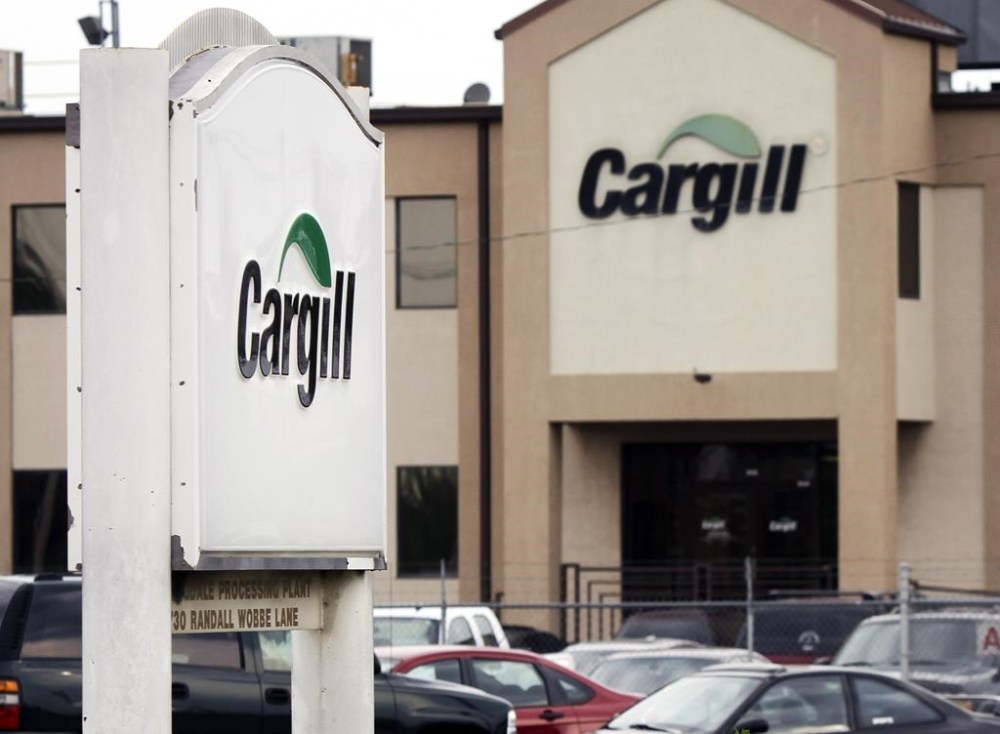
FILE - Cars sit parked at a Cargill Inc., turkey processing plant on Aug. 4, 2011, in Springdale, Ark. An activist group and researchers tried to increase pressure on agribusiness giant Cargill on Wednesday, June 14, 2023, to do more to fight deforestation and human rights abuse, releasing a report that accuses the company of not following through on commitments to help end such practices. (AP Photo/Danny Johnston, File)

Besides the news conference, Stand.Earth highlighted the report by buying full page advertisements in The New York Times and Minneapolis Star Tribune newspapers. Later Wednesday, the group planned to deliver documents backing its report to the Wayzata headquarters of the families that own a majority of Cargill and ask that they be given to 20 leading members of the families.

In response to the report, Cargill released a statement saying the group “grossly mischaracterized” the company’s efforts.

“At Cargill, we have an unwavering commitment to protect the human rights of those who work in our operations, supply chains and communities, and work tirelessly to eliminate deforestation and conversion in South America,” the statement said. “We do not source soy from farmers who clear land illegally and have controls in place to prevent non-compliant product from entering our supply chains.”

The company added that is has been transparent in its land use and human rights efforts and said it takes actions when it learns its policies have been violated.

According to its 2022 annual report, Cargill recorded $165 billion in revenue for the fiscal year ending May 31, 2022. The company says it has 155,000 employees and operates in 70 countries, with sales in 125 countries.

The report states that 193,000 square miles (500,000 square kilometers) of forest were destroyed through human activity from 2015 to 2020, primarily because of expansion of agriculture in South America, Central America and parts of Africa. Although Cargill has promised to end deforestation practices for products in its supply chain, the report argues the company has invested in ports and other infrastructure in South America that will lead to the removal of forests for land to grow soybeans.

The report, compiled with help from the Brazilian journalism organization Repórter Brasil and the nonprofit group AidEnvironment, also accuses Cargill of not following through on its commitments, first in 2001 and then in 2010, to end or at least reduce forced child labor in the cocoa industry. Cargill is one of the world’s largest cocoa suppliers.

The report cited a U.S. Department of Labor-funded study that found the number of children harvesting cocoa in the Ivory Coast and Ghana and the prevalence of hazardous child labor in those countries had both increased.

“It’s one thing not to meet an ambitious target,” said Mathew Jacobson, director of Stand.Earth. “It’s another to have the problems you claim to be addressing get worse.”

Jacobson said he is hopeful the families that own most of Cargill will push for change if it realizes company executives are not making meaningful changes.

“We are not asking for anything the company has not already promised,” the report says in its conclusion. “We seek implementation, not new commitments.”
Report Error Submit a Tip

More Stories

Empty desks: Advocates talk chronic school absenteeism

Maggie Macintosh 5 minute read Preview

Empty desks: Advocates talk chronic school absenteeism

Maggie Macintosh 5 minute read 6:00 AM CDT

Concerned school and government leaders are downplaying the state of student absenteeism, as community organizers are strategizing to create urgency around who’s regularly missing class — and why — in Winnipeg.

The inaugural Youth at Risk in Winnipeg Symposium, held over the weekend at the Canadian Mennonite University, drew roughly 100 people to discuss barriers to attendance and brainstorm ways to remove them.

Nearly 20 years after he began calling attention to the issue, first as a volunteer with the Point Douglas Residents Committee, Sel Burrows gave an impassioned speech about the lack of political will to take meaningful action to help students from “dysfunctional homes.”

“I’ve dealt with nine cabinet ministers, Conservative and NDP, and five deputy ministers, and the issue has not gotten any better,” Burrows told teachers, reseachers and community support workers gathered Saturday on CMU’s Shaftesbury campus.

Read
6:00 AM CDT

Consumer apprehension grows as US retailers adopt AI-assisted pricing tools

Dee-ann Durbin And Anne D'innocenzio, The Associated Press 7 minute read Preview

Consumer apprehension grows as US retailers adopt AI-assisted pricing tools

Dee-ann Durbin And Anne D'innocenzio, The Associated Press 7 minute read Updated: Yesterday at 6:00 PM CDT

U.S. consumers aren't just frustrated with high prices. They're angry and confused about the increasingly high-tech ways that restaurant chains and major retailers are setting those prices.

Digital price tags are rapidly replacing paper ones in grocery aisles. Artificial intelligence tools help businesses decide what to charge by predicting how customers might respond. Terms like “dynamic pricing” and “surveillance pricing” are stirring anxiety on social media, where users wonder if different people are getting different prices for the same product.

Americans have grown accustomed to changing prices when booking flights, hotel rooms and rides, but the prospect of everyday spending shaped by algorithms they don’t understand and personal data they may not realize they’re sharing has touched a nerve.

“There are major tensions happening right now between who’s really going to have the power with some of these algorithms and usage of bots and AI: the companies or the shopper,” said Katie Thomas, who leads an internal consumer behavior think tank at the management consulting firm Kearney.

Read
Updated: Yesterday at 6:00 PM CDT

Detox centre ready but staffing challenges persist

Scott Billeck 6 minute read Preview

Detox centre ready but staffing challenges persist

Scott Billeck 6 minute read Yesterday at 2:01 AM CDT

Peter McMullen’s decade-long struggle with addiction gives him insight into the challenges Lighthouse Mission hopes to address with a new Main Street detox facility focused on connecting people with longer-term treatment.

McMullen, executive director of Lighthouse Mission, knows how difficult it can be to navigate Winnipeg’s addiction treatment system, particularly when someone is ready to seek help but the services they need aren’t immediately available.

Now, after years of planning and a lengthy renovation of two century-old buildings, the downtown organization is preparing to open a 10-bed detox facility at 667 and 669 Main St., with five beds each for men and women.

The facility could begin accepting clients as early as November, provided Lighthouse Mission can overcome one final hurdle: recruiting enough staff to operate it.

Read
Yesterday at 2:01 AM CDT

Winnipeg: Home of IG’s past and future

Damon Murchison 4 minute read Preview

Winnipeg: Home of IG’s past and future

Damon Murchison 4 minute read Yesterday at 2:00 AM CDT

Shortly after IG Wealth Management was established in Canada, our founders chose Winnipeg as the home of our young, ambitious company.

Read
Yesterday at 2:00 AM CDT

Addressing homelessness and toxic drug use

Kate Kehler and Molly McCracken 5 minute read 2:00 AM CDT

Winnipeg is facing a housing and toxic drug crisis that is not going away. Every day, we see the consequences — people living without safe homes, encampments in neighbourhoods and public spaces, increasingly toxic drugs, overdoses and emergency services stretched to their limits.

These are symptoms of a deeper crisis of inter-generational trauma related to colonization of the original peoples of these lands, compounded by a crisis in housing, income security, mental health and addictions services and the availability of community based supports.

Winnipeg’s next city council must decide whether it is prepared to invest in solutions that address the root causes.

Weaving a Better Winnipeg: The Alternative Municipal Budget 2026, proposes a five-point action plan that would put housing, outreach, human rights and Indigenous leadership at the centre of Winnipeg’s response.

Campaign blunder: Klein features wrong city in election video

Malak Abas 4 minute read Preview

Campaign blunder: Klein features wrong city in election video

Malak Abas 4 minute read Yesterday at 4:08 PM CDT

A paid ad from mayoral candidate Kevin Klein on his commitment to Winnipeg has been pulled after commenters noticed one small error: the footage used in the ad was actually of Edmonton.

Read
Yesterday at 4:08 PM CDT