A nation ablaze
Smoky summers are likely our new normal as climate change, forestry management practices continue to stoke wildfires
Advertisement
Read this article for free:
or
Already have an account? Log in here »
To continue reading, please subscribe:

Digital Subscription
One year of digital access for only $205*
- Enjoy unlimited reading on winnipegfreepress.com
- Read the E-Edition, our digital replica newspaper
- Access News Break, our award-winning app
- Play interactive puzzles
*First annual payment billed as $205.00 + GST for one year. This annual subscription will automatically renew at $233.00 + GST every 52 weeks (10% off the regular annual price of $259.35). Offer available to new and qualified returning subscribers only. Cancel any time.
To continue reading, please subscribe:
Add Free Press access to your Brandon Sun subscription for only an additional
$1 for the first 4 weeks*
- Enjoy unlimited reading on winnipegfreepress.com
- Read the E-Edition, our digital replica newspaper
- Access News Break, our award-winning app
- Play interactive puzzles
*Your next Brandon Sun subscription payment will increase by $1.00 and you will be charged $17.95 plus GST for four weeks. After four weeks, your payment will increase to $24.95 plus GST every four weeks.
Read unlimited articles for free today:
or
Already have an account? Log in here »
Hey there, time traveller!
This article was published 08/07/2023 (1173 days ago), so information in it may no longer be current.
Canada is burning.
Wildfires are consuming record-breaking chunks of the country thanks to a dry, hot spring. Choking smoke, increasingly common in Western Canada during fire season, blanketed more populous eastern cities and led to more coverage and concern for what’s happening when it comes to Canada’s wildfires.
Hot conditions, lightning, human carelessness, and forests left cluttered and itching for rebirth have all contributed to the infernos this year.
It’s a pattern the country is likely to see repeated in the coming decades. Temperatures are expected to rise with climate change. Precipitation is expected to be erratic. Disease and pests are killing or weakening trees and forests are continuously managed for industry, homes and infrastructure, a practice that has made forests more flammable.
Here’s a breakdown of how fires start and why they seem to be getting worse.
Seth Wenig / The Associated Press Files A man runs in front of the sun rising over the lower Manhattan skyline in Jersey City, N.J., last month. Thick, smoky air from Canadian wildfires has made for days of misery as far away as New York City and across the U.S. Northeast.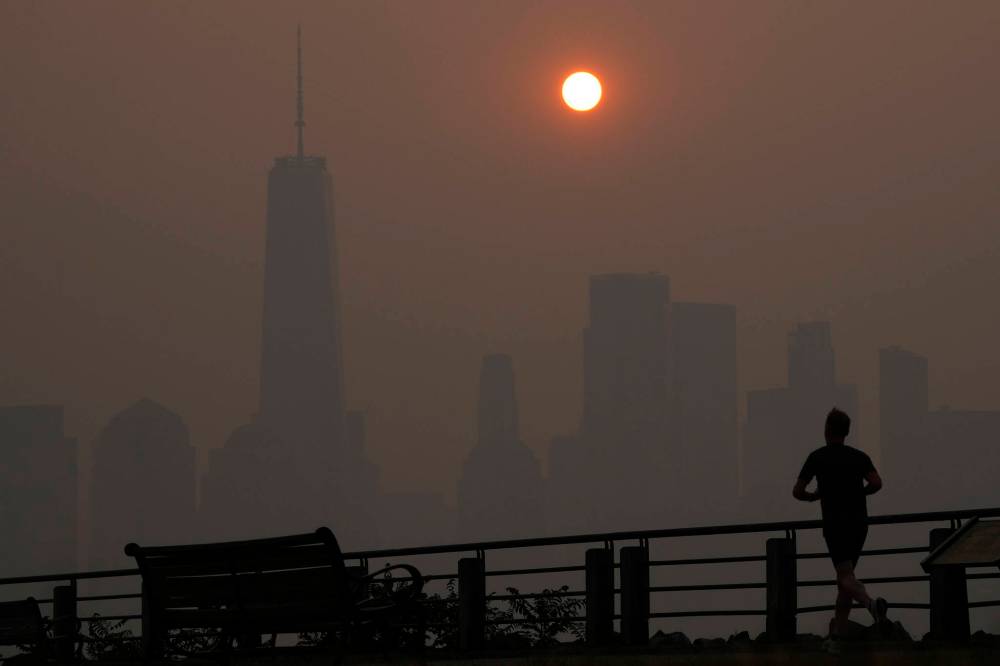
What starts wildfires?
Typically, nearly half of all wildfires in Canada are caused by lightning strikes, but that can vary from region to region and from month to month.
The B.C. government says the majority of wildfires each year are caused by lightning, while in Alberta, the majority are caused by humans — including from off-road vehicles, campfires, fireworks, ammunition, industrial activity, agriculture, power lines and some arson. Some years it’s not even close. In 2020, 88 per cent of wildfires in Alberta were caused by humans. Between 2017 and 2022, on average 68 per cent of wildfires were human-caused in Alberta.
The National Forest Database shows between 1990 and 2020, 33 per cent of fires in Quebec were caused by lightning, while in Ontario the figure was 50 per cent.
But according to the federal government, fires that start from lightning do the most damage, accounting for 67 per cent of land burned. Lightning-caused fires tend to occur in remote areas and several fires can start at once during a storm.
All of those flash points, like lightning, require a forest dry enough to burn.
What has caused this year’s fires?
The great fires that have swallowed large swaths of Canada early this season started before lightning found its yearly footing and for a while there was an outsized number of, mostly accidental, human-caused infernos.
From the beginning of May through to June 19, an analysis by The Narwhal of data from the Canadian Interagency Forest Fire Centre shows 34 per cent of the fires started in that period were from lightning, 40 per cent from human causes and 26 per cent were still undetermined.
So far this year in Quebec, almost 47 per cent of wildfires with known causes were started by lightning, while in Alberta, that figure is 22 per cent. In B.C., 37 per cent have been from lightning strikes so far this year.
Government of Alberta Fire Service / THE CANADIAN PRESS The Bald Mountain Wildfire burns in the Grande Prairie Forest Area of Alberta in early May. Hot and dry conditions are expected to continue as wildfires throughout western Canada have forced thousands of evacuations and air quality warnings due to smoke as far east as northern Ontario.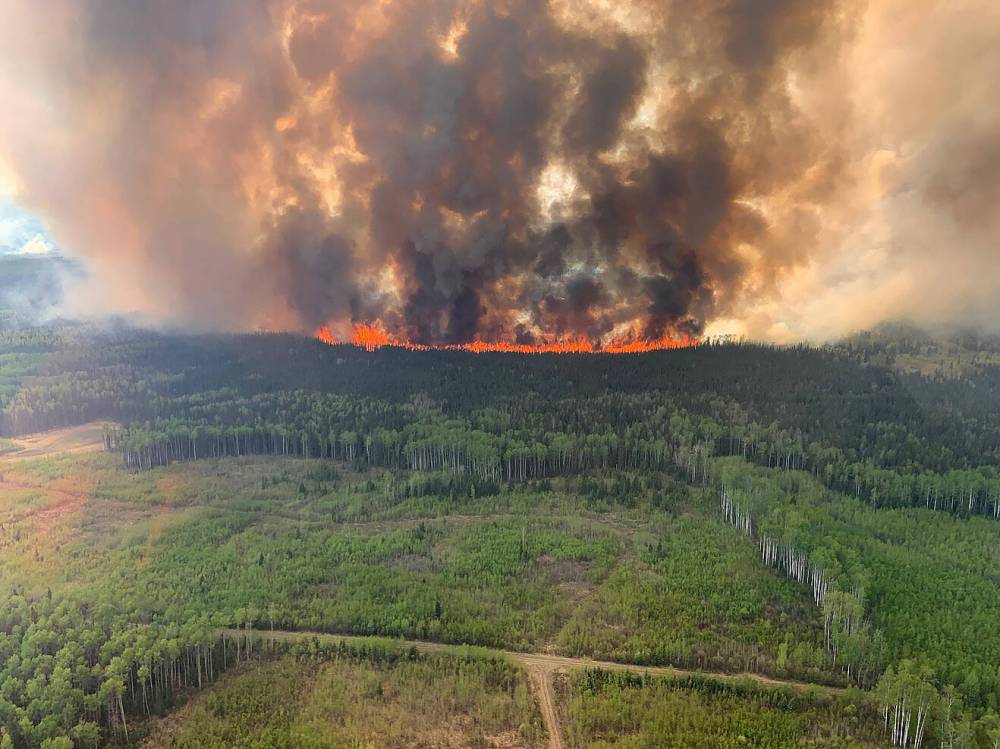
Ignition was driven by forests left parched by a dry spring and unseasonably hot temperatures across much of the country. Vast areas of Canada were experiencing drought conditions as of May 31, with some parts of Alberta classified as extreme. Those conditions are expected to continue, despite a recent reprieve in Alberta as much of the province experienced heavy rainfall — or even snow.
As wildfires continue to burn across the country, arson has been a source of debate, driven by misinformation. In Alberta it took on new meaning when it was amplified by Premier Danielle Smith. Turning to conspiracy in the face of anxiety is not an uncommon reaction when faced with the psychological impact of all-consuming smoke.
But the facts don’t support the claims.
The RCMP in Alberta said on June 14 it is investigating 12 suspicious fires, but stresses that doesn’t mean those blazes are arson.
What about forest management?
Canada’s forests aren’t what they used to be.
Decades of forestry and forest management have altered natural cycles and natural growth. An analysis of annual data from the federal government shows more than 930,000 hectares of forest were logged on average in Canada between 1990 and 2020 — that’s just over 1.5 times larger than the Greater Toronto Area.
Historically, the boreal forest, which stretches across Canada, would burn periodically, with species, including black spruce and lodgepole pine, dependent on fire for regeneration. The commercial value of trees for timber changed priorities.
Although there has been a shift towards recognizing the ecological importance of fire, governments have invested heavily in fighting fires before they can spread, in part to protect valuable trees destined to be logged.
The federal government says the cost to fight fires over the past decade have ranged between $800 million and $1.5 billion each year.
When fires threaten homes, infrastructure, oil and gas installations, and harvest areas for logging companies, firefighters sweep in to do battle — either fully committed to putting out the flames or letting parts of it burn while managing others.
Across Canada, fire agencies assess fires on a case-by-case basis while recognizing the ecological role of fire and the high costs of fighting them.
“High-priority areas for protection include residential areas, high-value commercial forests and recreational sites,” according to Natural Resources Canada. “Low-priority sites are generally wilderness parks and remote forests of limited economic value — although protection of rare habitat, culturally significant areas and similar values will influence suppression decisions.”
Graham Hughes / The Canadian Press A man wears a face mask as he cycles in Montreal last month amid smoke from wildfires.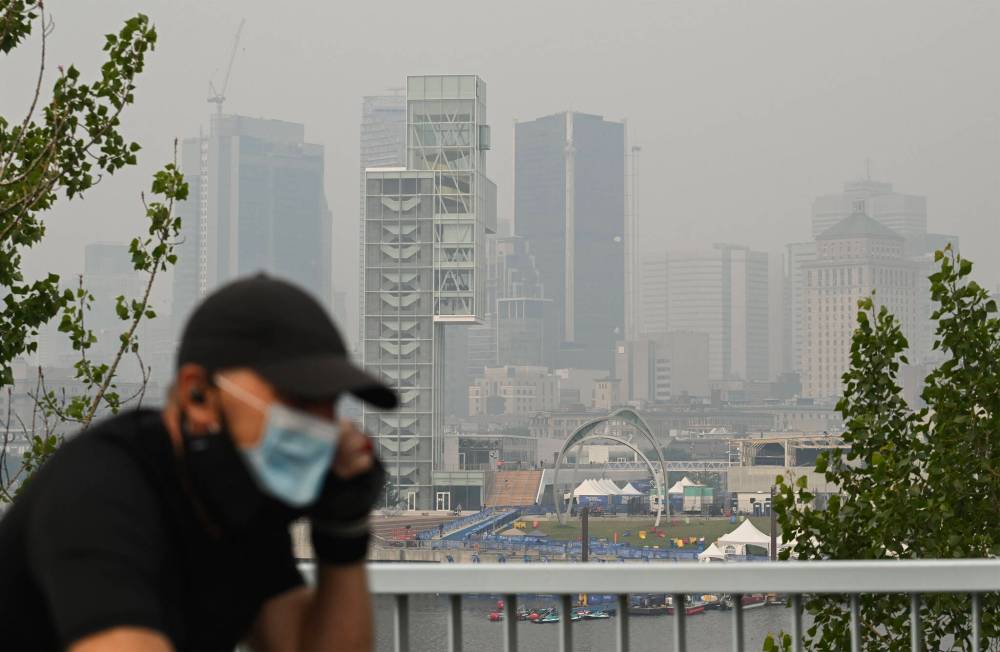
The consequences can be a buildup of fuel — the accumulation of deadfall, dense brush and more — that allows fires to burn bigger and stronger when lightning (or a careless human) strikes.
Decades of putting out fires has led to a “fire paradox” and makes fighting fires in the future more difficult, according to a 2019 paper examining Canada’s wildfire management.
In other words, the more you protect a forest from fire, the more likely it is to eventually burn.
Approximately 60 per cent of Canada’s 3.47 million square kilometres of forests are “covered by a management plan that includes production, conservation or other uses,” according to a 2017 Statistics Canada report.
Proponents of logging, often clearcut, argue the practice aims to mimic the sweep of a wildfire, clearing the land in order to help it rejuvenate, but those practices don’t necessarily achieve their ends — fire-dependent species like lodgepole pine rely on heat and research suggests logging doesn’t reproduce the “large numbers of small disturbances and the small number of extremely large disturbances created by wildfires.” Research has suggested logged areas of the boreal forest are more susceptible to fires in the decade after harvesting, while areas that were burned are not.
How bad is this year’s wildfire season?
In short, it’s bad.
There have been 2,727 fires so far this year, according to the Canadian Interagency Forest Fire Centre. That’s above the 25-year average of 2,420 fires by this time of year.
But it’s not just the number of fires, which can range from small outbursts of flame to enormous conflagrations, that matters.
This year so far, 5.8 million hectares — an area larger than Nova Scotia — have burned, compared to the 414,215 hectares burned on average by this date over the past 25 years. By this time last year, a comparatively meagre 80,216 hectares had burned.
Since 1990, according to the federal government, fires have burned an average of 2.5 million hectares each year. So far this year, more than double that average has already burned.
That’s not to say there haven’t been bad years, but this year is shaping up to be the worst in recorded history.
Over the past 40 years, the biggest year in terms of area burned was 1995, when 7.1 million hectares went up in smoke. We have just exceeded the second-worst year, 1989, when 5.9 million hectares fell to flame.
The caveat is that location matters. When fires burn in the wilderness, away from infrastructure, homes and industry, they are often left to their own devices. That can impact the number of hectares consumed.
Jeff McIntosh / The Canadian Press Files Thick smoke from wildfires blankets Calgary’s downtown in May.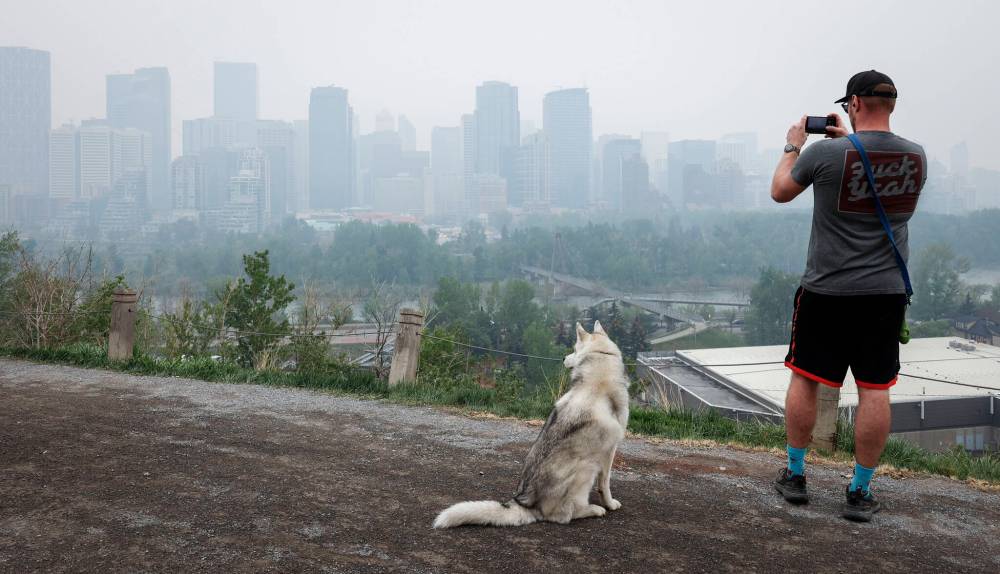
Is climate change to blame?
Weather is a big factor in how many fires are lit and how fast they grow. Hot and dry weather means forests are ready to burn and burn fast. This year’s weather is an example.
Models show climate change is having an impact.
Between 1948 and 2022, annual average temperatures have increased 1.9 C, according to Environment and Climate Change Canada.
“Nine of the 10 warmest years have occurred during the last 25 years, with 2010 being the warmest on record (3 C above the 1961 to 1990 reference value),” according to the department.
At the same time, annual average precipitation in the form of snow, rain and all the other wet-sky stuff increased between 1948 and 2012 and that trend is expected to continue. Ultimately, the impacts will vary by region, time of year and whether and to what extent carbon pollution is curtailed.
That might sound good for combatting wildfires, but projections also anticipate a feast-or-famine scenario, with extreme amounts of precipitation in short periods combined with dry spells. That can lead to both flooding and droughts.
The changes in climate are also putting strain on forests with increased disease and infestation from mountain pine beetles and other pests. According to data from Statistics Canada, in 2020, nearly 18 million hectares of forest was stripped of its greenery or contained dead-standing trees, courtesy of bug infestations. The result is more fuel for fires. The Canadian Wildland Fire Strategy, last updated in 2016, warns things are likely to get worse.
“Wildland fires caused by lightning and humans are predicted to increase 18 per cent by 2050 and 50 per cent by 2100,” it warns. “The growth of the wildland-urban interface, expanding industrial development and consequential results of climate change are compounding factors of this projection.”
— The Narwhal
Related Articles
Wildfire in Washington state near Columbia River Gorge grows slowly, still at 5% containment More B.C. fire bans, heat and lightning forecast
Advertisement Advertise With Us
Advertisement Advertise With Us