‘Tornado detectives’ at Western University out to demystify Canada’s twister history
Advertisement
Read this article for free:
or
Already have an account? Log in here »
To continue reading, please subscribe:

Digital Subscription
One year of digital access for only $205*
- Enjoy unlimited reading on winnipegfreepress.com
- Read the E-Edition, our digital replica newspaper
- Access News Break, our award-winning app
- Play interactive puzzles
*First annual payment billed as $205.00 + GST for one year. This annual subscription will automatically renew at $233.00 + GST every 52 weeks (10% off the regular annual price of $259.35). Offer available to new and qualified returning subscribers only. Cancel any time.
To continue reading, please subscribe:
Add Free Press access to your Brandon Sun subscription for only an additional
$1 for the first 4 weeks*
- Enjoy unlimited reading on winnipegfreepress.com
- Read the E-Edition, our digital replica newspaper
- Access News Break, our award-winning app
- Play interactive puzzles
*Your next Brandon Sun subscription payment will increase by $1.00 and you will be charged $17.95 plus GST for four weeks. After four weeks, your payment will increase to $24.95 plus GST every four weeks.
Read unlimited articles for free today:
or
Already have an account? Log in here »
Hey there, time traveller!
This article was published 08/07/2023 (1184 days ago), so information in it may no longer be current.
WASHINGTON – Confirming a tornado in Canada used to be a bit like the proverbial tree falling in the forest: if no one was there to see it, it never officially happened.
But a group of Canadian weather scientists, engineers and university students is out to change all that with modern technology and dogged forensic work — plus no small measure of that aforementioned toppled timber.
“I like to think of myself more as a tornado detective,” said Connell Miller, a full-time wind engineer with the Northern Tornadoes Project at Western University in London, Ont.
“I don’t go out there personally and put myself at risk. I’ll leave that to the storm chasers.”
The project, founded in 2017 with the help of ImpactWX, a Toronto-based social impact fund focused on mitigating the consequences of severe weather, is fast becoming a pioneer in the field of post-tornadic investigation.
With climate change on the march, the fund’s goals include better tornado detection and prediction and a wider understanding of extreme atmospheric events, all with an eye towards helping to protect people and property.
Canada is second only to the United States in tornado frequency. But until the Northern Tornadoes Project, the true number of twister touchdowns north of the border was a mystery — pegged at about 60 each year.
In truth, the typical annual total is more than twice that number.
“We didn’t think that the number of tornadoes being reported in Canada every year was right — we thought it was low,” said project co-founder Greg Kopp, a Western engineering professor and wind impact expert.
“So we went out to search for those missing tornadoes.”
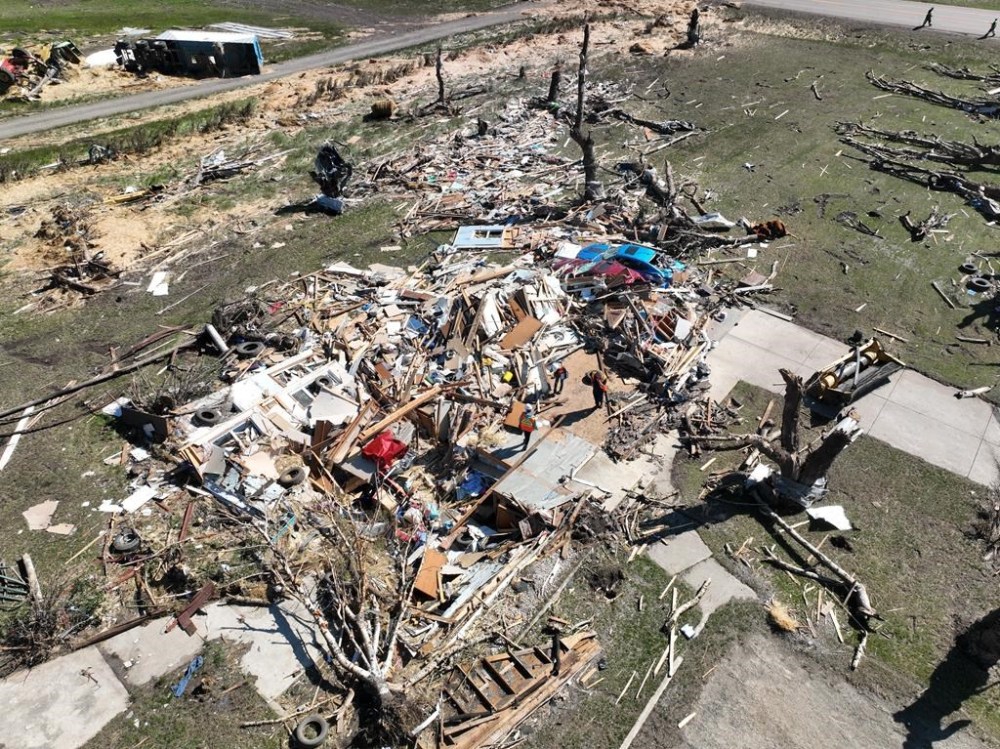
Using high-resolution drone-mounted cameras and satellite imagery, the team can get a detailed bird’s-eye view of the aftermath and look for telltale signs of tornadic activity — haphazard tree-fall patterns, for instance, rather than the uniform damage that can indicate a downburst or straight-line winds.
The project helped confirm a record 117 tornadoes in 2021 and another 117 in 2022 — numbers that are more a function of increased scrutiny than higher frequency. But Kopp and company are well aware that climate change is changing the equation.
“There’s indicators that things in Canada might get worse with the changing climate as things kind of move northward and the southern U.S. gets too hot and dry.”
This year’s season is just getting started, and the project has already confirmed 30 tornadoes in 2023 alone, including a vicious EF4 twister on Canada Day that raked Didsbury, Alta., with winds between 267 and 322 km/h.
Miller was on the ground the very next day, part of a team of forensic investigators using wind-tunnel research, eyewitness accounts and drones to examine the aftermath and deduce the culprit’s characteristics.
“The community that experienced this tornado got very lucky, I think,” he said — EF4 and EF5 events, the most violent, destructive categories on the Enhanced Fujita scale, typically include fatalities.
“Thankfully, they were warned in time, and people that were in vulnerable places got to places where they’d be safe.”
In the U.S., the 2023 season has already proven a busy one, according to data from the Center for Disaster Philanthropy, which works to maximize the efficiency of charitable donations to affected communities and residents.
More than 800 tornadoes had been confirmed in the U.S. by the end of June, with 170 last month alone. January saw 128 twisters, the second-highest total on record for a month that’s not typically a busy one.
Most of them strike in the corridor of the Great Plains known as Tornado Alley, a loosely defined region that stretches north from Texas through Oklahoma and Kansas, all the way to the Dakotas.
In recent years, however, studies have found the region has been extending east, capturing portions of Mississippi, Alabama, Arkansas, Missouri and Illinois.
The deadliest year in recent U.S. history was 2011, when a multiple-vortex EF5 tornado ripped through Joplin, Mo., in May of that year, killing 158 people, injuring more than 1,000 others and destroying some 4,000 buildings.
Tornadoes have killed nearly 75 people in the U.S. so far this year, a number that’s already three times the total for all of 2022, making 2023 one of the 10 deadliest years on record.
That included an EF4 twister March 24 in Mississippi that measured more than a kilometre wide and claimed 21 lives during more than an hour on the ground, unleashing peak winds of 273 km/h.
It all adds up to a troubling portent of what’s to come for both Canada and the U.S., especially given how difficult it has always been to predict severe tornadoes, let alone identify populated areas where they might touch down.
“Improving warning performance means you have to assess how you actually do with your forecast and issuing of warnings — and to do that, part of it is knowing what actually happened on the ground,” Kopp said.
“If you’re not systematically trying to identify the tornadoes and then comparing them to your warning performance, you’re not going to improve.”
That’s what the project did in 2022, using its confirmed tornado data from 2019 through 2021 to determine if and when Environment and Climate Change Canada was able to issue timely public warnings for those events.
The results were disappointing, if not surprising: a score of 37.5 out of 100, based on criteria such as whether and when tornado “watches” and the more urgent “warnings” were successfully deployed.
Project members also pay close attention to structural damage to determine whether building codes were properly followed, and whether changes to those codes might be a useful and cost-effective way to mitigate the dangers.
It would be all but impossible to prevent the sort of damage that an EF4 or EF5 can wreak, but the vast majority of tornadoes in Canada occur on a much smaller scale, Miller said.
Researchers have found that in a number of cases, requiring a more robust “roof-to-wall connection” would only add about $200 to building costs while dramatically decreasing the risk of the roof coming loose.
Not only would that help to keep the occupants more safe, but it’s one more piece of potentially deadly debris that won’t come flying off and cause even more extensive damage, like shrapnel from a bombshell.
“We can have these houses resist those EF2 winds and be safe from 95 per cent of Canadian tornadoes,” he said.
“I think for the $200 that it would cost, it’d be more than worth it to do so.”
This report by The Canadian Press was first published July 8, 2023.