Ontario, Quebec to see more tornado ‘fuel,’ but more data needed

Advertisement

Advertise with us

MONTREAL - Climate change will likely bring more weather conditions to Ontario and Quebec that are favourable to the development of tornadoes, but it's still unclear whether Central Canada will actually be hit by more of them, experts say.

Read this article for free:


or

Already have an account? Log in here »

To continue reading, please subscribe:

Subscribe and receive a limited-edition Free Press branded hat or tote.

Digital Subscription

One year of digital access for only $205*

  • Enjoy unlimited reading on winnipegfreepress.com
  • Read the E-Edition, our digital replica newspaper
  • Access News Break, our award-winning app
  • Play interactive puzzles

*First annual payment billed as $205.00 + GST for one year. This annual subscription will automatically renew at $233.00 + GST every 52 weeks (10% off the regular annual price of $259.35). Offer available to new and qualified returning subscribers only. Cancel any time.

To continue reading, please subscribe:

Add Free Press access to your Brandon Sun subscription for only an additional

$1 for the first 4 weeks*

  • Enjoy unlimited reading on winnipegfreepress.com
  • Read the E-Edition, our digital replica newspaper
  • Access News Break, our award-winning app
  • Play interactive puzzles
Start now

*Your next Brandon Sun subscription payment will increase by $1.00 and you will be charged $17.95 plus GST for four weeks. After four weeks, your payment will increase to $24.95 plus GST every four weeks.

Hey there, time traveller!
This article was published 18/07/2023 (1167 days ago), so information in it may no longer be current.

MONTREAL – Climate change will likely bring more weather conditions to Ontario and Quebec that are favourable to the development of tornadoes, but it’s still unclear whether Central Canada will actually be hit by more of them, experts say.

Severe thunderstorms — and at least two tornadoes — damaged homes, knocked down power lines and overwhelmed sewers in eastern Ontario and Quebec last week. Steven Flisfeder, Environment Canada warning preparedness meteorologist, says that as Ontario and Quebec get warmer and more humid because of climate change, the potential for extreme storms could increase.

“Those two things combined are fuel for those severe thunderstorms and potential tornadoes,” he said in a recent interview.
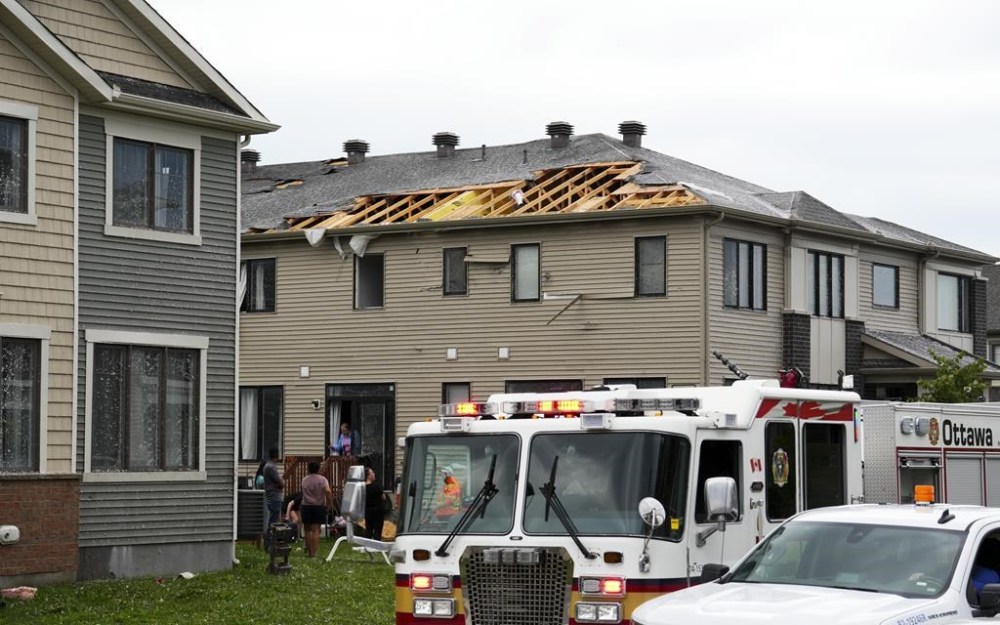
Homes are left damaged following a tornado in the Ottawa suburb of Barrhaven on Thursday, July 13, 2023. THE CANADIAN PRESS/Sean Kilpatrick

But whether Ontario and Quebec are seeing more tornadoes is so far unclear. Flisfeder explained that a lack of historical data and the propagation of cellphone videos and social media reports make it difficult to tell whether severe thunderstorms and tornadoes are actually becoming more frequent or simply more visible.

David Sills, executive director of the Northern Tornadoes Project, also says a rise in citizen reports has led to an increase in the number of recorded incidents of tornadoes. Project researchers are using archive satellite imagery to fill in some of those historical data gaps and leveraging social media to document storms in lesser populated areas of the country.

Sills said the number of known tornadoes in Canada has nearly doubled since the launch of the NTP: from 70 in 2017 to 117 in 2022, thanks to his team’s recording efforts.

NTP researchers counted more tornadoes in Ontario and Quebec in recent years than they expected. In 2021, they recorded a total of 45 tornadoes in both provinces during the period of highest activity, from mid-June to mid-August, compared to two in the Prairies.

“We were surprised by the number of tornadoes that are happening in eastern Ontario and southern Quebec,” he said. “We were expecting the maximum tornado activity to be in the central part of the country,” he said. That area sees the most tornado activity in Canada, on average, according to the NTP. “But … there’s been a couple of years now where, there’s there’s been really very little activity in the Prairies.”

Some recent studies suggest tornado activity could increase in the east as climate change progresses, but it’s still too early to determine if that forecast is manifesting in Canada, Sills said.

“Looking at the long-term trends is certainly something that we aim to do as part of this project,” he continued, “but we have to really get good quality data sets first and that’s where we’re spending most of our effort right now.”

“There is some change that’s happening,” he added, referring to the lower number of tornadoes in the Prairies in recent years.

“Whether that’s due to climate change, we’re not certain at this point.”

A similar trend is unfolding in the United States, where Jana Houser, a professor at The Ohio State University who studies tornadoes, says there’s already evidence that the domain of tornado activity has crept eastward.

The general areas that are conducive for producing tornadoes — typically in the central plains — “tend to be shifting a little bit towards particularly the south and the east of the United States,” she said. Prolonged periods of drought in the middle of the U.S., she added, is one explanation for a recent decrease in the number of tornadoes in the region.

Houser says she expects the geography of tornado activity to expand as climate change warms the atmosphere and pushes the jet stream — a key element in tornado formation — further north. But she says the storms may become more intense and less frequent as a result.

This report by The Canadian Press was first published July 18, 2023.

—

This story was produced with the financial assistance of the Meta and Canadian Press News Fellowship.
Report Error Submit a Tip

More Stories

Positive anticipation is growing about major housing developments underway in Winnipeg’s downtown

Gabrielle Piché 10 minute read Preview

Positive anticipation is growing about major housing developments underway in Winnipeg’s downtown

Gabrielle Piché 10 minute read Friday, Sep. 25, 2026

If traffic is light and the wind is down, Somia Sadiq is able to hear the roar of Winnipeg Jets fans twice: first through her window, then on TV.

From her apartment view high above downtown, she can look out at Graham Avenue’s painted pedestrian landscape, see construction cranes and hear the heavy equipment at work as massive housing projects take shape at The Forks, at what used to be Portage Place shopping centre and at the former Hudson’s Bay building.

Sadiq has lived at 300 Main for 2 1/2 years, a few steps from the city’s famous, windy and reopened-to-pedestrians Portage Avenue intersection. At 42 storeys, it’s the tallest building in Winnipeg.

She is among 18,000 downtown residents who will soon be joined by thousands of others attracted to the city’s core by the new wave of major construction projects.

Read
Friday, Sep. 25, 2026

Winnipeg a character all its own onscreen

Jen Zoratti 4 minute read Preview

Winnipeg a character all its own onscreen

Jen Zoratti 4 minute read Yesterday at 2:01 AM CDT

Watch something shot in Winnipeg with a Winnipegger, and you will be treated to a live running commentary. We can’t help playing “spot the location.”

When we recognize that field/statue/mall/intersection/theatre, we have to say it. It’s practically civically mandated.

A friend told me she was at a film screening at which people literally applauded footage of the Mint. (That likely would have been 2005’s The Constant Gardener.)

Being excited about seeing Portage Place Mall at Christmastime in the trailer for Violent Night 2 — and then exclaiming, to your husband, “Oh, look, it’s Portage Place Mall at Christmastime!” — is not, I will admit, particularly cosmopolitan behaviour. In fact, I could be accused of suffering from a mild case of Podunkitis.

Read
Yesterday at 2:01 AM CDT

‘In Normandy, we remember’

Aaron Epp 4 minute read Preview

‘In Normandy, we remember’

Aaron Epp 4 minute read Yesterday at 6:23 PM CDT

Travelling nearly 7,000 km from his home in France to Winnipeg gave Gabriel Zaranski a new perspective on warfare.

“It’s very different to speak about war in school (than) to speak with real people who (have fought) in a war,” he said. “We can feel the emotion when they speak … The testimony has more impact when it’s real soldiers.”

Zaranski is one of 14 Grade 12 students from Bayeux, a town in France’s Normandy region, in Winnipeg this week for a learning tour.

The students, who attend Lycée Arcisse de Caumont high school, met on Saturday with veterans from the Queen’s Own Cameron Highlanders of Canada, a local military regiment, to discuss their studies and the regiment’s role in the Second World War.

Read
Yesterday at 6:23 PM CDT

The never-ending, continuing war in Ethiopia

Gwynne Dyer 5 minute read Yesterday at 2:01 AM CDT

Another October coming up, and still the Nobel Peace Prize Committee refuses to give Donald Trump his prize. They even gave one to Barak Obama, who was Black and a Democrat and had only been in office for 20 minutes. Meanwhile, they ignore a man truly worthy of the prize, a man who ended eight wars last year alone. (He said so himself.)

Unfortunately the prize committee has a long record of backing the wrong person.

They gave it to Aung Sang Suu Kyi of Myanmar, who defended the Rohingya genocide: “I don’t think there is ethnic cleansing going on,” she said.

They gave it to former U.S. secretary of state Henry Kissinger, who ordered the secret carpet-bombing of Cambodia: “The illegal we do immediately; the unconstitutional takes a little longer.”

Flammable gas culprit of 2024 Transcona home explosion: police

Malak Abas 2 minute read Preview

Flammable gas culprit of 2024 Transcona home explosion: police

Malak Abas 2 minute read Friday, Sep. 25, 2026

Flammable gas is believed to be the cause of a 2024 house explosion in Transcona that damaged neighbouring homes and displaced residents.

“As a result of the investigation and upon Crown review, the explosion is believed to be an isolated incident,” Winnipeg Police Service Const. Dani McKinnon said in an email Friday afternoon.

“There are no public safety concerns connected to this incident, and no criminal charges have been laid.”

The sudden blast happened in a bungalow on Camrose Bay on June 26, 2024. It levelled the home and caused significant damage to 22 other houses. At the time, it was described as “catastrophic” by the fire chief at the scene.

Read
Friday, Sep. 25, 2026

Special teams woes hurt Bombers in loss to Argos

Ken Wiebe 7 minute read Preview

Special teams woes hurt Bombers in loss to Argos

Ken Wiebe 7 minute read Yesterday at 8:06 PM CDT

They’ve been the most consistent of the three phases in the Winnipeg Blue Bombers arsenal this season.

A port in the proverbial storm, throughout this topsy-turvy campaign of ups-and-downs, the special-teams units have been supplying strength to a group that is still searching for consistency with only four games left in the regular season.

That’s what made this momentary lapse so costly in a 30-28 loss to the Toronto Argonauts on Friday at Princess Auto Stadium.

“We didn’t keep up our end of the bargain. And that hurts our football team, hurts our chances of winning games,” said Blue Bombers special teams ace Tanner Cadwallader. “And if we want to win close games. we’ve got to be a whole lot better than that. And we will. We’re going to come in (on Saturday for the film session) and go through it with a fine-tooth comb and just work a little bit harder.”

Read
Yesterday at 8:06 PM CDT