B.C. ranchers struggle as drought sends hay prices soaring
Advertisement
Read this article for free:
or
Already have an account? Log in here »
To continue reading, please subscribe:

Digital Subscription
One year of digital access for only $205*
- Enjoy unlimited reading on winnipegfreepress.com
- Read the E-Edition, our digital replica newspaper
- Access News Break, our award-winning app
- Play interactive puzzles
*First annual payment billed as $205.00 + GST for one year. This annual subscription will automatically renew at $233.00 + GST every 52 weeks (10% off the regular annual price of $259.35). Offer available to new and qualified returning subscribers only. Cancel any time.
To continue reading, please subscribe:
Add Free Press access to your Brandon Sun subscription for only an additional
$1 for the first 4 weeks*
- Enjoy unlimited reading on winnipegfreepress.com
- Read the E-Edition, our digital replica newspaper
- Access News Break, our award-winning app
- Play interactive puzzles
*Your next Brandon Sun subscription payment will increase by $1.00 and you will be charged $17.95 plus GST for four weeks. After four weeks, your payment will increase to $24.95 plus GST every four weeks.
Read unlimited articles for free today:
or
Already have an account? Log in here »
Hey there, time traveller!
This article was published 25/07/2023 (1153 days ago), so information in it may no longer be current.
British Columbia rancher Suzanne Fradette had just got off the phone with a hay broker who had grim news amid an ongoing drought that has sent feed prices soaring: “It’s bad out there.”
“We’ve got a fairly small herd, like 140 head, but we are thinking it’s going to be about $100,000 this year for hay,” said Fradette.
That’s a 30-per-cent jump compared with recent years, and a painful price for a relatively small ranch.
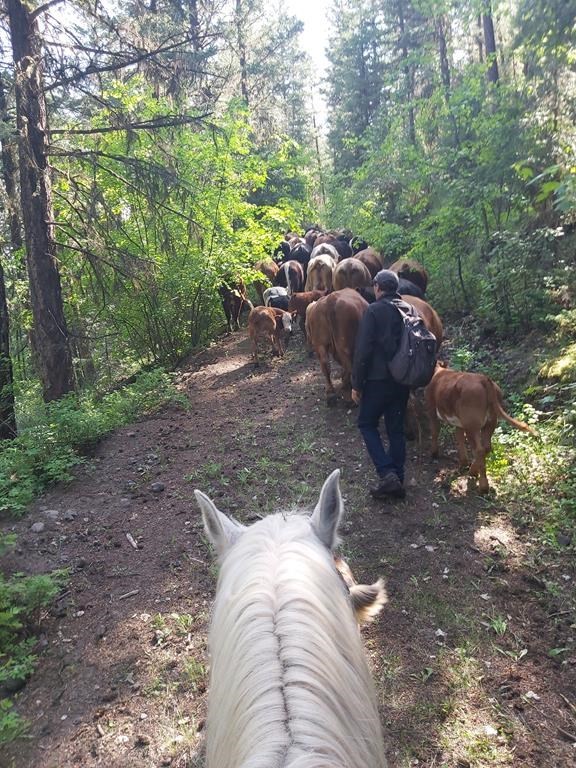
Fradette runs the Back Valley Ranch with partner Jerry Steves in the area between Savona and Cache Creek, about 350 kilometres northeast of Vancouver.
Fradette said they are just “keeping their heads above water,” getting by one day at a time. Feeding their herd costs about $700 per day.
Fradette and Steves aren’t alone in their plight, with drought conditions pushing up feed prices across much of the country.
The B.C. government said Tuesday that it’s partnering with the BC Cattlemen’s Association to match farmers in need of feed and hay with suppliers elsewhere, including the United States.
“We know all of Western Canada is being impacted by drought, so we’re looking at other jurisdictions where there may be some surplus hay,” Agriculture Minister Pam Alexis said at a news conference.
Alexis said the province has also received approval from the federal government to provide advance payments to farmers with cash flow issues under the AgriStability program.
Kevin Boon with the BC Cattlemen’s Association said the provincewide drought conditions are in contrast to years past because drought-related feed shortages in one part of B.C. could be made up for elsewhere.
Ranchers are facing increased costs to feed their herds, he said, but that is secondary to the availability of feed.
“This is an animal welfare issue and this is an issue where we, as farmers and ranchers, have to care for our animals and so decisions have to be made at some point in time,” he said. “If they can’t access feed, they are going to have to make a hard decision of what to do with those animals.”
Boon said they have had some success finding producers with hay at a reasonable price, but transporting feed from elsewhere is costly.
He said the persistent drought conditions have created the immediate challenge of sourcing feed and hay, but also raised questions over the long term of how to store and properly allocate water in the future.
For now, Boon said farmers can only hope for more rain in the forecast with “Mother Nature willing.”
Agriculture Canada’s most recent drought monitor report says 76 per cent of the country’s agricultural landscape is either abnormally dry or experiencing moderate to severe drought this summer.
The B.C. Ministry of Emergency Management and Climate Readiness says most of the province remains at either Level 4 or 5 drought conditions. It is urging people and businesses to continue to conserve water, even as the first rain in more than a month falls this week on Metro Vancouver.
Low precipitation and a historically early snowmelt have already pushed eight of B.C.’s 34 water basins into the worst Level 5 drought category, when all efforts should be made to conserve water and protect critical environmental flows. A further 13 are at level 4, meaning harm to ecosystems and communities is likely.
Fradette said that in previous years, her phone would be ringing briskly with offers of hay to feed her livestock, but things have changed this year.
“This time, I’m trying to phone around about it. There is no hay,” said Fradette.
Fradette said ranchers and farmers are struggling to get by.
“I always make the joke, I’m like, ‘I don’t want to be rich, rich. I just want to be change-my-oil-when-I-need-to rich.’ That’s our goal right there,” said Fradette.
Andy Wolfe operates Mount Lehman Farm, a family-owned beef ranch with 140 head of cattle in Abbotsford, B.C.
He said that thanks to “his farmer intuition,” he planned ahead this year to find three different suppliers to secure enough hay to cover him until next year.
“I basically took all the supply I could get from about three different local suppliers where normally I would be dealing with just one.”
Wolfe said loss of farmland to industrial use led to shrinking production of hay, a problem compounded by the drought.
He said hay prices were skyrocketing. Large bales that cost $65 last year are now $130, said Wolfe, and even that price required negotiation with suppliers.
“Most people are paying way more,” said Wolfe, adding that some ranchers had to downsize their herd because of the hay shortage.
Although Wolfe said he has enough hay to make it through the year, he’s already worrying about next year.
“My concern is if this year’s drought is going to affect next year’s prices,” said Wolfe.
“I made it through this year and I am going to be OK this winter, but if the drought continues, I don’t know what I’m going to have to pay for hay. Next year is my biggest concern.”
— with files from Darryl Greer
This report by The Canadian Press was first published July 25, 2023.