A drought alert for receding Lake Titicaca has Indigenous communities worried for their future
Advertisement
Read this article for free:
or
Already have an account? Log in here »
To continue reading, please subscribe:

Digital Subscription
One year of digital access for only $205*
- Enjoy unlimited reading on winnipegfreepress.com
- Read the E-Edition, our digital replica newspaper
- Access News Break, our award-winning app
- Play interactive puzzles
*First annual payment billed as $205.00 + GST for one year. This annual subscription will automatically renew at $233.00 + GST every 52 weeks (10% off the regular annual price of $259.35). Offer available to new and qualified returning subscribers only. Cancel any time.
To continue reading, please subscribe:
Add Free Press access to your Brandon Sun subscription for only an additional
$1 for the first 4 weeks*
- Enjoy unlimited reading on winnipegfreepress.com
- Read the E-Edition, our digital replica newspaper
- Access News Break, our award-winning app
- Play interactive puzzles
*Your next Brandon Sun subscription payment will increase by $1.00 and you will be charged $17.95 plus GST for four weeks. After four weeks, your payment will increase to $24.95 plus GST every four weeks.
Read unlimited articles for free today:
or
Already have an account? Log in here »
Hey there, time traveller!
This article was published 29/07/2023 (1162 days ago), so information in it may no longer be current.
HUARINA, Bolivia (AP) — A 70-year-old man’s feet sink into the soil as he passes abandoned boats where there used to be the water of Lake Titicaca. The highest navigable lake in the world has receded to what Bolivian authorities say are critically low levels due to a persistent drought.
“It’s completely dry,” Jaime Mamani said in exasperation while walking along the new shoreline in Huarina, a farming town 70 kilometers (43 miles) west of La Paz where he is a community leader.
The National Service of Naval Hydrography declared an alert this week for the iconic lake after its surface fell 2 centimeters (0.8 inches) below the drought warning stage, or 3,807.8 meters (12492.7 feet) above sea level. But the agency says this is just the beginning of a situation that is worrying Indigenous Aymara communities that rely on the lake for their livelihoods and fear the dry spell could permanently impact the region’s flora and fauna.
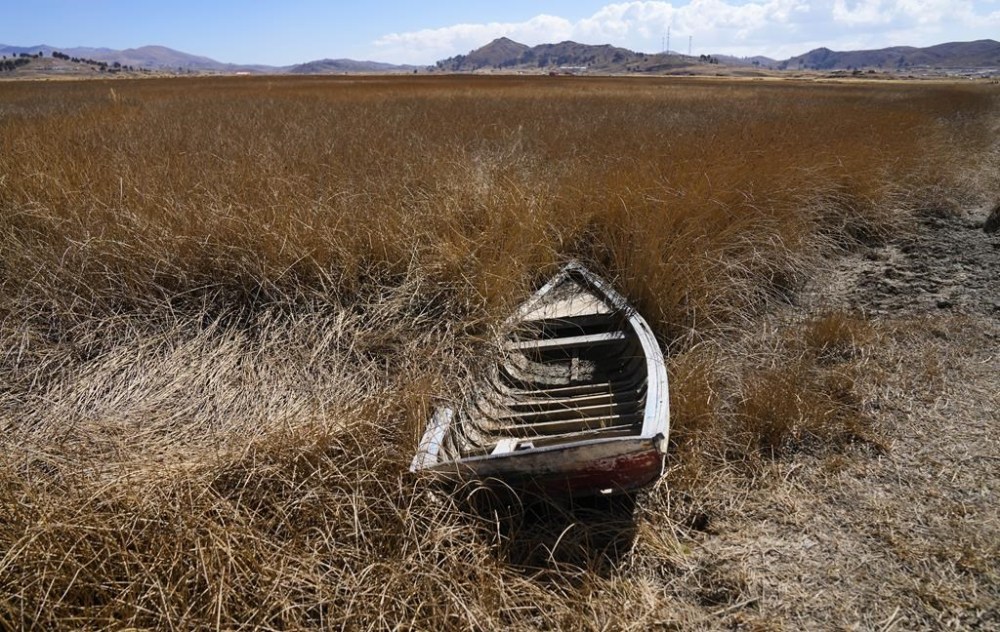
The hydrology unit of Bolivia’s navy warned that water levels could reach historically low levels in the coming months. By December, there is a “high probability” Lake Titicaca will be 64 centimeters (more than 25 inches) below the drought alert level, breaking a low water record set in 1998 by 33 centimeters (almost 13 inches).
“In three months, the water has decreased by 30 centimeters (11.8 inches), and considering that radiation is much stronger during this time of the year … we expect it to keep decreasing,” Carlos Carrasco, a hydraulic engineer for the hydrography service said.
The drought is the result of a combination of factors, including natural phenomena like La Niña and El Niño, which arrived unusually early this year and have been particularly strong due in part to climate change, according to Lucía Walper, who heads up the Hydrological Forecasting Unit at Bolivia’s National Meteorology and Hydrology Service.
But the vast lake is vital for this region of the Bolivian highlands, where hundreds of Aymara rural communities have relied on the blue body of water for millennia to practice subsistence farming and raise livestock.
Authorities in the Peruvian city of Puno also issued a warning about the declining water levels and expressed concern about the potential impact on tourism.
“We’re reaching a critical point. There will be a significant loss of water,” said Juan José Ocola, president of the Binational Authority of Lake Titicaca. The lake serves as the border between Bolivia and Peru.
Mateo Vargas, 56, a fisherman who has lived off the Lake Titicaca for 28 years, said he used to catch “lots” of fish daily. Now he considers himself lucky if he can catch six.
Vargas’ wife, Justina Condori, shares his concerns.
“The fish have vanished,” Condori, 58, said, predicting there will be famine if the current conditions persist.
Condori makes a living by renting boats to tourists. She worries fewer people will come to visit the lake, which at an elevation of 3,810 meters above sea level, is the largest body of freshwater in the Andes mountain range.
Evidence of the receding lake is seemingly everywhere. Women who sell fried fish and other snacks by the lake face rising costs for ingredients. Those who make a living transporting people from one side of the lake to the other are altering their routes because their rafts and boats no longer reach their usual docks.
Livestock farmers who rely on the plants that grow on the shores of the Titicaca to feed their animals are also seeing their livelihoods threatened.
The economic hardship is causing many residents of Huarina to migrate to other areas of the country, leaving behind mostly older townspeople, Mamani said. The waters of the Titicaca have always been shallow around the town, so the drought is even more visible there.

“There is a detriment to the economy of the inhabitants of the region,” he said.
Vargas, the fisherman, is also concerned about what the declining water levels will mean for the future.
“It looks like it will continue to decrease, day by day,” he said. “We’re worried because if we continue like this, what’s going to happen to our children?”
___
Follow AP’s coverage of the climate and environment at https://apnews.com/climate-and-environment