
Pig cooling pads and weather forecasts for cows are high-tech ways to make meat in a warming world

Advertisement

Advertise with us

CHICAGO (AP) — More than a third of the heat-trapping gases cooking the planet come from growing and raising food, but millions of cattle, pigs and other animals get to stay cool in the United States and other parts of the developed world.

Read this article for free:


or

Already have an account? Log in here »

To continue reading, please subscribe:

Subscribe and receive a limited-edition Free Press branded hat or tote.

Digital Subscription

One year of digital access for only $205*

  • Enjoy unlimited reading on winnipegfreepress.com
  • Read the E-Edition, our digital replica newspaper
  • Access News Break, our award-winning app
  • Play interactive puzzles

*First annual payment billed as $205.00 + GST for one year. This annual subscription will automatically renew at $233.00 + GST every 52 weeks (10% off the regular annual price of $259.35). Offer available to new and qualified returning subscribers only. Cancel any time.

To continue reading, please subscribe:

Add Free Press access to your Brandon Sun subscription for only an additional

$1 for the first 4 weeks*

  • Enjoy unlimited reading on winnipegfreepress.com
  • Read the E-Edition, our digital replica newspaper
  • Access News Break, our award-winning app
  • Play interactive puzzles
Start now

*Your next Brandon Sun subscription payment will increase by $1.00 and you will be charged $17.95 plus GST for four weeks. After four weeks, your payment will increase to $24.95 plus GST every four weeks.

Hey there, time traveller!
This article was published 30/07/2023 (1172 days ago), so information in it may no longer be current.

CHICAGO (AP) — More than a third of the heat-trapping gases cooking the planet come from growing and raising food, but millions of cattle, pigs and other animals get to stay cool in the United States and other parts of the developed world.

Many American farmers have apps to forecast animal comfort in the heat. There are computer-controlled “ cooling pads ” for sows. Dairy farmers lower barns’ temperatures with misters, air conditioning and giant fans. Special pedometers, the cow version of a Fitbit, measure vital signs that give clues to animals’ health.

More intense summer heat resulting from emissions-driven climate change means animal heat stress that can result in billions of dollars in lost revenue for farmers and ranchers if not properly managed. But technology often insulates livestock in richer countries — another way global warming exacerbates the gap between wealthy and poor nations.
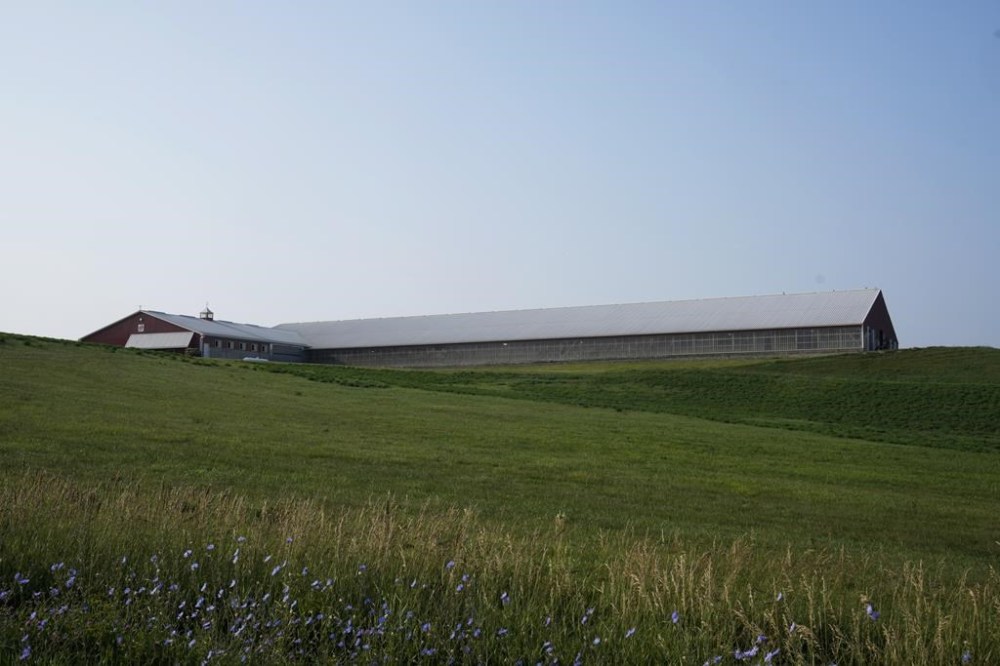
A freestall barn is seen on the Ted and Megan McAllister dairy farm, Monday, July 24, 2023, in New Vienna, Iowa. More intense summer heat resulting from emissions-driven climate change means animal heat stress that can result in billions of dollars in lost revenue for farmers and ranchers if not properly managed. The McAllister family installed new fans above the beds where their cows lie. (AP Photo/Charlie Neibergall)

The U.S. is the world’s largest producer and consumer of beef by volume. People have been drinking less milk in the U.S. but eating more cheese, and government programs still support dairies across the country. About 20% of all global greenhouse gas emissions come from animal-based food products, said Atul Jain, a professor in the department of atmospheric sciences at The University of Illinois Urbana-Champaign who studies the interactions between climate and human activities like agriculture.

Livestock producers in other parts of the world can’t adopt measures to beat the heat as easily as farmers in the U.S. A 2022 study in the Lancet Planetary Health found that cattle heat stress losses will be far greater in most tropical regions than in temperate regions, due to higher climate impacts and the relatively higher price of measures to adapt to climate change.

Many experts advocate for people in countries like the U.S., where diets are heavy with animal products, to eat less meat and dairy. But big, industrial farms in developed countries are relatively efficient, so to meet global demand with fewer animals, less-developed countries will also need to access the kind of technology that can make them more productive in the face of extreme heat.

“Those innovations bring me a lot of hope,” said Mario Herrero, a professor of food systems and global change at Cornell University who coauthored the Lancet Planetary Health study. “It’s a matter of how do we deploy them.”

This winter, the McAllister family of New Vienna, Iowa, installed new fans above the beds where their cows lie, and they’re happy with the updates. Their cows are already showing signs of improved welfare, like chewing more cud, and there’s more heat ahead this summer.

“We’re going to do what’s best by our cows no matter what is or isn’t going on with climate change,” said Megan McAllister, a sixth-generation dairy farmer. Her husband’s family has been farming for five generations.

September feels like another August these days, McAllister said.

“We want to make the right investments to better our cows, better our businesses that are our dairies, and make sure we’re here for the long haul and that we are thinking about sustainability,” she said.

Making that investment, of course, has a price: more fans for cooling means higher energy bills. That’s something Dr. Michelle Schack, a dairy veterinarian based in Arizona, has noticed as well. She said that the farmers she works with are well-prepared for the blistering heat the state has seen this year, because as research on animal health has improved, they’ve invested in infrastructure.

But it costs a lot.

“Fans and misters, let’s not forget, are hugely expensive, not only to install but the amount of electricity they take is insane,” Schack said.

That could be partly addressed with cheaper solar power integrated into agricultural projects. But regardless, “it’s going to be a challenge, a financial challenge” for more farms to adopt heat mitigation strategies, said Gerald Nelson, a professor emeritus at the University of Illinois Urbana-Champaign and a coauthor on the Lancet Planetary Health study.

Nelson described how different, heat-tolerant animal species or even something as simple as shade structures and extra water supplies can make a big difference when adapting to heat.
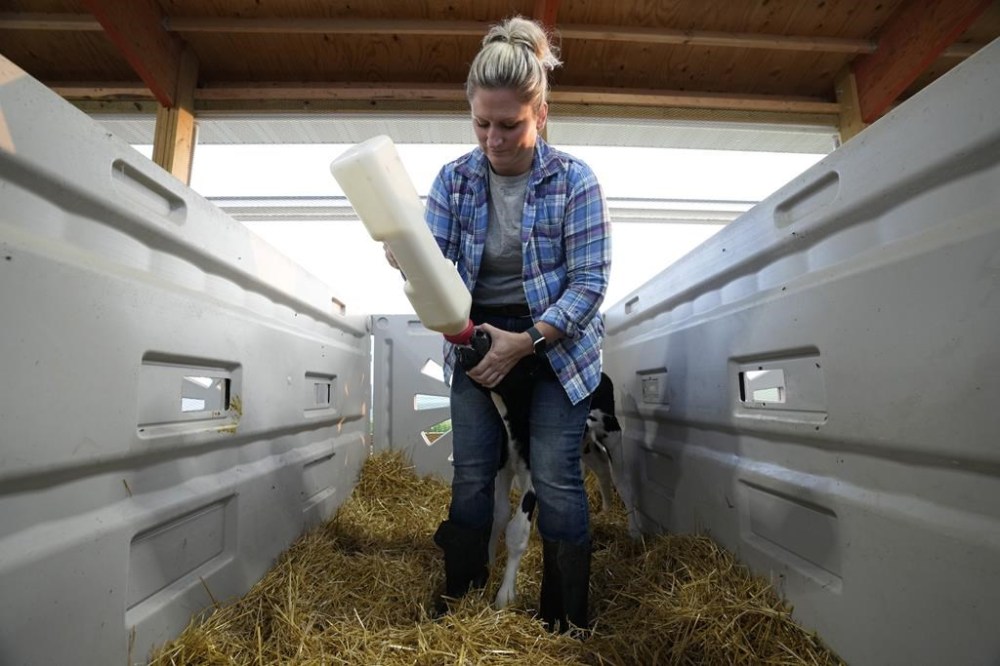
Dairy farmer Megan McAllister feeds a calf on her farm, Monday, July 24, 2023, in New Vienna, Iowa. More intense summer heat resulting from emissions-driven climate change means animal heat stress that can result in billions of dollars in lost revenue for farmers and ranchers if not properly managed. The McAllister family installed new fans above the beds where their cows lie. (AP Photo/Charlie Neibergall)

Information can help too. A team of USDA and university scientists recently launched a new app called HotHog that uses local weather data to help farmers anticipate conditions that might be uncomfortable for their pigs. And Chip Redmond, a meteorologist at Kansas State University, helped develop a seven-day animal comfort forecast tool for beef farmers that takes into account temperature as well as factors like humidity and wind.

As part of his work with Kansas State, Redmond gives presentations to producers and the general public, and he said that climate change has come up in conversations.

Both he and Jackie Boerman, an associate professor in the department of animal sciences at Purdue University, said that they recognize that farmers have to deal with the effects of climate change every day.

“We want to cool cows, but we also have to recognize that we want to also be environmentally sustainable,” Boerman said. Those two ideas are, she said, “sometimes a little bit at odds with each other.”

___

This story was first published on July 30, 2023. It was updated on July 31, 2023 to correct that more than a third of greenhouse gas emissions come from the food sector, not from farm animals.

___

Follow Melina Walling on Twitter @MelinaWalling.

___

Associated Press climate and environmental coverage receives support from several private foundations. See more about AP’s climate initiative here. The AP is solely responsible for all content.


Report Error Submit a Tip

More Stories

MPI leadership not fooling anyone by forcing PUB’s hand

Dan Lett 5 minute read Preview

MPI leadership not fooling anyone by forcing PUB’s hand

Dan Lett 5 minute read 1:33 PM CDT

It is not a question you will hear raised at Public Utilities Board hearings into Autopac rates, but you can bet it’s the one on most people’s minds.

When will the NDP government step in and repair leadership at Manitoba Public Insurance? For the third year in a row, MPI has limped into PUB hearings like a badly damaged vehicle that should have been written off years ago.

This week, the Crown corporation’s chief actuary admitted the 2.38-per-cent increase requested for the 2027-28 fiscal year was too low, in part because of the impact of last summer’s multiple hailstorms and the premiums MPI pays for re-insurance that protects the public insurer from surges in claims costs.

Chief actuary Cara Low said the rate application was not updated because of “uncertainty.” That is sort of like a firefighter complaining about not being able to do the job because there was too much smoke and flame.

Read
1:33 PM CDT

Tenants battling landlords find help in short supply from province

Scott Billeck 14 minute read Preview

Tenants battling landlords find help in short supply from province

Scott Billeck 14 minute read Yesterday at 6:00 AM CDT

For nearly three years, Quincy Houdayer and Avery Helm repeatedly pressed their landlord to address plumbing failures, water damage and other maintenance problems at their West Broadway apartment, with records showing some issues persisted until the couple turned to the Residential Tenancies Branch.

Emails and text messages between the tenants, Clearwater Management and the RTB reviewed by the Free Press document recurring leaks and flooding, periods without heat or hot water, concerns about mould and basement conditions and repeated followups from the couple seeking repairs.

“Most of the experiences we’ve had with them can be boiled down to, like, they either are very dismissive about it, they act like it’s not their problem… or they will just fully, blatantly ignore you,” Helm said, adding that the only way to get Clearwater to respond was to threaten going to the RTB, a provincial government agency.

RTB data obtained by the Free Press also shows 13 orders involving the three-building complex at 193-197 Furby St. in 2026 alone. All but one favoured the tenant, while the remaining order ruled in favour of both the tenant and landlord on different items.

Read
Yesterday at 6:00 AM CDT

Hydro’s unpredictable fortunes

Editorial 4 minute read Preview

Hydro’s unpredictable fortunes

Editorial 4 minute read Yesterday at 2:00 AM CDT

Hope for rain. Or snow. Or both. There’s a truism buried deep in a financial outlook in Manitoba Hydro’s 2025-26 annual report, released in late September: “Manitoba Hydro’s net income is highly dependent on several uncontrollable factors.”

Read
Yesterday at 2:00 AM CDT

Fire destroys St. Boniface housing unit

By Matthew Frank 3 minute read Preview

Fire destroys St. Boniface housing unit

By Matthew Frank 3 minute read Updated: Yesterday at 4:48 PM CDT

A six-unit housing development in St. Boniface was levelled by fire Tuesday.

The Winnipeg Fire Paramedic Service was notified at 4:50 a.m. that the site on the 800 block of Archibald Street, near Elizabeth Road, was on fire, a city spokesperson said in an email. No injuries were reported.

Firefighters had the blaze under control by about 6:15 a.m. after using an aerial ladder to tackle the flames from above and protect nearby homes, the spokesperson said.

At the site, no signs were present to identify the construction company or developer. The fences of neighbouring homes were burned and rooftop shingles were singed. Ash and fire-retardant foam littered the lawns.

Read
Updated: Yesterday at 4:48 PM CDT

Gang member who shot rival, bystander back in prison after release revoked

Erik Pindera 4 minute read Preview

Gang member who shot rival, bystander back in prison after release revoked

Erik Pindera 4 minute read Monday, Oct. 12, 2026

A Winnipeg man who shot a rival teenage gangster and an innocent 11-year-old bystander at the crowded Red River Exhibition more than four years ago has been sent back to prison.

Mocree Chuck Scatch-Dubour, now in his early 20s, left prison in April on statutory release on his 5 1/2-year federal sentence for the 2022 shooting. Scatch-Dubour was sentenced to the prison term as an adult in the spring of 2023 after pleading guilty to discharge of a firearm with intent to wound, aggravated assault and possession of a restricted firearm.

By law, most federal inmates automatically receive statutory release after two-thirds of their sentence, if they have not already been paroled.

Parole Board of Canada officials formally revoked Scatch-Dubour’s release this month after he unlawfully left his halfway house in June.

Read
Monday, Oct. 12, 2026

A decision with potential for ‘distraction’ and ‘disrespect’ in Transcona

Malak Abas 6 minute read Preview

A decision with potential for ‘distraction’ and ‘disrespect’ in Transcona

Malak Abas 6 minute read 5:24 PM CDT

Transcona voters acknowledge they have a tough decision to make at the ballot box on election day.

The east Winnipeg working-class ward is replete with lawn signs and posters, but most of the people the Free Press spoke with said they were still undecided.

While Winnipeg is, historically, more likely to elect an incumbent, longtime councillor Russ Wyatt is seeking a sixth term while facing five criminal charges, including sexual assault and administering a noxious substance, after incidents alleged to have occurred in 2023 and 2025.

Residents are not without options. In addition to Wyatt, former councillor Shawn Nason — who occupied the city council seat from 2018-22 is on the ballot (Wyatt chose not to run in the 2018 election after taking several months off to undergo addictions treatment) — there are three new faces on the ballot: Lora Meseman, Chris Giesbrecht and Nathine Dagdick.

Read
5:24 PM CDT



