Even frozen Antarctica is being walloped by climate extremes, scientists find

Advertisement

Advertise with us

Even in Antarctica — one of the most remote and desolate places on Earth — scientists say they are finding shattered temperature records and an increase in the size and number of wacky weather events.

Read this article for free:


or

Already have an account? Log in here »

To continue reading, please subscribe:

Subscribe and receive a limited-edition Free Press branded hat or tote.

Digital Subscription

One year of digital access for only $205*

  • Enjoy unlimited reading on winnipegfreepress.com
  • Read the E-Edition, our digital replica newspaper
  • Access News Break, our award-winning app
  • Play interactive puzzles

*First annual payment billed as $205.00 + GST for one year. This annual subscription will automatically renew at $233.00 + GST every 52 weeks (10% off the regular annual price of $259.35). Offer available to new and qualified returning subscribers only. Cancel any time.

To continue reading, please subscribe:

Add Free Press access to your Brandon Sun subscription for only an additional

$1 for the first 4 weeks*

  • Enjoy unlimited reading on winnipegfreepress.com
  • Read the E-Edition, our digital replica newspaper
  • Access News Break, our award-winning app
  • Play interactive puzzles
Start now

*Your next Brandon Sun subscription payment will increase by $1.00 and you will be charged $17.95 plus GST for four weeks. After four weeks, your payment will increase to $24.95 plus GST every four weeks.

Hey there, time traveller!
This article was published 07/08/2023 (1153 days ago), so information in it may no longer be current.

Even in Antarctica — one of the most remote and desolate places on Earth — scientists say they are finding shattered temperature records and an increase in the size and number of wacky weather events.

The southernmost continent is not isolated from the extreme weather associated with human-caused climate change, according to a new paper in Frontiers in Environmental Science that tries to make a coherent picture of a place that has been a climate change oddball. Its western end and especially its peninsula have seen dramatic ice sheet melt that threatens massive sea level rises over the next few centuries, while the eastern side has at times gained ice. One western glacier is melting so fast that scientists have nicknamed it the Doomsday Glacier and there’s an international effort trying to figure out what’s happening to it. And Antarctic sea ice veered from record high to shocking amounts far lower than ever seen.

What follows if the trend continues, a likely result if humans fail to curb emissions, will be a cascade of consequences from disappearing coastlines to increased global warming hastened by dramatic losses of a major source of sunlight-reflecting ice. That’s something scientists have long been watching and are even more concerned about now.
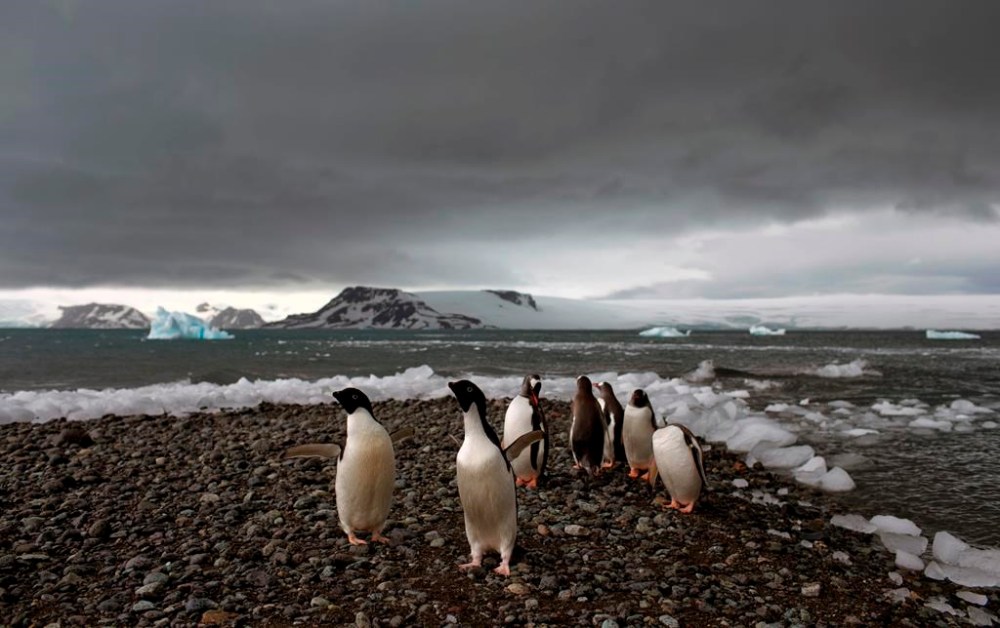
FILE - Penguins walk on the shore of Bahia Almirantazgo in Antarctica on Jan. 27, 2015. A new study released Tuesday, Aug. 8, 2023, concludes that Antarctica is already being and will continue to be affected by more frequent and severe extreme weather events, a known byproduct of human-caused climate change. (AP Photo/Natacha Pisarenko, File)

“A changing Antarctica is bad news for our planet,” said Martin Siegert, a glaciologist, professor of geosciences at University of Exeter and lead author on the paper.

Siegert said he and his team wanted to understand more about the causes of extreme events, and whether more of those events would happen as a result of burning fossil fuels, so the team synthesized research on a wide range of topics including atmosphere and weather patterns, sea ice, land ice and ice shelves and marine and land biology. The study found climate change extremes are getting worse in a place that once seemed slightly shielded from global warming’s wildness. The continent “is not a static giant frozen in time,” they said, but instead feels climate change’s wrath and extremes “sporadically and unpredictably.”

Anna Hogg, a co-author on the paper and professor at the University of Leeds, said that their work illustrates complex and connected changes between the ice, ocean and air. “Once you’ve made a big change, it can then be really hard to sort of turn that around,” she said.

And it’s a change with links to human activity. “This is indeed a strong signature of climate change,” Helen Fricker, a professor of geophysics with the Scripps Institution of Oceanography at the University of California, San Diego who was not involved with the study, said in an email. “It’s not good.”

Siegert and Hogg’s team looked at several factors including heat waves, loss of sea ice, collapse of ice shelves and impacts on biodiversity. Siegert described last year’s heat wave in Antarctica, which brought research station thermometers to a whopping 38 degrees Celsius (70 degrees Fahrenheit) above normal temperatures. Hogg said that sea ice is at an all time low, a major cause for concern: In the Antarctic, the July average for sea ice extent fell below previous low set in 2022. And ice shelves, which can be the size of several large buildings, are also under threat as they melt and eventually collapse.

Sea ice and ice shelves work like a cork in a bottle, holding back glaciers that would otherwise rush into the ocean. When they disappear, glaciers flow many times faster. What’s more, the disappearance of large swaths of ice accelerates warming like swapping a white T-shirt for a black one on a hot summer day — replace ice with land or water, and suddenly the earth is absorbing the sun’s rays rather than reflecting them.

The topic of extremes “is with us more frequently and will be with us even more frequently in the future,” said Peter Schlosser, vice president and vice provost of the Global Futures Laboratory at Arizona State University not involved with the research. Systems like Antarctica are extreme by nature, but that doesn’t mean they’re not vulnerable, he added — they’re highly susceptible to small changes.

“I’m not an alarmist, but what we see is alarming,” said Waleed Abdalati, an environmental researcher at the University of Colorado not involved with the study. He said that extreme events are one thing, but when superimposed on a trend — a trend of global warming that heightens those extreme events — that’s a cause for concern. “We can handle events,” he added, “but we can’t handle a steady increase of those destructive events.”

That’s something climate scientists say we’ll need to prepare for, by continuing to reduce greenhouse gas emissions while introducing adaptation measures for sea level rise and extreme weather around the world.

“We’ve been saying this for 30 years,” said Ted Scambos, an ice scientist at the University of Colorado whose paper from 2000 was cited in Siegert and Hogg’s article. “I’m not surprised, I’m disappointed. I wish we were taking action faster.”
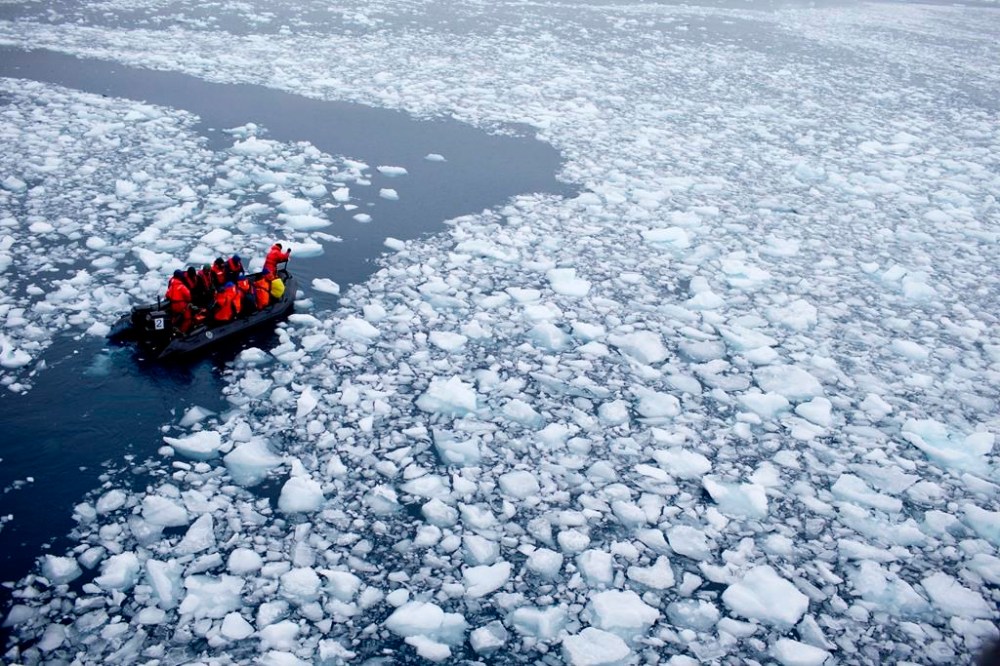
FILE - A team of international scientists heads to Chile's station Bernardo O'Higgins, Antarctica, on Jan. 22, 2015. A new study released Tuesday, Aug. 8, 2023, concludes that Antarctica is already being and will continue to be affected by more frequent and severe extreme weather events, a known byproduct of human-caused climate change. (AP Photo/Natacha Pisarenko, File)

___

Seth Borenstein contributed from Washington, D.C.

___

Follow Melina Walling on Twitter @MelinaWalling.

___

Associated Press climate and environmental coverage receives support from several private foundations. See more about AP’s climate initiative here. The AP is solely responsible for all content.

Report Error Submit a Tip

More Stories

Letters, Oct. 3

7 minute read 2:01 AM CDT

A morning in the life …

My very first lesson does not start when I walk into that lecture hall, oh no — it starts long before. It begins when I walk to my car, check the estimated arrival time to the University of Manitoba and hope that Winnipeg traffic agrees with it.

A drive that appears completely manageable changes almost immediately when I’m greeted by a tsunami of orange pylons and a line of cars that appears to go on forever. Traffic moves by the inch, lanes magically disappear and the detour I took yesterday now has a detour of its own. These factors make me do a calculation that I have become all too familiar with. How late can I arrive and still find parking, run to my class across campus and get to class with enough time left to make it worth it?

I have grown used to people saying, “Why not just leave earlier?” I do. But when I’m already leaving for my 8:30 a.m. class at 7 a.m., there’s only so much I can do. This drive that some would think is relaxing is one that feels like an assignment that I didn’t know I had to complete and is due at 8:30 a.m.

Nearly four in 10 Manitobans hope Canada restarts trade talks after U.S. midterm elections, poll reveals

Gabrielle Piché 4 minute read Preview

Nearly four in 10 Manitobans hope Canada restarts trade talks after U.S. midterm elections, poll reveals

Gabrielle Piché 4 minute read Yesterday at 7:00 AM CDT

Disorganized — that’s what Marcus Langlois calls recent United States tariffs.

He expects suppliers’ prices to increase — on mugs, pens, hoodies — for his employer, Dreamcatcher Promotions, if the United States–Canada trade war persists.

Still, he’s not pining for a quick trade deal.

“I think it should wait,” said Langlois, Dreamcatcher Promotions’ vice-president. “Let’s hope that it’s later on with proper negotiations happening.”

Read
Yesterday at 7:00 AM CDT

Broadening prediction-market gambling a bad idea

Editorial 4 minute read Preview

Broadening prediction-market gambling a bad idea

Editorial 4 minute read 2:01 AM CDT

Let’s make a prediction: sooner or later, when Canadian governments find a way to take their own cut of the action, prediction-contract gambling on everything from sports to entertainment to political decisions is going to come to Canada.

And that’s a horrible, dangerous, pernicious idea.

Unless you have particular access to information — either inside information or strategic information based on skills or education — you’re not likely to make money at it. In fact, structurally, you’re likely to lose. In prediction markets, you basically pay an amount, plus fees from the company involved, to bet on whether something will or will not happen within a certain time frame. The amount you pay for your contract depends on how other people are also betting.

As Wealthsimple describes it, “You buy whichever side you think is right. Prices move with demand, so if the market leans towards one outcome, the more that side costs. If a lot of people are backing the TSX to finish above 38,000, yes gets more expensive and no gets cheaper.”

Read
2:01 AM CDT

International flavour: Canadian investors may want to make like Ottawa, diversify beyond U.S.

Joel Schlesinger 6 minute read Preview

International flavour: Canadian investors may want to make like Ottawa, diversify beyond U.S.

Joel Schlesinger 6 minute read 2:01 AM CDT

Canada is learning the hard way about the dangers of putting too many eggs in its U.S. economic basket.

Much has been made about the need to diversify our economy away from the United States.

Diversification is understandably beneficial. The more varied streams of revenue a nation has, the less affected the economy will be when one of those sources is interrupted.

The same can be said about investment portfolios.

Read
2:01 AM CDT

Gordon Bell rings in a century

Maggie Macintosh 13 minute read Preview

Gordon Bell rings in a century

Maggie Macintosh 13 minute read Updated: Yesterday at 8:06 PM CDT

Mischka Valencia had gotten used to the hum of heavy machinery at Gordon Bell High School.

“Ever since I’ve been here, it’s all been under construction,” the Grade 12 student said, standing on the sidelines of the brightly painted revamped outdoor basketball court. “I had no idea this was a court.”

The Filipina teenager landed in Winnipeg several months after the inner-city campus had transformed into a construction site.

It was the fall of 2023 and Mischka’s priorities were fitting in, befriending classmates and learning a third language via first-period French.

Read
Updated: Yesterday at 8:06 PM CDT

Volunteer pop-up library axed from Manitoba Youth Centre

Matthew Frank 4 minute read Preview

Volunteer pop-up library axed from Manitoba Youth Centre

Matthew Frank 4 minute read 2:01 AM CDT

Manitoba Corrections has cancelled a pop-up library program at the Manitoba Youth Centre, leaving inmates without librarian services and fewer options to borrow certain books.

The Prison Libraries Committee, part of the non-profit Manitoba Library Association, operated and funded the volunteer program since 2024 before it was shut down by the province last month. The group previously partnered with the province to offer the service because the facility has no dedicated library of its own.

“It is concerning that community members who are incarcerated, especially youth, are losing out on meaningful programming, access to information and rehabilitation efforts, which are offered at no cost to (Manitoba) Corrections. We urge Manitoba Justice to promote more library services and programming, not less,” said a Sept. 24 letter from the non-profit addressed to the justice minister.

Ashley Huot, chair of the Prison Libraries Committee, said she was puzzled when she received an email last month from Manitoba Corrections stating that the pop-up library was no longer needed.

Read
2:01 AM CDT