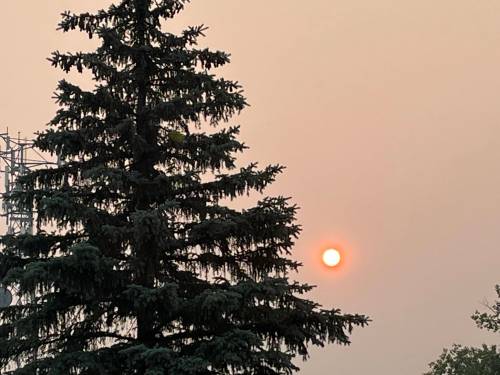
B.C.’s wildfire crisis was forecast, but it arrived decades sooner than expected

Advertisement

Advertise with us

The onset of large, severe wildfires that threaten communities year after year has occurred earlier in British Columbia than previous research projected, and experts say the record-shattering 2023 season must serve as a springboard for action.

Read this article for free:


or

Already have an account? Log in here »

To continue reading, please subscribe:

Subscribe and receive a limited-edition Free Press branded hat or tote.

Digital Subscription

One year of digital access for only $205*

  • Enjoy unlimited reading on winnipegfreepress.com
  • Read the E-Edition, our digital replica newspaper
  • Access News Break, our award-winning app
  • Play interactive puzzles

*First annual payment billed as $205.00 + GST for one year. This annual subscription will automatically renew at $233.00 + GST every 52 weeks (10% off the regular annual price of $259.35). Offer available to new and qualified returning subscribers only. Cancel any time.

To continue reading, please subscribe:

Add Free Press access to your Brandon Sun subscription for only an additional

$1 for the first 4 weeks*

  • Enjoy unlimited reading on winnipegfreepress.com
  • Read the E-Edition, our digital replica newspaper
  • Access News Break, our award-winning app
  • Play interactive puzzles
Start now

*Your next Brandon Sun subscription payment will increase by $1.00 and you will be charged $17.95 plus GST for four weeks. After four weeks, your payment will increase to $24.95 plus GST every four weeks.

Hey there, time traveller!
This article was published 10/09/2023 (1105 days ago), so information in it may no longer be current.

The onset of large, severe wildfires that threaten communities year after year has occurred earlier in British Columbia than previous research projected, and experts say the record-shattering 2023 season must serve as a springboard for action.

The surge stems from a combination of climate change and entrenched forest management practices, which have together created a landscape more conducive to large, high-intensity blazes, says Lori Daniels, a professor in the department of forest and conservation sciences at the University of B.C.

“Society is already paying a huge cost for these climate change-fuelled fires,” she says.

A helicopter being used to battle hot spots near Sorrento lands in Squilax, B.C., Wednesday, Sept. 6, 2023, as trees burned by the Bush Creek East wildfire are seen on a mountainside. The onset of large, severe wildfires that threaten communities year after year has occurred earlier in British Columbia than previous research projected, and experts say the record-shattering 2023 season must serve as a springboard for action. THE CANADIAN PRESS/Darryl Dyck

“The thing we can control in the short term is the vulnerability of the landscape.”

Reducing that vulnerability means transforming how B.C.’s diverse landscape is managed. Shifting away from a timber-focused approach that prioritizes conifers over less-flammable broadleaf trees and ramping up prescribed burningare key steps toward protecting communities by supporting healthy, resilient forests, Daniels says.

“The sooner we do it, the better,” she adds.

Daniels is the co-author of a paper published by the peer-reviewed journal Nature that examined data from the last century and found an “abrupt” uptick in wildfire activity in B.C. corresponding with a warming and drying trend that began in the mid-2000s.

The province has experienced its four most severe wildfire seasons on record during the past seven years, in 2017, 2018, 2021 and 2023.

This season has smashed records for area burned in B.C. and Canada, with wildfires scorching more than 165,000 square kilometres across the country.

The paper published last week notes wildfires scorched more than 10,000 square kilometres of land in B.C. during three of the past seven seasons. Between 1919 and 2016, just three years saw more than 5,000 square kilometres.

The surge in large, intense wildfires is not surprising given climate projections for the province over the coming decades, says Marc-André Parisien, a research scientist with the Canadian Forest Service based in Edmonton who led the study.

However, both researchers say it came sooner than expected.

“According to a lot of projections, in 20, 30 years is where you would have seen a real amplification of these fire regimes, but (it happened) around the turn of the millennium, so a fair bit earlier,” Parisien said.

Daniels says she previously thought the next generation of fire ecologists, not hers, would have to contend with the “new reality” of high-intensity wildfires.

“To have four of these seasons out of the last seven is shocking,” she says.

As communities expand farther into the wildland-urban interface, where forests meet human development, the paper shows summers in B.C. are increasingly characterized by hot, dry and windy conditions that are primed for wildfire to burn with speed and intensity that would almost certainly overwhelm suppression efforts.

Parisien underscores the significance of fire intensity.

“If a fire comes in rolling as a 30-metre wall of flames, there’s not a lot you can do,” he says. “You can dump a lot of water on it, but it amounts to spitting on a campfire.”

The researchers say climate change is not the only culprit, though.

The warming and drying trend that began in the mid-2000s coincided with pine beetle outbreaks that left swaths of B.C.’s forests dead, dry, brittle and ripe for wildfire.

The outbreaks also prompted the B.C. government to approve extensive clear-cut harvesting to salvage the economic value of the beetle-killed timber.

After logging, Daniels says the predominant approach in B.C. is to replant coniferous trees intended to feed the forest industry.

It’s also common practice to remove broadleaf or hardwood trees, she says, sometimes using glyphosate, the main ingredient in the herbicide Roundup.

“We have this kind of old dogma in forestry that the broadleaf trees only slow down the growth of the needle-leaf trees so we don’t want them there,” she says.

Yet broadleaf forests do not burn as intensely as their coniferous counterparts.

“If we can have patches of broadleaf forest and if we actively manage to maintain those to create fire breaks … we can actually reconfigure our landscapes to be more resilient to climate change and more resistant to these very large fires,” Daniels says.

Wildfire can be healthy for the landscape. It consumes dead leaves, branches and other fuels that build up and stoke high-intensity blazes, she explains.

Yet aggressive fire suppression that ramped up in the latter half of the 20th century has also led to what the researchers call a “fire deficit” in B.C., especially in forests and grasslands that are near communities with homes and infrastructure to protect.

Data from the provincial wildfire service shows more than 90 per cent of fires between the 1970s and the early 2000s were detected and suppressed before they reached four hectares in size, underscoring the extent of the strategy, Daniels says.

With the global climate heating up, Daniels says it’s critical for governments at all levels to work together to transform how B.C.’s diverse landscape is managed.

“That’s where we can take immediate action.”

Climate projections “give us forewarning of what is coming,” she says.

“This summer will repeat in the future, not only in B.C. but likely across Canada.”

Forests Minister Bruce Ralston says he’s optimistic that a new system of forest landscape planning introduced two years ago will usher a “new era” of forest management that includes wildfire resilience once it’s expanded across the province.

Rather than focus on timber alone, the new process aims to consider a range of values, including biodiversity, ecosystem health and community participation, Ralston told a press conference related to wildfire and drought last week.

Parisien says the 2023 wildfire season is likely to be a “game-changer” in Canada.

“There’s going to be lots of conversations that may lead to some really creative and original ways to manage the land,” he says.

“To really deal with this wildfire problem, with the new climatic context, you really need to take the bull by the horns.”

This report by The Canadian Press was first published Sept. 10, 2023.
Report Error Submit a Tip

More Stories

Manitoba abandoning spring, fall clock changes

Carol Sanders 8 minute read Preview

Manitoba abandoning spring, fall clock changes

Carol Sanders 8 minute read Updated: Yesterday at 8:48 AM CDT

Time’s up for the time change in Manitoba.

Manitobans won’t be setting their clocks back an hour in November. The province has decided to permanently stay on daylight time after surveying residents on the twice annual clock adjustment.

“We heard from Manitobans loud and clear — no more changing the clocks in Manitoba,” Premier Wab Kinew said in a news release Thursday.

Most of the 72,000 votes submitted in an online EngageMB survey — 92 per cent — said they would like to see the practice end. The survey asked if they preferred earlier sunrises in winter with standard time or the later sunsets in summer with daylight time. More than half of survey participants (58 per cent) indicated a preference to stay on permanent daylight time; 34 per cent voted to eliminate the time change but stay on standard time.

Read
Updated: Yesterday at 8:48 AM CDT

Grieving child builds backyard rocket ship

Harriet Zaidman 4 minute read 2:01 AM CDT

I Built a Rocket Ship (Kids Can Press, 32 pages, hardcover, $22) by Winnipegger Anna Lazowski is a tender story for children ages 4-8 about a little girl trying to make sense of her mother’s death. The child engages in conversation with her late mom, agreeing and disagreeing about things said as she carries objects (and of course, the cat) to the backyard. There, she is building a rocket ship she will pilot into the skies to find her mom again.

Jennica Lounsbury’s varied perspectives show the range of emotions the little girl experiences.

● ● ●

Northwoods Lullaby by Mary Casanova (University of Minnesota Press, 32 pages, hardover, $25) is a bedtime book for readers up to age eight, perfect to bring a busy, happy day to a close. Just like children who are listening to adults reading the book, all the animal babies are being tucked into their nests and burrows by loving parents: “Thump and scamper,/nimble clover./ Soon it’s time to rest. Baby loon/ nestles in/as Papa floats along.”

Jets vets weigh in on franchise goalie Hellebuyck not reporting to training camp

Mike McIntyre 7 minute read Preview

Jets vets weigh in on franchise goalie Hellebuyck not reporting to training camp

Mike McIntyre 7 minute read Thursday, Sep. 17, 2026

Hockey is the ultimate team sport, where it’s supposed to be about the crest on your chest rather than the name on your back.

So how is Connor Hellebuyck’s trade request and subsequent training camp strike playing out inside the Winnipeg Jets locker room — particularly among other core players he’s gone to battle with over the years?

“Obviously the news is heartbreaking,” Jets forward Kyle Connor said Thursday.

“It feels like we had such a special group here and for whatever reason — I can’t speak to the reason until we hear from the man, I’m not going to speculate on what it is but I know that a lot of guys in that room that are heartbroken.”

Read
Thursday, Sep. 17, 2026

Siloam Mission, WFPS discussing on-site paramedic to reduce staggering number of emergency calls

Scott Billeck 4 minute read Preview

Siloam Mission, WFPS discussing on-site paramedic to reduce staggering number of emergency calls

Scott Billeck 4 minute read Yesterday at 2:00 AM CDT

Winnipeg’s fire-paramedic service and its largest homeless-serving organization are discussing what it would look like to station at least one paramedic at Siloam Mission, as emergency calls to the downtown facility surge.

The ongoing discussions come as Winnipeg Fire Paramedic Service crews were dispatched 1,771 times during the first eight months of the year to the two adjacent Siloam properties at 303 Stanley St. and 300 Princess St.

WFPS said most of the calls were related to overdoses or other consequences of substance use, with the total nearly double the 854 calls recorded over the same period last year. By comparison, there were 831 calls during the same span in 2024, and 591 in 2023.

“The number of emergency calls isn’t sustainable for us as a service, but it’s certainly not sustainable for them as an agency trying to provide services,” WFPS chief Ryan Sneath told the Free Press. “And they recognize that they’re impacting emergency services, not them specifically, but the site in a significant way.”

Read
Yesterday at 2:00 AM CDT

Not falling back means time loop remains unclosed

Jen Zoratti 4 minute read 2:01 AM CDT

I demand restitution. Where’s my hour?

In the traditional fall-back, spring-forward time change set up — you know, ol’ trusty that’s been effect for lo these 63 years — we lost an hour in the spring that we got back in the fall.

That was the social contract: you commit to feeling like you’re on cold medication for a week in March because you know a glorious extra hour of sleep will be returned to you in November. (Unless, of course, you have little kids, but look: we all make our choices.)

Well, that transaction, flawed as it was, isn’t happening this year. That hour you sacrificed to the sun gods in the spring? Gone. Not coming back. We’ve sprung forward and we shan’t be falling back — not in November, and (possibly) not ever. The scale shall remain unbalanced and the loop shall remain unclosed as Manitoba has adopted permanent daylight time.

Family account spiced with magic realism, geopolitical intrigue and a ghost story

Reviewed by Zilla Jones 4 minute read Preview

Family account spiced with magic realism, geopolitical intrigue and a ghost story

Reviewed by Zilla Jones 4 minute read 2:01 AM CDT

Tom Lin’s second novel Babylon, South Dakota moves beyond a historical account of an immigrant family’s struggle, delightfully blending and bending genres.

Lin is a Chinese-born novelist whose family emigrated to the U.S. when he was four years old. His debut novel, The Thousand Crimes of Ming Tsu, won the 2022 Andrew Carnegie Medal for Excellence in Fiction, making him the youngest ever recipient of that award. He earned a PhD in English from the University of California Davis and is currently an assistant professor of English and creative writing at the University of Iowa.

Babylon, South Dakota takes place in an unspecified time period that can be understood to be during the Mao era — likely the 1950s or ’60s. A young Chinese couple, the Hsuis, immigrate to the rural community that gives the book its title. They take the names Saul and Mei and settle on a 160-acre homestead left to them by a distant relative.

Saul’s dream is to breed and sell chrysanthemums from seeds he brought from China, while Mei wants to raise livestock. They speak no English, know nothing of life in the United States, are unprepared for the harshness of winter and the isolation of the farm and bring nothing with them except some gold, which Mei hides around the house for emergencies. Their only link to the outside world is a discarded and marginally functioning TV set, which Saul rescues and rigs up.

Read
2:01 AM CDT