Takeaways from AP report on Maui fire investigation

Advertisement

Advertise with us

Investigators are trying to solve a mystery about the origin of last month's deadly Maui wildfire: How did a small, wind-whipped fire sparked by downed power lines and declared extinguished flare up again hours later into a devastating inferno that killed at least 97 people?

Read this article for free:


or

Already have an account? Log in here »

To continue reading, please subscribe:

Subscribe and receive a limited-edition Free Press branded hat or tote.

Digital Subscription

One year of digital access for only $205*

  • Enjoy unlimited reading on winnipegfreepress.com
  • Read the E-Edition, our digital replica newspaper
  • Access News Break, our award-winning app
  • Play interactive puzzles

*First annual payment billed as $205.00 + GST for one year. This annual subscription will automatically renew at $233.00 + GST every 52 weeks (10% off the regular annual price of $259.35). Offer available to new and qualified returning subscribers only. Cancel any time.

To continue reading, please subscribe:

Add Free Press access to your Brandon Sun subscription for only an additional

$1 for the first 4 weeks*

  • Enjoy unlimited reading on winnipegfreepress.com
  • Read the E-Edition, our digital replica newspaper
  • Access News Break, our award-winning app
  • Play interactive puzzles
Start now

*Your next Brandon Sun subscription payment will increase by $1.00 and you will be charged $17.95 plus GST for four weeks. After four weeks, your payment will increase to $24.95 plus GST every four weeks.

Hey there, time traveller!
This article was published 27/09/2023 (1090 days ago), so information in it may no longer be current.

Investigators are trying to solve a mystery about the origin of last month’s deadly Maui wildfire: How did a small, wind-whipped fire sparked by downed power lines and declared extinguished flare up again hours later into a devastating inferno that killed at least 97 people?

Here are the key takeaways of an Associated Press investigation into the probe:

WHAT DO THEY THINK HAPPENED?
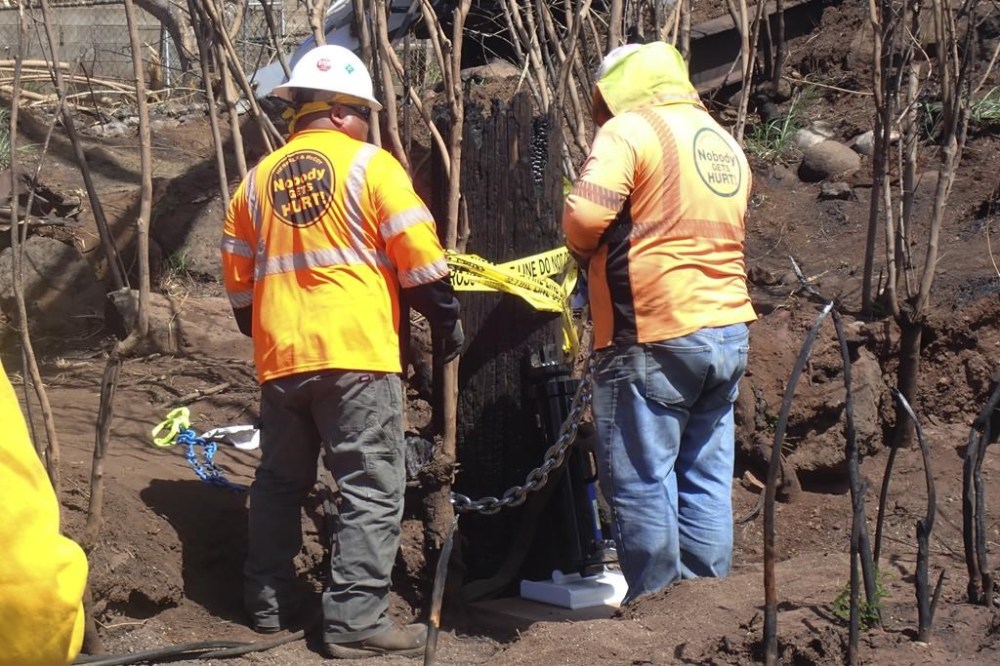
In this photo provided by the Morgan & Morgan law firm, utility contractors remove a charred Hawaiian Electric utility pole stump in Lahaina, Maui, Hawaii on Aug. 29, 2023. Investigators are examining this and other pieces of evidence as they seek to solve the mystery of how a small, wind-whipped fire sparked by downed power lines and declared extinguished flare up again hours later into a devastating inferno. (Morgan & Morgan via AP)

The answer may lie in an overgrown gully beneath Hawaiian Electric Co. power lines and something that harbored smoldering embers from the initial fire Aug. 8 before rekindling in high winds into a wall of flame that quickly overtook the town of Lahaina, destroying thousands of structures and forcing residents to jump into the ocean to escape.

Investigators led by the federal bureau of Alcohol, Tobacco, Firearms and Explosives and Maui County have declined to comment on specifics of the probe.

But The Associated Press reviewed more than 950 photos taken last month showing investigators combing through the gully area and examining several items that could be possible ignition sources for the rekindled fire. They included a heavily charred, hollowed 4-foot-tall stump of a utility pole, two heavily burned trees and the remains of an old car tire.

While experts cautioned the gully was full of places where embers could fester, they noted that these larger items stood out because the second fire erupted hours later, and stumps and roots have been known to harbor embers and keep them glowing a long time, in some cases weeks.

WHAT ELSE IS GETTING SCRUTINY?

As investigators sift through blackened debris to explain the deadliest U.S. wildfire in more than a century, one fact has become increasingly clear: Hawaiian Electric’s right-of-way was untrimmed and unkempt for years, despite being in an area classified as being at high risk for wildfires.

Aerial and satellite imagery reviewed by the AP show the gully has long been choked with thick grass, shrubs, small trees and trash, which a severe summer drought turned into tinder-dry fuel for fires. Photos taken after the blaze show charred foliage in the utility’s right-of-way still more than 10 feet high.

“It was not manicured at all,” said Lahaina resident Gemsley Balagso, who has lived next to the gully for 20 years and never saw it mowed. He watched and took video Aug. 8 after the flames reignited there and were stoked by winds from a hurricane churning offshore into a raging inferno that grew too fast for firefighters to stop.

The focus on Hawaiian Electric’s role in managing brush in its right-of-way could strengthen claims of negligence against the utility, which is facing an onslaught of lawsuits.

WHAT DOES THE UTILITY SAY?

Hawaiian Electric has acknowledged its downed lines caused the initial fire but has argued in court filings it couldn’t be responsible for the later flare-up because its lines had been turned off for hours by the time the fire reignited and spread through the town. The utility instead sought to shift the blame to Maui County fire officials for what it believes was their premature, false claim that they had extinguished the first fire. The county says the firefighters are not to blame.
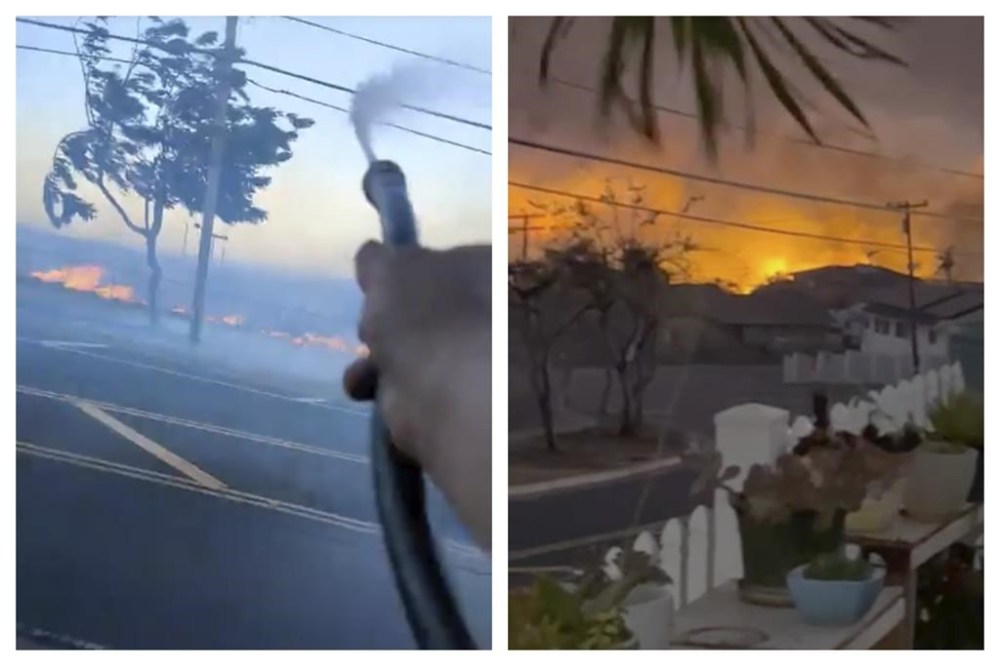
FILE - This combination of images from video made by neighbors Shane Treu, left, and Robert Arconado on Aug. 8, 2023, shows fires outside their homes on the Hawaiian island of Maui. Treu used a garden hose to spray water during fires caused by snapped electrical cables falling to the dry grass below and quickly igniting a row of flames. Investigators are examining pieces of evidence as they seek to solve the mystery of how a small, wind-whipped fire sparked by downed power lines and declared extinguished flare up again hours later into a devastating inferno. (Shane Treu, Robert Arconado via AP, File)

Asked about the overgrown gully, Hawaiian Electric said in a statement to AP that the right-of-way allows it “to remove anything that interferes with our lines and could potentially cause an outage.”

“It generally does not give us the right to go on to private property to perform landscaping or grass-mowing,” the company said.

National standards don’t specifically call for utilities to clear away vegetation unless it is tall enough to reach their lines, but fire science experts say utilities should go beyond that in wildfire areas to remove excess brush that could fuel a fire.

WHAT IS THE UTILITY’S RECORD?

Hawaiian Electric has a history of falling behind on what the electricity industry calls “vegetation management.”

A 2020 audit of Hawaiian Electric by an outside consulting firm found the company failed to meet its goals for clearing vegetation from its rights of way for years, and the way it measured its progress was inadequate and needed to be fixed “urgently.” The 216-page audit by Munro Tulloch said the utility tracked money it spent on clearing and tree trimming but had “zero metrics” on things that really mattered, such as the volume of vegetation removed or miles of right-of-way cleared.

Hawaiian Electric said in its statement to the AP that since that audit it has “completely transformed” its trimming program, spending $110 million clearing vegetation in the past five years, using detailed maps to find critical areas and tracking outages caused by trees and branches.


Report Error Submit a Tip

More Stories

Gillingham in lead with decided voters

Nicole Buffie 6 minute read Preview

Gillingham in lead with decided voters

Nicole Buffie 6 minute read Friday, Sep. 18, 2026

A cloud of uncertainty is hanging over Winnipeg as October’s municipal election nears.

Three months after a poll showed more than 40 per cent of Winnipeggers wanted to see someone other than current mayor Scott Gillingham elected, a new Abacus Data poll indicates more than half of Winnipeg voters are undecided heading into next month’s civic election.

Of decided voters, 55 per cent favour Gillingham compared to 23 per cent for former councillor and provincial cabinet minister Kevin Klein and 11 per cent for funeral director Mike Vogiatzakis.

Of all respondents, just over 50 per cent said they were unsure while 13 per cent said they will not vote.

Read
Friday, Sep. 18, 2026

Severe weather preparedness not one-time exercise for businesses

Abiola Odutola 3 minute read 2:00 AM CDT

BRANDON — Local business owners should prepare for the possibility that severe weather could disrupt their operations — even when their facilities escape major damage, a climate resilience expert told the Brandon Chamber of Commerce last week.

Emilia Cameron of the Institute for Catastrophic Loss Reduction told attendees at a September luncheon the recent flooding and heavy rainfall across southern Manitoba affected several businesses.

“Businesses need to prepare not just for direct damages to buildings, but for wide disruptions that can prevent them from operating,” she said. “Road closures, power outages, damaged infrastructure, internet failures and employees being unable to reach work can all bring operations to a standstill.”

Supply chains can also be affected when suppliers cannot reach their customers, she said.

Not falling back means time loop remains unclosed

Jen Zoratti 4 minute read Saturday, Sep. 19, 2026

I demand restitution. Where’s my hour?

In the traditional fall-back, spring-forward time change set up — you know, ol’ trusty that’s been effect for lo these 63 years — we lost an hour in the spring that we got back in the fall.

That was the social contract: you commit to feeling like you’re on cold medication for a week in March because you know a glorious extra hour of sleep will be returned to you in November. (Unless, of course, you have little kids, but look: we all make our choices.)

Well, that transaction, flawed as it was, isn’t happening this year. That hour you sacrificed to the sun gods in the spring? Gone. Not coming back. We’ve sprung forward and we shan’t be falling back — not in November, and (possibly) not ever. The scale shall remain unbalanced and the loop shall remain unclosed as Manitoba has adopted permanent daylight time.

Hellebuyck standoff caused by… Nathan MacKinnon?

Mike McIntyre 6 minute read Preview

Hellebuyck standoff caused by… Nathan MacKinnon?

Mike McIntyre 6 minute read Friday, Sep. 18, 2026

Looking for someone to blame in the Connor Hellebuyck fiasco and cast as public enemy No. 1? How about long-time Winnipeg Jets nemesis Nathan MacKinnon?

Allow us to explain as we fire up the time machine and head back to February in Italy.

Oh, what could have been if MacKinnon had been able to score on what appeared to be an open net late in the third period of the men’s gold medal game with Hellebuyck down and seemingly out of position.

Instead, the star forward fired wide, keeping the score deadlocked at 1-1 as the clock ticked down on regulation.

Read
Friday, Sep. 18, 2026

‘She was looking to destroy me’: convicted harasser faces new charges

Dean Pritchard 6 minute read Preview

‘She was looking to destroy me’: convicted harasser faces new charges

Dean Pritchard 6 minute read Thursday, Sep. 17, 2026

When Agnieszka Ciochon-Newton moved into the 55-plus apartment building on Stradbrook Avenue last year, she came across as “timid, soft-spoken and sensitive,” said building manager Tanya Owen.

Little did Owen know the meek-looking 58-year-old woman would soon turn her life and the lives of many of her tenants upside down and threaten her career and family.

“She was looking to destroy me for a simple tenant disagreement,” Owen said Thursday.

Court records show Ciochon-Newton was arrested earlier this month and charged with seven counts of criminal harassment, two counts of uttering threats and one count each of fraud, breaking and entering, attempting to obstruct justice, intimidation of a justice official, mischief and defamatory libel.

Read
Thursday, Sep. 17, 2026

Finding new markets — across an ocean

Editorial 4 minute read Preview

Finding new markets — across an ocean

Editorial 4 minute read 2:00 AM CDT

Prime Minister Mark Carney’s barnstorming trade mission to the European Union has created a ton of discussion and debate about cultivating new trade opportunities for Canadian exporters. What is hasn’t created, however, is very much certainty.

At first blush, opening up new trade relationships with the EU seems like a no-brainer as Canada is confronted with an increasing number of tariffs and restrictions from an increasingly unhinged Trump White House. And the possibilities are tantalizing; the EU and United Kingdom represent a market of more than 519 million people, which is larger than North America.

Canada is one of few nations to push back against Trump’s irrational trade demands. The result is an almost daily escalation of punitive measures and threatening rhetoric. Our trade relationship with the U.S. has been deeply wounded; in short order, it may become fatally so.

However, it is our courage in the face of American trade threats that has made us a coveted trading partner for many European nations. So much so that the EU created an entirely new category of “associate member” to give Canada an incentive to strengthen trading relationships.

Read
2:00 AM CDT