Academic report calls for public inquiry into Alberta Energy Regulator

Advertisement

Advertise with us

Academics at the University of Calgary are calling for a public review of the Alberta Energy Regulator, describing it as secretive and too close to industry.

Read this article for free:


or

Already have an account? Log in here »

To continue reading, please subscribe:

Subscribe and receive a limited-edition Free Press branded hat or tote.

Digital Subscription

One year of digital access for only $205*

  • Enjoy unlimited reading on winnipegfreepress.com
  • Read the E-Edition, our digital replica newspaper
  • Access News Break, our award-winning app
  • Play interactive puzzles

*First annual payment billed as $205.00 + GST for one year. This annual subscription will automatically renew at $233.00 + GST every 52 weeks (10% off the regular annual price of $259.35). Offer available to new and qualified returning subscribers only. Cancel any time.

To continue reading, please subscribe:

Add Free Press access to your Brandon Sun subscription for only an additional

$1 for the first 4 weeks*

  • Enjoy unlimited reading on winnipegfreepress.com
  • Read the E-Edition, our digital replica newspaper
  • Access News Break, our award-winning app
  • Play interactive puzzles
Start now

*Your next Brandon Sun subscription payment will increase by $1.00 and you will be charged $17.95 plus GST for four weeks. After four weeks, your payment will increase to $24.95 plus GST every four weeks.

Hey there, time traveller!
This article was published 11/10/2023 (1087 days ago), so information in it may no longer be current.

Academics at the University of Calgary are calling for a public review of the Alberta Energy Regulator, describing it as secretive and too close to industry.

In a peer-reviewed report issued by the university’s School For Public Policy, three authors examine what they call a “massive policy failure” in dealing with the large and growing environmental liability left by the province’s oil and gas industry.

They use decades of documents from registries and access to information requests to accuse the regulator of consistently favouring industry over public interest.

“There needs to be an inquiry of some kind,” said co-author and resource law professor Martin Olszynski. “Albertans don’t have the information they need.”

A spokeswoman for the regulator said recent programs funded by industry and government have improved spending on reclamation.

“Over $1 billion was spent on closure activities in 2022,” said Teresa Broughton in an email.

Alberta has about 230,000 drilled wells that need to be abandoned and reclaimed. Another 90,000 have been abandoned but not reclaimed.

That liability is estimated to be at least $60 billion. Some estimates double that.

The university report concludes that liability is the result of years of regulatory cosiness with industry.

“You have 30 years of essentially bilateral meetings between industry and the regulator,” Olszynski said. “The records we do have show very clearly how an initial policy would be proposed by government and then over the course of 20 or 30 meetings a very different policy emerges.”

As well, the report says too many of Alberta’s environmental requirements are left to the regulator’s discretion.

Legislation requires companies to clean up after themselves, but that obligation comes only after an order from the regulator. Although the province now has reclamation spending targets for industry, those targets are also set at the regulator’s discretion.

The report says the word “may” — as in “the regulator may prescribe conditions” — appears 190 times in Alberta’s Oil and Gas Conservation Act, 84 times in its Pipeline Act and 437 times in its Environmental Protection and Enhancement Act.

Alberta once had a requirement that all wells inactive for more than 10 years be abandoned, placed back into production or have financial security posted for their abandonment. That program was cancelled in 2000.

“The absence of legislated time frames for closure work means that, in almost all cases, the work is only conducted either voluntarily by the licensee or when the regulator issues an order,” the report says.

Broughton said the regulator is working on the problem and now has mandatory requirements for spending on well closure and remediation.

“Mandatory closure spend quotas specify the minimum amount of money that licensees are required to spend on closure work each year,” she said.

That requirement has grown to $700 million in 2024, from $422 million in 2022. In 2022, 4,461 sites received reclamation certificates, an increase of a third over the previous year.

However, the report says that requirement is also set at the regulator’s discretion and the 2024 target is lower than the $764 million forecast when the program was set out. The percentage of spending required is also significantly lower for operators deemed financially at risk.

The report criticizes how the regulator has, over the years, choked off the information it releases around the financial health of companies acquiring oil and gas leases.

The regulator used to post how much security each company had posted, as well as its score on the system used to assess ability to clean up old sites. The information on security was no longer posted after 2010 and individual liability scores were kept private after 2019, says the report.

The report also criticizes the Orphan Well Fund, an industry-funded and -run group that is supposed to oversee the reclamation of wells for which no owner exists. The authors say the fund’s board is dominated by industry and is exempt from freedom of information legislation despite receiving hundreds of millions of dollars in public funding in recent years.

The solutions to Alberta’s huge unfunded environmental liability aren’t going to be easy, said Olszynski. Some may feel the economic benefits are worth it, he said.

But he said no informed debate is possible under the current regime.

“We don’t know enough about how this came to be,” Olszynski said.

“How is it that over 20 years, the inactive well inventory mushroomed and nobody decided this was a problem?”

This report by The Canadian Press was first published Oct. 11, 2023.
Report Error Submit a Tip

More Stories

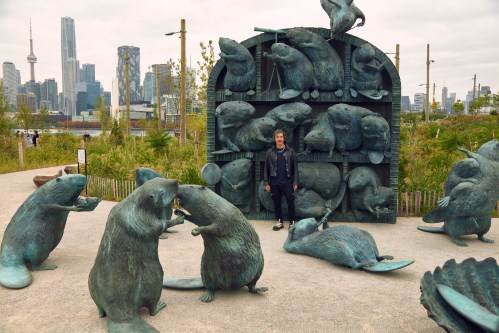
Kent Monkman debuts beaver sculpture in Toronto’s ambitious new waterfront park

Alex Nino Gheciu, The Canadian Press 2 minute read Preview

Kent Monkman debuts beaver sculpture in Toronto’s ambitious new waterfront park

Alex Nino Gheciu, The Canadian Press 2 minute read Wednesday, Sep. 30, 2026

TORONTO - Kent Monkman’s first-ever public art installation is dam good.

The celebrated Cree artist’s new permanent sculpture, dubbed “The Colony,” debuts Wednesday in Toronto’s east end.

The 15-foot-high bronze structure features beavers dancing, feasting and celebrating, evoking Indigenous ceremonies.

It highlights the vital role of beavers in the natural, Indigenous and colonial histories of Turtle Island, says a release.

Read
Wednesday, Sep. 30, 2026

Ferraro gets call-up to the Jets

Mike McIntyre 5 minute read Preview

Ferraro gets call-up to the Jets

Mike McIntyre 5 minute read Wednesday, Sep. 30, 2026

Landon Ferraro vividly recalls the moment his NHL career came to an extremely painful end — Oct. 20, 2017, in downtown Winnipeg.

“My last play was a breakaway on Connor Hellebuyck,” Ferraro told the Free Press this week.

“I tried to poke the puck past the first D. It was me and (Dustin) Byfuglien chasing it down. I thought he was going to throw me across the ice, so I tried to cut in on him, and he moved. I overextended, and I literally ripped my abductor off the bone and gave myself a hernia.”

Ferraro — at the time playing forward for the visiting Minnesota Wild — said he managed to get off a weak shot that hit the Jets goaltender square in the chest. But his 77th appearance in the big leagues would be his last following previous stops with Detroit (which drafted him 32nd overall in 2009) and Boston.

Read
Wednesday, Sep. 30, 2026

Port of Churchill signs agreement with Dutch port

Aaron Epp 2 minute read Preview

Port of Churchill signs agreement with Dutch port

Aaron Epp 2 minute read Tuesday, Sep. 29, 2026

Arctic Gateway Group, operator of the Port of Churchill, has signed an agreement with the Port of Rotterdam in the Netherlands to attract business and strengthen supply chains linking Western Canada and Europe.

The agreement enables the two ports to work together to develop new trade in critical minerals and energy products, connect Canadian producers with European buyers, and identify opportunities to improve the supply chain from Western Canadian resource projects through Churchill and into European markets.

The Port of Rotterdam is Europe’s largest port and home to more than 3,000 businesses across its industrial complex, serving as a major gateway for critical raw materials and energy.

Meanwhile, the Port of Churchill has been identified as a transformative national strategy for Canada and is emerging as a northern trade corridor connecting Western Canada’s resources to global markets.

Read
Tuesday, Sep. 29, 2026

Province putting $8M into safe space for Thompson Indigenous women and families

Free Press staff 2 minute read Preview

Province putting $8M into safe space for Thompson Indigenous women and families

Free Press staff 2 minute read 12:40 PM CDT

An $8-million provincial investment in the Mino’Ayaawag Ikwewag Northern Lodge in Thompson fulfils the NDP’s 2023 election promise to establish three new 24-7 safe spaces for Indigenous women and their families in that city, Winnipeg and Brandon.

The lodge is expected to be up and running in 2028, Families Minister Nahanni Fontaine, who is also responsible for women and gender equity, said at a news conference in Winnipeg. It builds on a 2025 investment of $3.5 million to establish a first-of-its-kind 24-7 safe space for Indigenous women and their children in Winnipeg, and a 2024 investment of $500,000 to support the creation of Franny’s Place, a new 24-7 safe space in Brandon.

The Mino’Ayaawag Ikwewag (Anishinaabemowin for “all women doing well”) Northern Lodge will operate as a community of care, offering culturally grounded supports that help individuals and families heal, stabilize and rebuild lives at risk of violence.

It will include 10 short-term private studio suites, a communal kitchen and living area, counselling and program space, laundry facilities and a dedicated child-minding area with Indigenous cultural teaching and play-based learning. Residents will have access to trauma-informed supports, cultural programming, parenting supports, peer support and supported connections to housing, health, education, employment and legal services.

Read
12:40 PM CDT

Listen up

2 minute read 3:00 PM CDT

Listen to Laura June RoseWritten while moving from Vancouver to Winnipeg, the four songs on Laura June Rose’s debut EP Passages — released this week for free or with a donation on her Bandcamp — is a retrospective roadmap that tracks a songwriter finding her way back and forward.

“I view the four songs and stories on this album as ‘passages’ in many senses of the word,” writes Rose, who also plays drums with the O.D. Beresford band.

“They are a way of exit from the punk and rock ’n’ roll subcultures that I grew up (with) in Calgary, Alberta, and Vancouver, British Columbia, as well as a way of entrance into the American folk revival, outlaw country, and contemporary Celtic traditional movements,” Rose writes. “They move through different geographical locations, psychological and spiritual conditions, and stages of my early adulthood.”

The first track, titled Winnipeg, sees Rose “in the village,” finding “a hole with a lonesome sound” in a pub on Osborne Street. “And the room was empty — almost no one around,” Rose drawls. “But he played the songs I knew.”

Safety upgrades completed at Whiteshell park falls where brothers drowned

Free Press staff 2 minute read Preview

Safety upgrades completed at Whiteshell park falls where brothers drowned

Free Press staff 2 minute read Updated: 2:54 PM CDT

Safety improvements have been completed at Sturgeon Falls in Whiteshell Provincial Park, where two brothers from Winnipeg drowned in July, the province announced Friday.

The Sturgeon Falls trail was closed for upgrades after Maximo Au Ramirez, 10, and Aaron Au Ramirez, 13, disappeared in the fast-moving rapids. Their bodies were recovered days later.

The trail and viewing areas have reopened. Viewing areas are now fenced to prevent people from walking onto hazardous slippery rocks. Signs were installed to warn visitors of drowning hazards.

A new portage gives canoeists and kayakers access to and from safe shoreline areas adjacent to the falls, the province said.

Read
Updated: 2:54 PM CDT