Ozone hole is about average size, despite undersea volcano eruption that was expected to worsen it
Advertisement
Read this article for free:
or
Already have an account? Log in here »
To continue reading, please subscribe:

Digital Subscription
One year of digital access for only $205*
- Enjoy unlimited reading on winnipegfreepress.com
- Read the E-Edition, our digital replica newspaper
- Access News Break, our award-winning app
- Play interactive puzzles
*First annual payment billed as $205.00 + GST for one year. This annual subscription will automatically renew at $233.00 + GST every 52 weeks (10% off the regular annual price of $259.35). Offer available to new and qualified returning subscribers only. Cancel any time.
To continue reading, please subscribe:
Add Free Press access to your Brandon Sun subscription for only an additional
$1 for the first 4 weeks*
- Enjoy unlimited reading on winnipegfreepress.com
- Read the E-Edition, our digital replica newspaper
- Access News Break, our award-winning app
- Play interactive puzzles
*Your next Brandon Sun subscription payment will increase by $1.00 and you will be charged $17.95 plus GST for four weeks. After four weeks, your payment will increase to $24.95 plus GST every four weeks.
Read unlimited articles for free today:
or
Already have an account? Log in here »
Hey there, time traveller!
This article was published 01/11/2023 (1065 days ago), so information in it may no longer be current.
With last year’s undersea volcano injecting massive amounts of water high into the atmosphere, scientists were bracing for a big Antarctica ozone hole this fall. But it didn’t happen.
Instead this year’s ozone hole was about average size for the last 20 years, even a bit smaller than 2022’s, according to NASA and the National Oceanic and Atmospheric Administration.
From September to mid October, the ozone hole this year averaged 8.9 million square miles (23.1 million square kilometers), which is the 16th largest since satellites started tracking in 1979. It peaked this year at 10 million square miles (26 million square kilometers), about the size of North America.
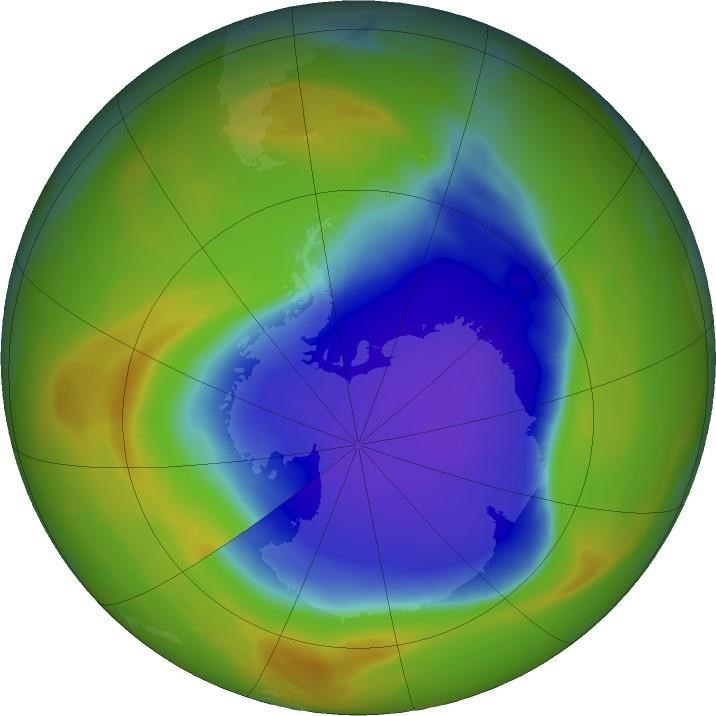
When ozone, three joined oxygen atoms, is 5 to 30 miles high (8 to 50 kilometers) in the atmosphere it protects Earth from the sun’s ultraviolet rays that could cause skin cancer, cataracts and even could sterilize crops. Because of chemicals in aerosol sprays and refrigerants that produce chemicals that munch ozone, Earth’s ozone layer a few decades ago started to thin and even form a large hole over Antarctica during September and October.
“That is massive in scale,” said Paul Newman, NASA’s ozone research leader and chief of Earth sciences at Goddard Flight Center. “That’s pretty bad and bad for folks who have to live in that depleted region” of southernmost South America.
“But it wasn’t as bad as we thought,” Newman said.
When the Hunga Tonga Hunga Ha’apai volcano shot millions of tons of water into the southern hemisphere’s atmosphere in January 2022, scientists figured the water, 10% more than usual, would eventually be bad for the ozone layer.
That’s because liquid water in the upper atmosphere gives a place for chlorine and bromine to perch and then eat away at the ozone layer, making the annual fall hole bigger, Newman said. So scientists and computer models predicted a bad ozone season this year.
“We were wrong,” Newman said.
Researchers will have to figure out where their understanding and computer simulations went wrong, Newman said. He thinks the water froze out higher and earlier, leaving less clouds and liquid water for perching ozone-munching chemicals.
Local weather conditions also cause variations in ozone size.

The ozone hole and thinning ozone layer has improved a bit thanks to the 1987 Montreal Protocol, when countries in the world agreed to stop producing many of the chemicals that deplete ozone, Newman said. The ozone hole was at its biggest in 2000 at nearly 11.6 million square miles (29.9 million square kilometers), according to NASA data.
But scientists say it will take decades to completely heal. ___
Follow Seth Borenstein on X, formerly known as Twitter at @borenbears
___
Associated Press climate and environmental coverage receives support from several private foundations. See more about AP’s climate initiative here. The AP is solely responsible for all content.