Maine considers electrifying proposal that would give the boot to corporate electric utilities
Advertisement
Read this article for free:
or
Already have an account? Log in here »
To continue reading, please subscribe:

Digital Subscription
One year of digital access for only $205*
- Enjoy unlimited reading on winnipegfreepress.com
- Read the E-Edition, our digital replica newspaper
- Access News Break, our award-winning app
- Play interactive puzzles
*First annual payment billed as $205.00 + GST for one year. This annual subscription will automatically renew at $233.00 + GST every 52 weeks (10% off the regular annual price of $259.35). Offer available to new and qualified returning subscribers only. Cancel any time.
To continue reading, please subscribe:
Add Free Press access to your Brandon Sun subscription for only an additional
$1 for the first 4 weeks*
- Enjoy unlimited reading on winnipegfreepress.com
- Read the E-Edition, our digital replica newspaper
- Access News Break, our award-winning app
- Play interactive puzzles
*Your next Brandon Sun subscription payment will increase by $1.00 and you will be charged $17.95 plus GST for four weeks. After four weeks, your payment will increase to $24.95 plus GST every four weeks.
Read unlimited articles for free today:
or
Already have an account? Log in here »
Hey there, time traveller!
This article was published 05/11/2023 (1058 days ago), so information in it may no longer be current.
PORTLAND, Maine (AP) — Taking a page from the “throw-the-bums-out” script in politics, Mainers are poised to vote on an unprecedented plan to rid themselves of the state’s two largest electric utilities and start with a clean slate.
The proposed takeover of two investor-owned utilities that distribute 97% of electricity in the state would mark the first time a U.S. state’s utilities were forcibly removed at the same time. The referendum calls for dismantling Central Maine Power and Versant Power and replacing them with a nonprofit utility called Pine Tree Power to operate 28,000 miles (45,000 kilometers) of transmission lines.
Across the country, ratepayers who are unhappy with their utilities are watching what happens when Mainers vote on Nov. 7 in the off-year election.
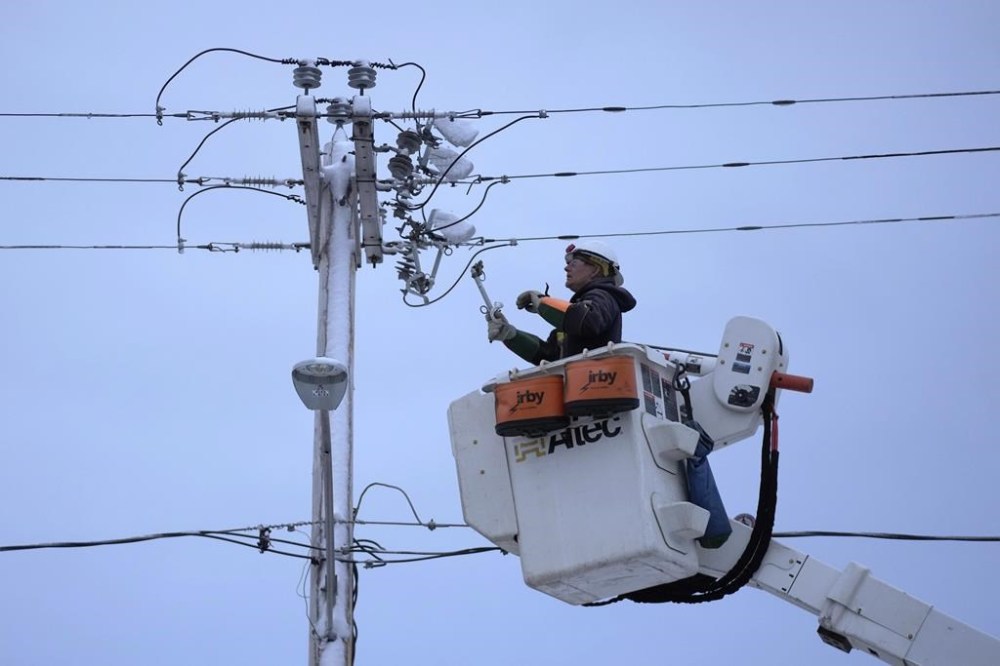
“What we say about state policy and trends is that it could become contagious,” said Timothy Cox, from Washington-based Clear View Energy Partners.
The referendum calls for creation of a nonprofit utility with a board made up of mostly elected members and a few appointed ones. A primary selling point is that the new utility would be beholden only to ratepayers, not corporate shareholders, allowing lower costs, greater investments in the grid and improved performance, supporters said. Interest rates for long-term borrowing for capital improvements also would be less costly for Pine Tree Power.
Supporters say there’s little to lose: Both investor-owned utilities rank near the bottom in customer satisfaction, with longer-than-average response to power outages and higher-than-average electricity rates.
But critics, including Democratic Gov. Janet Mills, worry about the power grid becoming politicized. They also question savings projections because of the billions of dollars needed to buy out the utilities, and worry about the prospect of lengthy litigation. Maine Public Advocate William Harwood contends legal disputes could postpone the new utility’s implementation by five to 10 years.
The amount of money spent on the referendum campaign reflects the stakes for the existing utilities. The owners of Central Maine Power and Versant have donated nearly $40 million to fight the takeover attempt — vastly outpacing the $1.2 million raised by supporters of the proposed utility takeover.
“I don’t think there’s ever been a more David vs. Goliath matchup,” said Seth Berry, a former state senator and a longtime critic of CMP.
Harwood is taking no position on the proposal, but his office’s assessment points out uncertainties, the biggest being the inevitable legal battle over the valuation given “utility assets are infrequently bought and sold.”
Nationwide, investor-owned utilities serve about 66% of electric customers, according to the American Public Power Association. Smaller co-ops and municipal utilities account for the remaining share.
San Francisco and San Diego, Ann Arbor, Michigan, and Rochester, New York, are among communities currently considering ditching their investor-owned utilities, said Ursula Schryver, from the public power group.
But there has been nothing on the scale of what’s proposed in Maine in terms of taking over the service territory of an entire state, Schryver said. Nebraska would come closest. It’s the only state where all ratepayers are served by municipal utilities, but it didn’t happen all at once, said Mike Jacobs, a senior energy analyst at the Union of Concerned Scientists, based in Boston.
There are no guarantees that changing ownership will solve problems, said Jacobs, who’s skeptical of Maine’s referendum. He suggested people should focus on tackling problems instead of demanding new ownership.
The anger and frustration from electric ratepayers in Maine is a far cry from the days when Iberdrola bought Central Maine Power, the state’s largest electric utility. Back in 2008, observers thought the company’s focus on renewable energy made it a good match for Maine, and CMP launched a $1.4 billion power grid upgrade that included bulked-up capacity for renewable energy.
The honeymoon lasted less than a decade.
CMP angered ratepayers with the botched rollout of its billing system in 2017, leading to errant cutoff notices, investigations and lawsuits. The billing mess coincided with frustration over slow response to storm-related power outages and increasing electricity costs, and opposition to a $1 billion hydropower corridor project. Furthermore, green energy advocates accused CMP of dragging its feet on connecting Maine-based renewable energy projects to the grid.
Some ratepayers are chomping at the bit for change. Others are more cautious.
Christie Decker, 67, of Wilton, is no fan of Central Maine Power, having sued over billing problems after receiving a cutoff notice when her bill unexpectedly jumped. But she also has concerns about Pine Tree Power. She said while she understands what supporters want to do, too many details are left to be sorted out after the election.
“I know what their hopes are. But I haven’t seen any concrete plans. I’d like to see some concrete plans,” said Decker, who’s undecided on how she’s going to vote on the measure.
The proposal would set in motion a process for establishing a 13-member board. The privately operated, nonprofit Pine Tree Power utility would contract with a private grid operator through a competitive bidding process. The board would approve an operation plan, and CMP and Versant workers get bonuses to sign on with the new contractor.
Freed of shareholders, the utility’s board could reinvest in a more resilient system as the nation faces the prospect of extreme weather events happening more often due to climate change.
But Pine Tree Power would face some of the same constraints as CMP and Versant. It’s costly to maintain power lines, substations and other equipment across a vast, rural state. And, like the existing utilities, Pine Tree Power would have no control over the actual cost of electricity, which comprises about half of consumers’ monthly bills.

If approved, the proposal still may face another hurdle. A second ballot question would require voter approval for borrowing topping $1 billion, potentially crimping access to bonds needed for the buyout.
Willy Ritch, executive director for the Maine Affordable Energy Coalition, which opposes the referendum, said supporters of Pine Tree Power “want us to take on debt, go through years of bureaucratic and legal fights, and hope that the elected politicians they put in charge of the grid someday figure out how to save us money or improve reliability.”
Al Cleveland, campaign manager for the drive to oust the utilities, had a response for doubters: “We truly could not get any worse than what we have right now. We have the worst quality service. We have to be able to improve that.”
___
Follow David Sharp on X, the platform formerly known as Twitter, @David_Sharp_AP