B.C., Newfoundland agree to share details on growing hydrogen sectors

Advertisement

Advertise with us

ST. JOHN'S, N.L. - The premiers of British Columbia and Newfoundland and Labrador have agreed to share information on developing the hydrogen energy sector in both provinces in a bid to become more efficient.

Read this article for free:


or

Already have an account? Log in here »

To continue reading, please subscribe:

Subscribe and receive a limited-edition Free Press branded hat or tote.

Digital Subscription

One year of digital access for only $205*

  • Enjoy unlimited reading on winnipegfreepress.com
  • Read the E-Edition, our digital replica newspaper
  • Access News Break, our award-winning app
  • Play interactive puzzles

*First annual payment billed as $205.00 + GST for one year. This annual subscription will automatically renew at $233.00 + GST every 52 weeks (10% off the regular annual price of $259.35). Offer available to new and qualified returning subscribers only. Cancel any time.

To continue reading, please subscribe:

Add Free Press access to your Brandon Sun subscription for only an additional

$1 for the first 4 weeks*

  • Enjoy unlimited reading on winnipegfreepress.com
  • Read the E-Edition, our digital replica newspaper
  • Access News Break, our award-winning app
  • Play interactive puzzles
Start now

*Your next Brandon Sun subscription payment will increase by $1.00 and you will be charged $17.95 plus GST for four weeks. After four weeks, your payment will increase to $24.95 plus GST every four weeks.

Hey there, time traveller!
This article was published 07/11/2023 (1048 days ago), so information in it may no longer be current.

ST. JOHN’S, N.L. – The premiers of British Columbia and Newfoundland and Labrador have agreed to share information on developing the hydrogen energy sector in both provinces in a bid to become more efficient.

Newfoundland and Labrador Premier Andrew Furey says the coastal provinces will swap details on their experience building the sector, including governance structure and other processes aimed at creating green hydrogen, which he calls key to a net-zero economy.

B.C. Premier David Eby says the two provinces share common challenges around climate change but both have growing clean-energy sectors and complementary export markets.
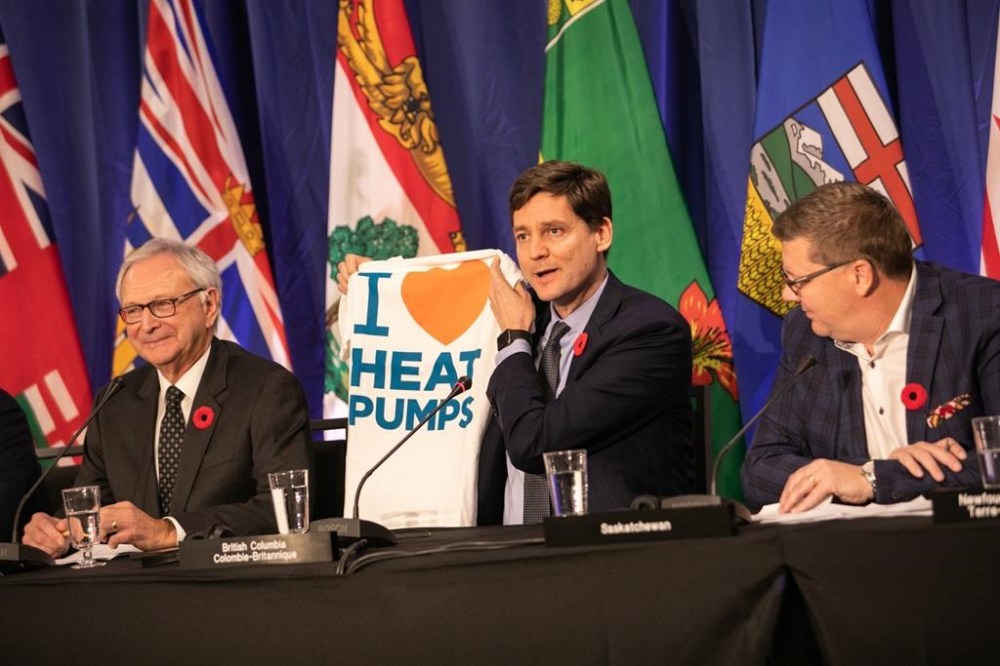
David Eby, Premier of British Columbia, speaks during a press conference at the meeting of the Council of the Federation, where Canada's provincial and territorial leaders meet, in Halifax, Monday, Nov. 6, 2023. THE CANADIAN PRESS/Kelly Clark

Furey says his province is focused on exporting to Europe and the United States while Asia would be the obvious export market for British Columbia.

Eby says B.C. can learn about Newfoundland’s process of using Crown land for projects, and his province can share its knowledge around fuel cells and other technology.

He says the federal government appreciates when provinces collaborate on best practices so there is co-ordination across the country and improvements can happen faster and more efficiently.

More than half of Canada’s hydrogen and fuel-cell companies are in B.C.

A joint statement says the agreement means the two provinces will share information and work with Ottawa to make sure new tools and investments “reduce risks associated with clean-growth initiatives and strengthen the global competitiveness of the clean-hydrogen sector.”

“Newfoundland and Labrador is perfectly positioned at this time of transition, with world-class wind resources, available Crown land, fresh water and deep sea ports that are free of ice,” Furey said in the statement.

“Like our friends in British Columbia, we recognize the impacts of climate change and look forward to continuing our conversations on moving forward in green-energy development.”

This report by The Canadian Press was first published Nov. 7, 2023

Report Error Submit a Tip

More Stories

Klein has burned bridges with PM, Gillingham says

Joyanne Pursaga 3 minute read Preview

Klein has burned bridges with PM, Gillingham says

Joyanne Pursaga 3 minute read Friday, Sep. 18, 2026

One mayoral candidate accused another of writing a column so critical it could compromise his ability to work with the federal government.

Read
Friday, Sep. 18, 2026

Family account spiced with magic realism, geopolitical intrigue and a ghost story

Reviewed by Zilla Jones 4 minute read Preview

Family account spiced with magic realism, geopolitical intrigue and a ghost story

Reviewed by Zilla Jones 4 minute read Yesterday at 2:01 AM CDT

Tom Lin’s second novel Babylon, South Dakota moves beyond a historical account of an immigrant family’s struggle, delightfully blending and bending genres.

Lin is a Chinese-born novelist whose family emigrated to the U.S. when he was four years old. His debut novel, The Thousand Crimes of Ming Tsu, won the 2022 Andrew Carnegie Medal for Excellence in Fiction, making him the youngest ever recipient of that award. He earned a PhD in English from the University of California Davis and is currently an assistant professor of English and creative writing at the University of Iowa.

Babylon, South Dakota takes place in an unspecified time period that can be understood to be during the Mao era — likely the 1950s or ’60s. A young Chinese couple, the Hsuis, immigrate to the rural community that gives the book its title. They take the names Saul and Mei and settle on a 160-acre homestead left to them by a distant relative.

Saul’s dream is to breed and sell chrysanthemums from seeds he brought from China, while Mei wants to raise livestock. They speak no English, know nothing of life in the United States, are unprepared for the harshness of winter and the isolation of the farm and bring nothing with them except some gold, which Mei hides around the house for emergencies. Their only link to the outside world is a discarded and marginally functioning TV set, which Saul rescues and rigs up.

Read
Yesterday at 2:01 AM CDT

Cabernet Sauvignon star of wine festival

Ben Sigurdson 5 minute read Preview

Cabernet Sauvignon star of wine festival

Ben Sigurdson 5 minute read Yesterday at 3:00 AM CDT

The Winnipeg Wine Festival will celebrate the king of red wine grapes next weekend — the theme of this year’s festival, which takes place Sept. 25 and 26 at the RBC Convention Centre, is Cabernet Sauvignon.

Cab Sauv, as it’s also known, is the world’s most widely planted wine grape of any colour, first coming to prominence in the 1800s in France’s Bordeaux region, where the grape is still popular. Rather than single-variety wines, Bordeaux reds tend to be blends, with those coming from the left bank of the Gironde estuary being Cabernet-dominant, while right-bank wines are Merlot-dominant, with Cabernet Sauvignon playing a supporting role. Cabernet and Merlot work well together and many other countries have followed suit in blending the two.

A team at University of California Davis put Cabernet Sauvignon through a DNA test in 1996 and discovered its parent grapes are Cabernet Franc and Sauvignon Blanc — it’s likely that at some point the two varieties, planted next to each other in some vineyard, crossed and mutated and became the grape we know today. (Someone growing grapes in the 19th century must have had an inkling of what was up, as the grape has been called Cabernet Sauvignon since long before the DNA test.)

Flavour-wise, most Cabernet Sauvignon wines are big and bold, with a core of deep dark berry flavours, some graphite and spice notes and relatively bright acidity. It’s a grape that is well-suited to barrel aging, with most examples seeing at least some time in wood.

Read
Yesterday at 3:00 AM CDT

Steinbach Credit Union member warns others after scammer steals $10K

Scott Billeck 5 minute read Preview

Steinbach Credit Union member warns others after scammer steals $10K

Scott Billeck 5 minute read Friday, Sep. 18, 2026

A Winnipeg single mother whose bank account was drained of nearly $10,000 says Steinbach Credit Union needs to warn its members about what she believes is a broader security problem.

The woman, who is not being named to protect her identity, said a scammer gained access to her account earlier this week after calling SCU’s contact centre, claiming to be her and successfully completing the credit union’s authentication process.

She said she knows of at least six others who have experienced similar incidents in which callers impersonate SCU account holders and pass the authentication checks.

The woman discovered something was wrong when her minor son asked why money had been transferred out of an account they jointly hold.

Read
Friday, Sep. 18, 2026

News briefs for Sunday, September 20, 2026

2 minute read Updated: 3:36 PM CDT

A collection of breaking news briefs filed on Sunday, September 20, 2026

Woman charged after Toronto Street shooting

3:18 PM

The Winnipeg Police Service Major Crimes Unit is continuing to investigate a shooting in the 600 block of Toronto Street that took place around 1 a.m. on Friday.

A quick look at where provinces and territories stand on time changes

The Canadian Press 2 minute read Preview

A quick look at where provinces and territories stand on time changes

The Canadian Press 2 minute read Friday, Sep. 18, 2026

WINNIPEG - Manitoba's government said Thursday the province will be sticking with daylight time year-round, making it the latest jurisdiction to move away from twice-annual time changes. Here's a look at where things stand across Canada:

British Columbia said in March that it was moving to permanent Pacific daylight time. The change also means that parts of northeastern B.C., which have been on mountain standard time year round, are now in alignment with the rest of the province.

Alberta also switched to permanent daylight time this year in what it calls Alberta time. The change means it now has the same time as Saskatchewan year round.

Saskatchewan has been on permanent central standard time since 1966.

Read
Friday, Sep. 18, 2026