Fund to compensate developing nations for climate change is unfinished business at COP28
Advertisement
Read this article for free:
or
Already have an account? Log in here »
To continue reading, please subscribe:
Digital Subscription
One year of digital access for only $1.44 a week*
- Enjoy unlimited reading on winnipegfreepress.com
- Read the E-Edition, our digital replica newspaper
- Access News Break, our award-winning app
- Play interactive puzzles
*Billed as $5.77 plus GST every four weeks. After 52 weeks, price increases to the regular rate of $19.95 plus GST every four weeks. Offer available to new and qualified returning subscribers only. Cancel any time.
To continue reading, please subscribe:
Add Free Press access to your Brandon Sun subscription for only an additional
$1 for the first 4 weeks*
- Enjoy unlimited reading on winnipegfreepress.com
- Read the E-Edition, our digital replica newspaper
- Access News Break, our award-winning app
- Play interactive puzzles
*Your next Brandon Sun subscription payment will increase by $1.00 and you will be charged $17.95 plus GST for four weeks. After four weeks, your payment will increase to $24.95 plus GST every four weeks.
Read unlimited articles for free today:
or
Already have an account? Log in here »
Hey there, time traveller!
This article was published 21/11/2023 (1070 days ago), so information in it may no longer be current.
NEW DELHI (AP) — Sunil Kumar watched helplessly in July as his home and 14 others were washed away by intense monsoon rains lashing the Indian Himalayas.
“All my life’s work vanished in an instant. Starting over feels impossible, especially with my three children relying on me,” said Kumar, a waste collector in the village of Bhiuli, in the mountainous state of Himachal Pradesh.
This year’s monsoon season in India was devastating, with local governments estimating 428 deaths and more than $1.42 billion in property damage in the region. But India was just one of many developing nations to suffer from extreme weather made worse or more likely by climate change, caused largely by greenhouse gas emissions that result from the burning of fossil fuels.
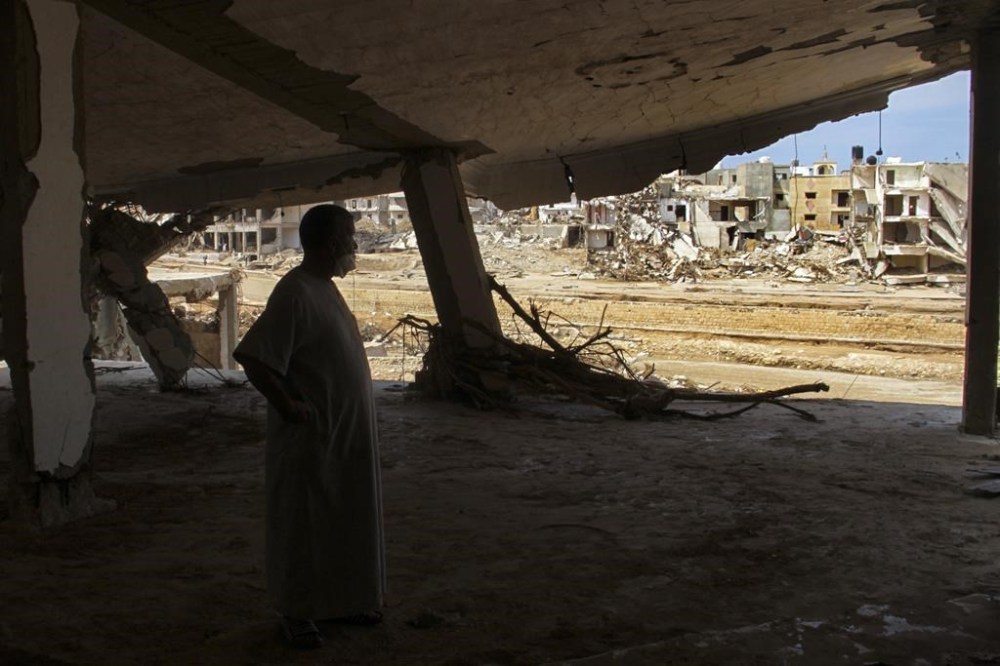
Tropical storm Daniel hammered Libya with massive flooding in September, and Cyclone Freddy battered several African nations early in the year. Activists say all three disasters show how poorer nations, which historically have contributed less to climate change because they have emitted fewer planet-warming gases than developed countries, are often hit hardest by the impacts of global warming.
____
EDITOR’S NOTE: This article is part of a series produced under the India Climate Journalism Program, a collaboration between The Associated Press, the Stanley Center for Peace and Security and the Press Trust of India.
___
Developing nations had long sought to address the problem, and finally broke through with an agreement at last year’s annual United Nations climate talks, known as COP27, to create what’s known as a loss and damage fund. But many details were left unresolved, and dozens of contentious meetings were held in the year since to negotiate things like who would contribute to it, how large it would be, who would administer it, and more.
A draft agreement was finally reached earlier this month, just a few weeks before this year’s COP28 talks open Nov. 30 in Dubai. The agreement will be up for final approval at the climate talks, and dissatisfaction from both wealthy and developing nations could block approval or require additional negotiations.
“For us, it’s a matter of justice,” said New Delhi-based Harjeet Singh, head of global political strategy at Climate Action Network International, a group that spent the past decade lobbying to compensate those nations. “Poor communities in developing countries are losing their farms, homes, and incomes due to a crisis caused by developed countries and corporations.”
A recent report by the United Nations estimates that up to $387 billion will be needed annually if developing countries are to adapt to climate-driven changes. Even if details of a loss and damage fund are worked out, some are skeptical that it will raise anything close to that amount. A Green Climate Fund that was first proposed at the 2009 climate talks in Copenhagen, and began raising money in 2014, hasn’t come close to its goal of $100 billion annually.
Chandra Bhushan, head of New Delhi-based climate think tank International Forum for Environment, Sustainability and Technology, said he doesn’t expect countries to contribute more than a few billion dollars to the loss and damage fund.
“Developing countries should be ready to manage these events independently, as seen with COVID-19. They can’t always rely on others,” Bhushan said.
The draft agreement calls for the World Bank to temporarily host the fund for the next four years. It lays out basic goals for the fund, including its planned launch in 2024, and specifies how it will be administered and who will oversee it, with a requirement that developing countries get a seat on the board.
The agreement asks developed countries to contribute to the fund but says other countries and private parties can, too. It says allocations will prioritize those most vulnerable to climate change, but any climate-affected community or country is eligible.
Developing nations were disappointed that the agreement didn’t specify a scale for the fund, and wasn’t more specific about who must contribute.
They also wanted a new and independent entity to host the fund, accepting the World Bank only reluctantly. They see the organization, whose president is typically appointed by the United States, as part of a global finance system that has often saddled them with crushing loans that make it more difficult to cope with the costs of climate change. They have long argued that there is a need for a larger, better coordinated pool of money that’s available without deepening debt crises.
“This arrangement won’t provide the new fund with true independence, will obstruct direct access to vulnerable communities, and will lack full accountability to governments and those most affected by climate change,” said RR Rashmi, a former climate negotiator with the Indian government who is now a distinguished fellow at New Delhi-based think-tank The Energy Resources Institute.
Meanwhile, wealthy nations sought to limit countries eligible for payments from the fund to the most vulnerable, like Afghanistan and Bangladesh in Asia, several African countries as well as island nations such as Kiribati, Samoa and Barbados. They also said all nations should contribute, particularly rapidly growing countries like China and Saudi Arabia.
“It’s important that the fund focuses on the poorest and most vulnerable. Those who have the strength and resources to contribute should do so,” said Dan Jørgensen, Denmark’s minister for global climate policy.
The U.S. State Department expressed disappointment that the draft agreement didn’t specifically describe donations as voluntary despite what it said was broad consensus among negotiators.
Brandon Wu is director of policy and campaigns at ActionAid USA, a nonprofit that pressed the U.S. to help reach a recommended agreement that could be taken to COP28. He said that unhappiness could still lead to discussions on the fund being re-opened in Dubai, but negotiators are under heavy pressure to deliver.
“Many believe this COP will be judged a success or failure based on whether or not it happens,” Wu said. “The UAE presidency has a huge interest in ensuring it does.”
Representatives from developing countries say it was critical to get the draft agreement in early November, and failure to approve it at COP28 would be the worst outcome.
Samoa’s U.N. ambassador, Fatumanava-o-Upolu III Pa’olelei Luteru, also chairs the Alliance of Small Island States. He said the world’s most industrialized nations have a “moral responsibility” to move as quickly as possible on loss and damage.
“We cannot continue with the path that we have taken over the last 30 years,” he said.
___
Saini is a reporter for Press Trust of India. Arasu is a reporter for The Associated Press.
___
Associated Press climate and environmental coverage receives support from several private foundations. See more about AP’s climate initiative here. The AP is solely responsible for all content.