Climate contradictions key at UN talks. Less future warming projected, yet there’s more current pain
Advertisement
Read this article for free:
or
Already have an account? Log in here »
To continue reading, please subscribe:

Digital Subscription
One year of digital access for only $205*
- Enjoy unlimited reading on winnipegfreepress.com
- Read the E-Edition, our digital replica newspaper
- Access News Break, our award-winning app
- Play interactive puzzles
*First annual payment billed as $205.00 + GST for one year. This annual subscription will automatically renew at $233.00 + GST every 52 weeks (10% off the regular annual price of $259.35). Offer available to new and qualified returning subscribers only. Cancel any time.
To continue reading, please subscribe:
Add Free Press access to your Brandon Sun subscription for only an additional
$1 for the first 4 weeks*
- Enjoy unlimited reading on winnipegfreepress.com
- Read the E-Edition, our digital replica newspaper
- Access News Break, our award-winning app
- Play interactive puzzles
*Your next Brandon Sun subscription payment will increase by $1.00 and you will be charged $17.95 plus GST for four weeks. After four weeks, your payment will increase to $24.95 plus GST every four weeks.
Read unlimited articles for free today:
or
Already have an account? Log in here »
Hey there, time traveller!
This article was published 28/11/2023 (1028 days ago), so information in it may no longer be current.
The world is heading for considerably less warming than projected a decade ago, but that good news is overwhelmed by much more pain from current climate change than scientists anticipated, experts said.
That’s just one of a set of seemingly contradictory conditions facing climate negotiators who this week gather in Dubai for marathon United Nations talks that include a first-ever assessment of how well the world is doing in its battle against global warming. It’s also a conference where one of the central topics will be whether fossil fuels should be phased out, but it will be run by the CEO of an oil company.
Key to the session is the first “global stocktake” on climate, when countries look at what’s happened since the 2015 Paris climate agreement, how off-track it is and probably say what’s needed to get back on track.
Even though emissions of heat-trapping gases are still rising every year, they’re rising more slowly than projected from 2000 to 2015. Before the Paris deal, scientists at Climate Action Tracker and the United Nations Environment Programme were projecting about 3.5 degrees Celsius (6.3 degrees Fahrenheit) of warming over pre-industrial levels based on how much carbon dioxide countries were spewing and what they planned to do about it.
That 3.5 “is totally out of the picture. It will not happen,” said NewClimate Institute scientist Niklas Hohne, who works on Climate Action Tracker. “Our number is 2.7 (4.9 degrees Fahrenheit). It could be even lower with pledges and with net zero targets.”
UNEP’s Emissions Gap projected 2.5 to 2.9 degrees (4.5 to 5.2 degrees Fahrenheit). The global goal is 1.5 degrees Celsius (2.7 degrees Fahrenheit).
Countries are promising and even starting on actions that should eventually reduce emissions, but those cuts haven’t materialized yet, said Climate Analytics CEO Bill Hare, also of Climate Action Tracker.
“So things aren’t as bad as they could have been or as we worried they might be 20 years ago, but they’re still far from where we need to be,” said Stanford University climate scientist Rob Jackson, who heads scientists who annual track world emissions in the Global Carbon Project.
When he looks at the impacts of just 1.1 degrees Celsius (2 degrees Fahrenheit) of warming — about what the world has gotten so far — World Resources Institute CEO Ani Dasgupta said he wants to scream from the rooftops about how “unfair and unequal the devastation is.”
“No one who has half a brain can be happy where we are,” Dasgupta said.
Scientists underestimated for decades how much destruction just a little warming would cause, several scientists said. And that damage we are feeling far outweighs the gains made in reducing future warming projections, they said.
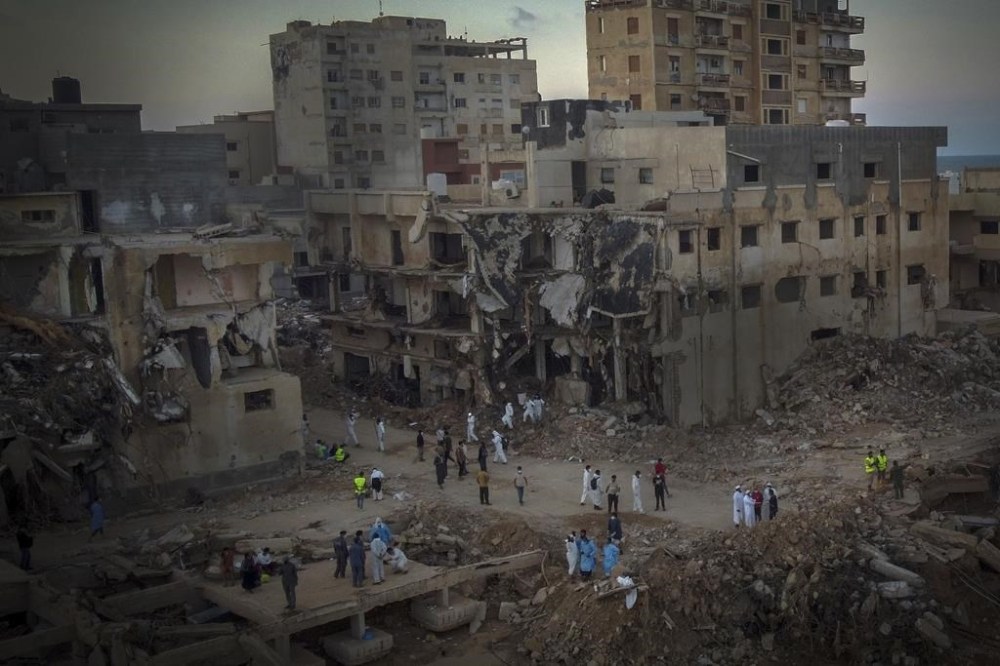
Hare points to more than 60,000 heat deaths in Europe in 2022. Others point to thousands dead from flooding in Pakistan and Libya.
“The more we know, the more severe impacts we see at lower temperature changes,” said Anne Olhoff, chief author of the UNEP Emissions Gap report. “The impacts happen much faster than we thought previously and much harder than we thought previously.”
The damage the world is seeing “is scarier to me than almost anything else,” Jackson said. “We are seeing the world’s weather start to unravel and there’s no evidence that that will stop.”
When it comes to emissions, the key is what’s causing them, experts say, citing fossil fuels.
“I think rightly the fundamental role of fossil fuels will take center stage” at the Dubai negotiations, called “COP” for conference of parties, said Melanie Robinson, climate director for World Resources Institute.
Heading into negotiations, world leaders have crowed about tentative agreements to triple the amount of renewable energy use and double energy efficiency. But that’s not enough, said Johan Rockstrom, director of the Potsdam Institute for Climate Research.
“It requires the tearing out the poisoned root of the climate crisis: fossil fuels,” said United Nations Secretary-General Antonio Guterres.
Guterres, numerous climate scientists and environmental activists all say what’s needed is a phase-out — or at the very least a phase-down — of coal, oil and gas.
But the host country runs the negotiations and appoints a president. The host country is the oil state United Arab Emirates and it has named ADNOC oil company CEO Sultan al-Jaber, who also runs a renewable energy company, as the conference president. Al-Jaber and his colleagues say by bringing fossil fuel companies to the table they can get more done and that it may take someone in the industry to get the concessions needed.
Environmental activists don’t believe it.
“We cannot trust these politicians and we cannot trust the processes of the COPs because the fossil fuel industries are tightening their grip around their processes and dictating their outcomes,” youth environmental activist Greta Thunberg said.
The process is in the hands of parties or nations and because of the COP rules it has to be by consensus or practically unanimous so that makes a phase-out of fossil fuels agreement unlikely, but a “phase-down of fossil fuels is inevitable,” said Adnan Amir, the UAE’s No.2 official for the climate talks.
“There are many different views on the fossil fuels language from many different parties and how exactly we will land it will be about how we get the right formulation,’’ said COP28 Director-General Majid Al Suwaidi. “I think the sentiment is all the same. The language here that we’re seeing between parties is really much closer than we’ve seen in the past.”
New Climate Institute’s Hohne said a phase-out is needed but doesn’t think Al Jaber will allow it: “He would basically have to agree that the basis of his business model of his company would be eliminated.”
Hohne, Hare, Dasgupta and others look at al-Jaber and others’ heavy promotion of carbon capture and storage — technology that the scientists say hasn’t proven itself — and they worry that the climate talks will look like something significant has been accomplished when it actually hasn’t.
“I think there’s a high risk that it (negotiations) ends up in greenwashing, in just looking nice but not leading to much,” Hohne said.
Activists and even United Nations officials also said they are disturbed by countries pointing to their efforts to reduce coal and increase renewable energy, as they also approve new oil and gas drilling projects, especially after Russia invaded Ukraine.
A report by the activist Center for Biological Diversity said that while new efforts by the Biden Administration in its Inflation Reduction Act would reduce nearly 1 billion metric tons of carbon emissions by 2030, 17 different oil and gas projects it has approved would add 1.6 billion metric tons of emissions.
“Governments can’t keep pledging to cut commitments to cut emissions under the Paris Agreement and then greenlighting huge fossil fuel projects,” UNEP Director Inger Andersen said. “This is throwing the global energy transition and humanity’s future into question.”
___
Read more of AP’s climate coverage at http://www.apnews.com/climate-and-environment.
___
Follow Seth Borenstein on X, formerly known as Twitter, at @borenbears
___
Associated Press climate and environmental coverage receives support from several private foundations. See more about AP’s climate initiative here. The AP is solely responsible for all content.