How to adapt to climate change may be secondary at COP28, but it’s key to saving lives, experts say
Advertisement
Read this article for free:
or
Already have an account? Log in here »
To continue reading, please subscribe:

Digital Subscription
One year of digital access for only $205*
- Enjoy unlimited reading on winnipegfreepress.com
- Read the E-Edition, our digital replica newspaper
- Access News Break, our award-winning app
- Play interactive puzzles
*First annual payment billed as $205.00 + GST for one year. This annual subscription will automatically renew at $233.00 + GST every 52 weeks (10% off the regular annual price of $259.35). Offer available to new and qualified returning subscribers only. Cancel any time.
To continue reading, please subscribe:
Add Free Press access to your Brandon Sun subscription for only an additional
$1 for the first 4 weeks*
- Enjoy unlimited reading on winnipegfreepress.com
- Read the E-Edition, our digital replica newspaper
- Access News Break, our award-winning app
- Play interactive puzzles
*Your next Brandon Sun subscription payment will increase by $1.00 and you will be charged $17.95 plus GST for four weeks. After four weeks, your payment will increase to $24.95 plus GST every four weeks.
Read unlimited articles for free today:
or
Already have an account? Log in here »
Hey there, time traveller!
This article was published 08/12/2023 (1031 days ago), so information in it may no longer be current.
DUBAI, United Arab Emirates (AP) — As United Nations climate talks enter their second week, negotiators who are largely focused on how to curb climate change have another thing on their plates: how to adapt to the warming that’s already here.
Discussions for what’s known as the Global Goal on Adaptation — a commitment made in the 2015 Paris Agreement to ramp up the world’s capacity to cope with climate-fueled extreme weather — are being overshadowed by negotiations on how the world is going to slash the use of fossil fuels, causing frustration among some climate campaigners in the most vulnerable countries.
Officials and activists from climate-vulnerable nations are pushing for more money to help them deal with scorching temperatures, punishing droughts and deluges and strengthening storms made worse by global warming. Major fossil fuel-emitting countries need to pay vulnerable, developing countries being battered by these events, experts and officials say, to help them avoid catastrophic humanitarian and economic losses.
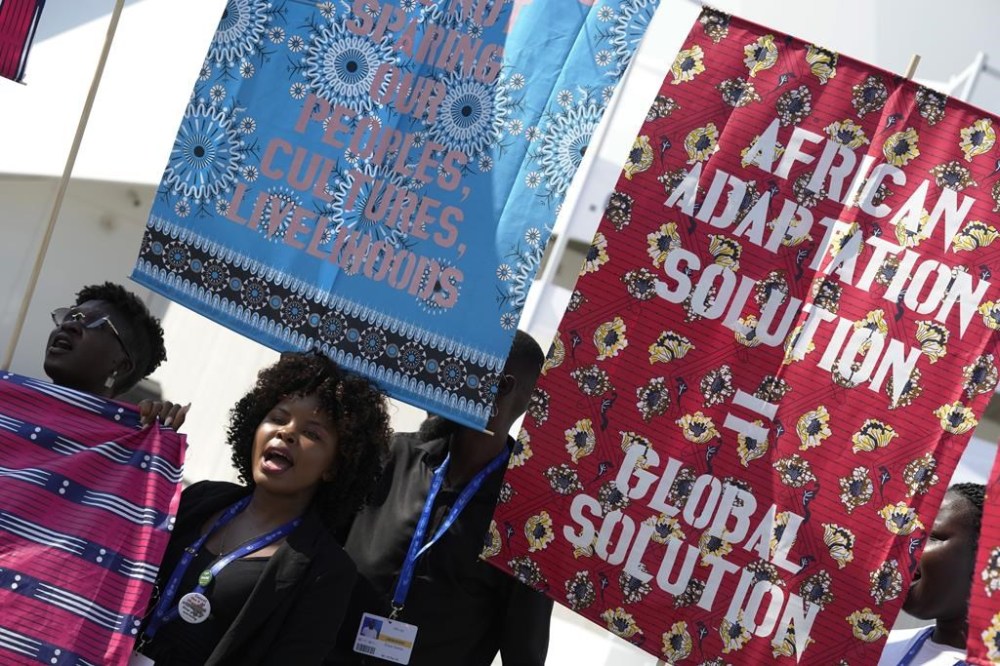
“The problem is the fact that adaptation is actually the second long long-term goal of the Paris agreement,” said South Africa-based Amy Giliam Thorp of climate think-tank Power Shift Africa. The first goal is a commitment to curb warming to 1.5 degrees Celsius (2.7 degrees Fahrenheit) since pre-industrial times.
Climate talks have already pledged millions to deal with the aftereffects of extreme weather events fueled by climate change as part of a loss and damage fund, and over a hundred nations promised to triple renewable energy production globally.
Adaptation hasn’t seen similar commitments at the talk so far. At a protest Friday calling for more money for adaptation, climate activist Evelyn Achan from Uganda said that “our countries, our communities are suffering so much.”
“We don’t have the money to adapt to the climate crisis and yet we do not cause the climate crisis, we are least responsible for the climate crisis. So, we’re demanding for leaders to put in place adaptation finance,” she said.
Observers say a goal for adaptation is likely to be decided at the summit, but as things stand, it’s set to be only a fraction of what some nations are calling for.
At plenary remarks on Wednesday, COP28 President Sultan al-Jaber said adaptation “is a key element of climate action” and urged countries to “consider how we can make real progress to address the adaptation finance gap” between what’s been promised and what’s needed.
But Ani Dasgupta, the CEO of the World Resources Institute said he’s “concerned” about what will happen to adaptation goals at COP28. “Not much is there,” he said. Dasgupta said he had expected some discussions on adaptation to be ongoing at this stage of climate talks.
“One would have expected to see some vision” with regards to adaptation, said Dasgupta. According to him, negotiators couldn’t agree to something on adaptation that they could give to the ministers. “That’s a worrying sign, so it goes with a blank slate.”
Dasgupta feels that as things stand there is a chance that fossil fuel phaseouts and adaptation goals might be used as a tradeoff on the high tables of global climate diplomacy. “Both of them are needed,” he said.
Mary Friel, Climate Policy lead at the International Federation of Red Cross and Red Crescent Societies said “not moving forward on adaptation would be a major failure.”
A U.N. report found that developing countries need nearly $400 billion per year to prepare for climate change but only $21 billion was given in 2021. The report also said that an additional $194 to $366 billion is needed with every passing year.
And the longer it takes to act on giving money adaptation, the higher the costs will be in future, Power Shift Africa’s Thorp said.
Negotiations on climate adaptation have been “incredibly frustrating” said Teresa Anderson, global lead of climate justice at Action Aid International, who’s in Dubai, United Arab Emirates for the climate talks. “The negotiations haven’t matched the urgency and pace and the type of ambitious commitments we need to see.”
The trouble is that adaptation money doesn’t give funders a return on investment, she said.
“Rich countries see mitigation action in their own interest. Wherever it happens in the world, it’s going to benefit everyone, even in the global north. Adaptation efforts and finance will only benefit people in the global south,” Anderson said. “The only reason they (rich countries) apparently want to give climate finance is if it’s going to help themselves.”
Rishikesh Ram Bhandary, who tracks climate finance at the Boston University Global Development Policy Center, added that the money that has been earmarked for adaptation is also not getting out the door fast enough.
It’s having real-life implications for people living on the frontlines of climate change.

Tiwonge Gondwe, a small-scale farmer who grows groundnuts, pumpkins, maize and other crops in Malawi, which is susceptible to droughts and food insecurity, said the land is becoming less fertile each year because of global warming.
“I have never received any funding from my government saying this is the mechanism to adapt to climate change,” she said. “We don’t have food, and it’s increasing hunger and poverty in my country. We need leaders to act now.” ___
Associated Press journalists Malak Harb and Seth Borenstein contributed. ___
Follow Sibi Arasu on X, formerly known as Twitter, @sibi123 ___
Associated Press climate and environmental coverage receives support from several private foundations. See more about AP’s climate initiative here. The AP is solely responsible for all content.