Invasive clover in Yukon can help clean mine water, even in the cold: researcher

Advertisement

Advertise with us

A pesky invasive plant found in many areas of Yukon could be put to use helping clean contaminated water from mines, research suggests.

Read this article for free:


or

Already have an account? Log in here »

To continue reading, please subscribe:

Subscribe and receive a limited-edition Free Press branded hat or tote.

Digital Subscription

One year of digital access for only $205*

  • Enjoy unlimited reading on winnipegfreepress.com
  • Read the E-Edition, our digital replica newspaper
  • Access News Break, our award-winning app
  • Play interactive puzzles

*First annual payment billed as $205.00 + GST for one year. This annual subscription will automatically renew at $233.00 + GST every 52 weeks (10% off the regular annual price of $259.35). Offer available to new and qualified returning subscribers only. Cancel any time.

To continue reading, please subscribe:

Add Free Press access to your Brandon Sun subscription for only an additional

$1 for the first 4 weeks*

  • Enjoy unlimited reading on winnipegfreepress.com
  • Read the E-Edition, our digital replica newspaper
  • Access News Break, our award-winning app
  • Play interactive puzzles
Start now

*Your next Brandon Sun subscription payment will increase by $1.00 and you will be charged $17.95 plus GST for four weeks. After four weeks, your payment will increase to $24.95 plus GST every four weeks.

Hey there, time traveller!
This article was published 05/01/2024 (1002 days ago), so information in it may no longer be current.

A pesky invasive plant found in many areas of Yukon could be put to use helping clean contaminated water from mines, research suggests.

But the closure of Minto Mine, 240 kilometres north of Whitehorse, last summer means researchers have been stalled in their efforts to test what they found in a real world environment.

Master’s degree student Taylor Belansky said a Sea-Can full of lab equipment for their pilot project remains on the site after the copper and gold mine was abandoned in May.
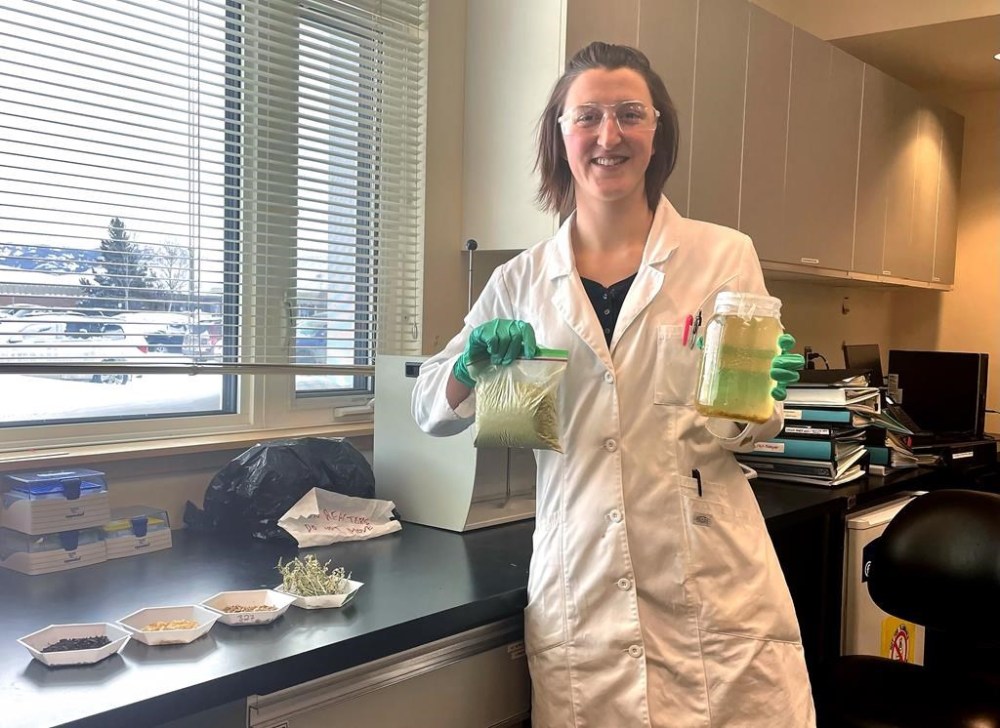
Master's student Taylor Belansky is shown in this handout image at the YukonU Research Centre Analytical Lab, part of the Ayamdigut (Whitehorse) Campus of Yukon University, in March 2023. Belansky's work found that an invasive species of clover combined with bacteria can be used to clean mine water. THE CANADIAN PRESS/HO-YukonU Research Centre-Avery Zammit **MANDATORY CREDIT**

Belansky’s work at Yukon University focused on bacteria that can remove nitrates from mine water by converting the contaminant into gas. But doing that most effectively depended on finding the right source of nutrients for the bacteria.

She said she tested food sources ranging from wood chips to waste from the local brewery but found that invasive white sweet clover helped to remove 99 per cent of nitrates from the water.

In practice, contaminated water would be pumped through long Plexiglas tubes containing both the bacteria and the clover. The water would flow at a rate allowing the bacteria enough time to consume the nitrates.

Belanskyfound this passive method of cleaning the water, using bacteria rather than filters or other forms of human management, was able to work in cold northern temperatures in a similar way to how it is already used in some southern projects.

“What we really had to do was make sure that we could use it and adapt the system to work in cold climates,” she said.

“So, we did that by changing the amount of food that we gave (the bacteria) and also changing … how much time it took the water to pass through the system so the bacteria could be in contact with the contaminated water and have time to remediate it.”

“Those are the two factors that we found we could manipulate to make sure that this treatment system worked in the cold.”

Nitrates and nitrogen naturally exist in the environment, but activities like blasting at mines can release more into the environment and throw off the balance of an ecosystem.

Belansky said too many nitrates can cause algae blooms, impacting the oxygen levels in water and suffocating fish, as well as potentially affect drinking water.

She said Minto workers would have no problem finding white sweet clover, which grows across much of the territory, including near the mine

The Yukon Invasive Species Council warns that the plant “readily invades open areas and forest clearings as well as on river banks,” pushing out other species and degrading natural grasslands.

“Mines are actually mandated to manage their invasive species on site. So, we would never want to be planting it intentionally, we wouldn’t want to be spreading it in a way that would allow it to continue its invasion of the natural ecosystem,” Belansky said.

“It’s more like harvesting it, taking it out of the places where it’s a problem, and kind of containing it in our treatment system.”

Belansky said the pilot project would examine how the bacteria responds in the fluctuating temperatures in nature, how often the clover needs to be added to the soil, and whether it works better after being composted.

“The rest of the research team is hoping to be able to access the Minto site in the coming years, hopefully next year, to set up that pilot project and test the system in those conditions,” she said.

The Yukon government controls entry to the site along with the Selkirk First Nation.

The Department of Energy Mines and Resources said in a statement that it appreciates the work researchers do to understand approaches to mine remediation.

“We plan to work with Yukon University and the Minto site operator to facilitate the continuation of this research,” the statement said.

“We will be speaking with the university soon to better understand how this research could be done without conflicting with reclamation works happening on the site.”

For now, Belansky said she’s working on finishing her Master’s thesis and waiting to get DNA tests back that will reveal exactly what type of bacteria is in Minto’s soil. She then hopes to publish her findings.

The mine was put up for sale by a court-appointed receiver in August.

This report by The Canadian Press was first published Jan. 4, 2024

Report Error Submit a Tip

More Stories

Letters, Oct. 3

7 minute read 2:01 AM CDT

A morning in the life …

My very first lesson does not start when I walk into that lecture hall, oh no — it starts long before. It begins when I walk to my car, check the estimated arrival time to the University of Manitoba and hope that Winnipeg traffic agrees with it.

A drive that appears completely manageable changes almost immediately when I’m greeted by a tsunami of orange pylons and a line of cars that appears to go on forever. Traffic moves by the inch, lanes magically disappear and the detour I took yesterday now has a detour of its own. These factors make me do a calculation that I have become all too familiar with. How late can I arrive and still find parking, run to my class across campus and get to class with enough time left to make it worth it?

I have grown used to people saying, “Why not just leave earlier?” I do. But when I’m already leaving for my 8:30 a.m. class at 7 a.m., there’s only so much I can do. This drive that some would think is relaxing is one that feels like an assignment that I didn’t know I had to complete and is due at 8:30 a.m.

Puzzles Palace

1 minute read Monday, Jul. 27, 2026

To solve our puzzles, please subscribe with this special offer: |

Sisters relieved hospital takes accountability after mother’s death

Scott Billeck 5 minute read Preview

Sisters relieved hospital takes accountability after mother’s death

Scott Billeck 5 minute read Thursday, Oct. 1, 2026

Eight months after losing their mother, two Winnipeg sisters say an internal hospital review has finally given them something they had been seeking since her death: accountability.

Chelsea Mann and Samantha Burns said St. Boniface Hospital officials acknowledged mistakes were made in the care of their mother, Judy Burns, during a recent meeting to discuss the findings of a critical incident review into her death.

The acknowledgement marked a significant departure from an earlier meeting with hospital officials, when they felt their concerns were largely dismissed.

Burns, 68, died on Jan. 21, three days after being admitted, after experiencing rectal bleeding.

Read
Thursday, Oct. 1, 2026

Mayoral candidate Vogiatzakis criticized for living outside Winnipeg

Malak Abas 4 minute read Preview

Mayoral candidate Vogiatzakis criticized for living outside Winnipeg

Malak Abas 4 minute read Updated: Yesterday at 6:03 PM CDT

A mayoral hopeful took heat from other candidates Friday for living outside Winnipeg while running in the civic election.

Mike Vogiatzakis’s primary residence is in the Rural Municipality of St. Andrews, about 25 kilometres north of Winnipeg — a community with its own mayor and councillors.

But the funeral director said he owns a home in Winnipeg where he divides his time, and he would move to the city full-time if elected mayor.

“It doesn’t matter where a person lives. Why are we dividing St. Andrews and Manitoba and Winnipeg? I’ve met the criteria to run for mayor,” Vogiatzakis said Friday morning.

Read
Updated: Yesterday at 6:03 PM CDT

Khan should’ve taken high road: Goertzen

Carol Sanders 5 minute read Preview

Khan should’ve taken high road: Goertzen

Carol Sanders 5 minute read Yesterday at 6:39 PM CDT

The veteran Progressive Conservative who championed Obby Khan’s leadership bid says the former Blue Bomber dropped the ball by dissing his Tory teammates before he stepped down.

“I wouldn’t recommend it, and I didn’t recommend it,” Kelvin Goertzen (Steinbach) said in an interview Friday.

Khan resigned as PC leader and quit the caucus Monday saying some members were secretly plotting his ouster, even after he won a confidence vote on Sept. 25.

On Tuesday, Khan lashed out in a CJOB interview, naming the alleged plotters, saying constituents deserved to know which of their elected representatives “lacked moral integrity.” Khan told the Free Press he was “deeply emotionally hurt,” and felt stabbed in the back.

Read
Yesterday at 6:39 PM CDT

Brandonmeat packer thriving on its own

Abiola Odutola 3 minute read Preview

Brandonmeat packer thriving on its own

Abiola Odutola 3 minute read 2:01 AM CDT

BRANDON — Canada Packers has strengthened its business and laid the foundation for future growth during its first year as an independent company, its president says.

The Brandon-based pork producer, separated from Maple Leaf Foods in October 2025, established its own leadership, strategy, systems, culture and identity while continuing operations across its hog production farms and regional hog barns in southern and eastern Manitoba.

The company’s first year was focused on building a successful standalone business while continuing to serve customers, communities and shareholders, president Dennis Organ said.

“Market conditions over the past year have been more challenging than we anticipated when we became a separate entity,” he said in an email. “Despite that, we continued to execute against our priorities, including increasing processing volumes, maintaining disciplined operations and strengthening the business.”

Read
2:01 AM CDT