More than 100 wildfires still not considered out after B.C.’s record wildfire season
Advertisement
Read this article for free:
or
Already have an account? Log in here »
To continue reading, please subscribe:

Digital Subscription
One year of digital access for only $205*
- Enjoy unlimited reading on winnipegfreepress.com
- Read the E-Edition, our digital replica newspaper
- Access News Break, our award-winning app
- Play interactive puzzles
*First annual payment billed as $205.00 + GST for one year. This annual subscription will automatically renew at $233.00 + GST every 52 weeks (10% off the regular annual price of $259.35). Offer available to new and qualified returning subscribers only. Cancel any time.
To continue reading, please subscribe:
Add Free Press access to your Brandon Sun subscription for only an additional
$1 for the first 4 weeks*
- Enjoy unlimited reading on winnipegfreepress.com
- Read the E-Edition, our digital replica newspaper
- Access News Break, our award-winning app
- Play interactive puzzles
*Your next Brandon Sun subscription payment will increase by $1.00 and you will be charged $17.95 plus GST for four weeks. After four weeks, your payment will increase to $24.95 plus GST every four weeks.
Read unlimited articles for free today:
or
Already have an account? Log in here »
Hey there, time traveller!
This article was published 16/01/2024 (999 days ago), so information in it may no longer be current.
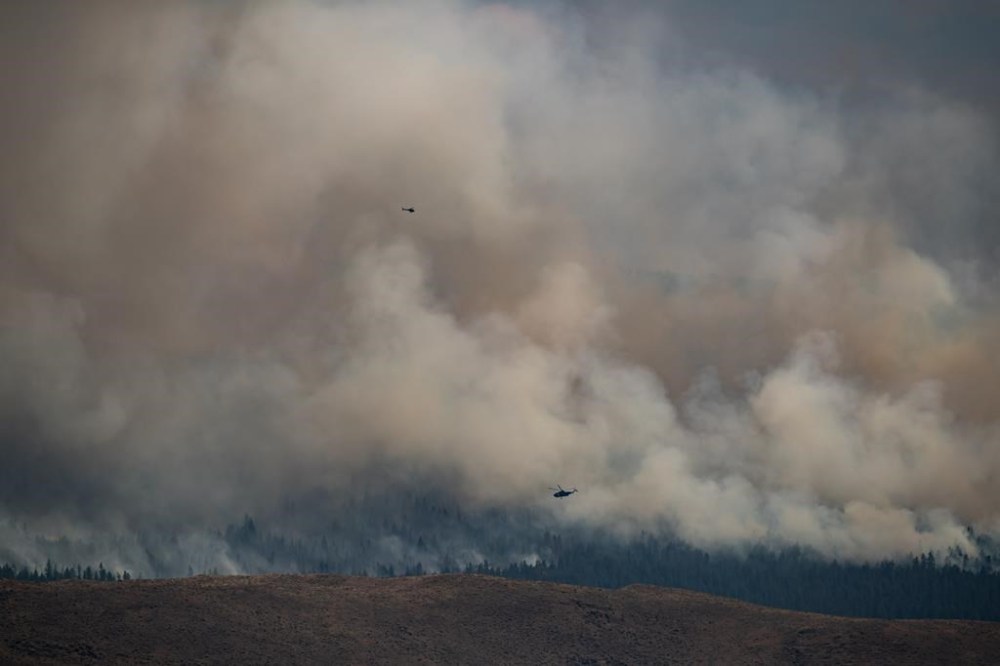
More than 100 wildfires are still listed as burning in British Columbia thanks to a combination of a busy wildfire season, extreme drought and generally warmer and drier conditions through December.
Forrest Tower of the BC Wildfire Service said that while it’s not uncommon for some fires to burn through the winter, that number usually hovers around a couple dozen, not the 106 that were listed as active on New Year’s Day.
“In the last 10 years, there were a couple of years where it was zero, but those were in years where we didn’t really have much of a fire season at all,” he said.
“Most times we’re going to have, I would say, 15 or less, that would be the kind of average, if we look at year-to-year on the first of January.”
The 2023 fire season burned more than 28,000 square kilometres of B.C., breaking records and forcing thousands to escape. Hundreds of homes were destroyed in the Okanagan and Shuswap regions.
Tower said July and August are typically B.C’s busiest months for firefighting, which gives crews enough time at the end of their contract to tackle the smaller fires that didn’t require immediate attention.
But the large number of more remote fires in 2023 meant that crews weren’t able to get eyes on every blaze by the last day of their extended contracts in November, he said.
About 80 per cent of the fires that are still considered active are in the hard-to-access northeast region of B.C., which is experiencing extreme drought.
The dry conditions mean the fires burn deep into the ground, particularly in the peat or bog-like conditions that exist in the northeast, Tower said. That makes them even more challenging to put out when firefighters are able to reach them.
“It’s not necessarily that they’re out-of-control and moving and growing. It’s just how deep some of these fires burned and the size of them. It takes a ton of manual labour to dig deep enough or to access some of these more remote fires,” Tower said.
“So, the work needed to extinguish them fully, that we can call them out, is quite (difficult) in some areas.”
Tower said some of the fires that are listed as active are small “spot” fires that may have gone out on their own, but the service has not been able to confirm that.
When there aren’t enough people to go around, the wildfire service relies on enough precipitation before it can confidently label a fire as out.
The rain and snow didn’t come.
The province’s final drought update for 2023, posted at the end of November, lists eight of B.C.’s 34 basins at the two highest levels of risk for adverse drought impacts.
The northeast corner of B.C., which includes the Fort Nelson and Peace regions, remains at the highest level of drought where adverse impacts are almost certain.
The B.C. River Forecast Centre said as of Jan. 1, the provincial snowpack was extremely low, averaging about 56 per cent of normal, with warmer temperatures and less precipitation between Oct. 1 and Dec. 31.
Active fires in winter rarely have visible smoke, Tower said. Instead, burning underground allows them to stay protected and smoulder for longer.
“There’s enough energy there, and enough available fuel, that it can retain that heat, potentially over winter or just longer than normal,” he said.
Some underground fires, often dubbed “zombie fires,” can flare up again in the spring if conditions are right.
Tower said that may be the case for parts of the massive Donnie Creek blaze in the northeast which grew to become B.C.’s largest-ever wildfire in June when it surpassed 5,300 square kilometres.
“If we continue to see really low or abnormally low snowpack and then a warm spring, I would say in some of those larger fires, it’s pretty possible that we would see (flare-ups) happening again,” he said.
Lori Daniels, a professor in the Department of Forest and Conservation Sciences at the University of British Columbia, said the province should be prepared for more years with 100 or more fires burning in January.
She said four of the last seven fire seasons have neared or surpassed one million hectares burned.
“That doesn’t mean that we’re still going to cross the million-hectare mark every year, but it means we are already into the pattern where it’s going to become more common rather than unusual,” she said.
Daniels said she and others who monitor fires are concerned about what the upcoming season might look like.
‘It was a hot, dry summer. We had drought preceding the 2023 fire season, we’re still in this drought scenario, and there’s little indication on the horizon that that’s going to change dramatically,” she said.
The wildfire service is still collecting data before it will make any predictions about what the 2024 wildfire season could look like, Tower said.
For now, he warns that the lower snow pack could make areas damaged by fire more accessible this winter and people need to watch for hazards, including falling trees.
“There were so many hectares burned last summer that there still is a high hazard in those areas.”
This report by The Canadian Press was first published Jan. 16, 2024.