Dandelions and shrubs to replace rubber, new grains and more: Are alternative crops realistic?
Advertisement
Read this article for free:
or
Already have an account? Log in here »
To continue reading, please subscribe:

Digital Subscription
One year of digital access for only $205*
- Enjoy unlimited reading on winnipegfreepress.com
- Read the E-Edition, our digital replica newspaper
- Access News Break, our award-winning app
- Play interactive puzzles
*First annual payment billed as $205.00 + GST for one year. This annual subscription will automatically renew at $233.00 + GST every 52 weeks (10% off the regular annual price of $259.35). Offer available to new and qualified returning subscribers only. Cancel any time.
To continue reading, please subscribe:
Add Free Press access to your Brandon Sun subscription for only an additional
$1 for the first 4 weeks*
- Enjoy unlimited reading on winnipegfreepress.com
- Read the E-Edition, our digital replica newspaper
- Access News Break, our award-winning app
- Play interactive puzzles
*Your next Brandon Sun subscription payment will increase by $1.00 and you will be charged $17.95 plus GST for four weeks. After four weeks, your payment will increase to $24.95 plus GST every four weeks.
Read unlimited articles for free today:
or
Already have an account? Log in here »
Hey there, time traveller!
This article was published 17/02/2024 (960 days ago), so information in it may no longer be current.
Katrina Cornish spends her days raising dandelions and desert shrubs. She harvests the stretchy rubber substances they produce and uses special machines to dip them into condoms, medical gloves and parts for trachea tubes. And she thinks those products could forever alter the landscape of agriculture in the United States.
Cornish, a professor at Ohio State University who studies rubber alternatives, isn’t the only one pouring energy into alternative crops like that desert shrub, guayule, or the rubber dandelions that bloom with yellow petals in the greenhouse where Cornish works. In Arizona, too, guayule thrives amidst drought, its blue-green leaves set apart from dry dirt at a research and development farm operated by the tire company Bridgestone. And in Nebraska and other parts of the central U.S., green grasses of sorghum spring up, waving with reddish clusters of grains.
They’re not the corn, soybeans, wheat or cotton that have dominated those areas for decades. Instead, they’re crops that many companies, philanthropic organizations and national and international entities tout as promising alternatives to fight climate change. But while some researchers and farmers are optimistic about the potential of these crops, many of which are more water-efficient and important in certain parts of the world to fight hunger, they also say drastic changes would need to happen in markets and processing before we ever see fields full of these out-of-the-box plants or many products in stores made with them, especially in the United States.
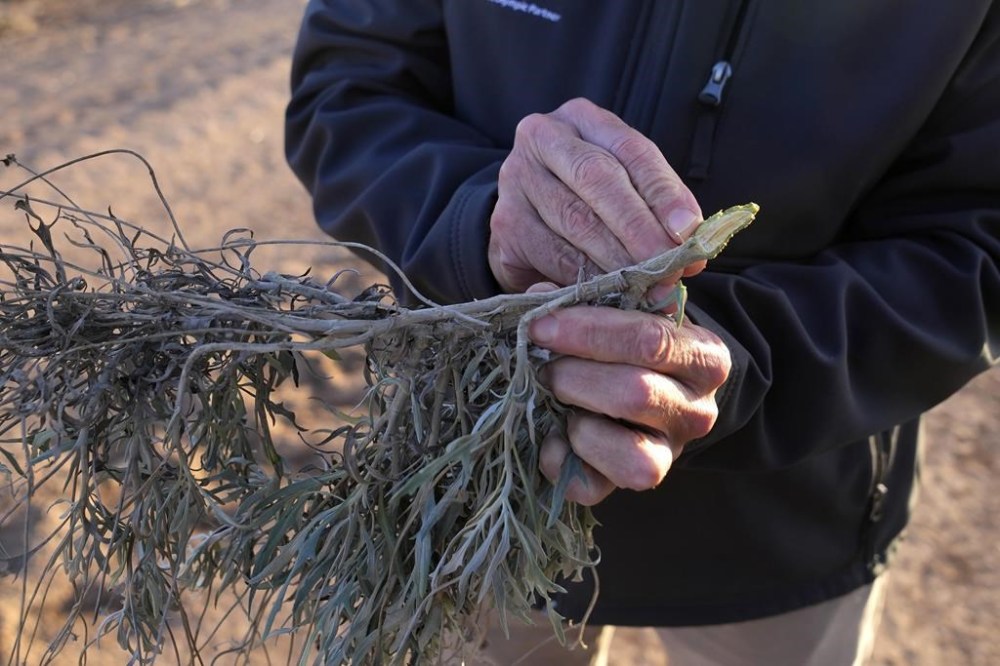
Most rubber processing happens overseas, and the U.S. isn’t prepared to process rubber domestically. But Cornish also says the threats of disease, climate change and international trade tensions also mean that it would be a smart investment to work on growing and processing domestic alternatives.
With sorghum, too, grown for people to eat as well as for farm animals or even pet food, processing would need to be scaled up, said Nate Blum, chief executive officer of Sorghum United, an international non-governmental organization focused on spreading awareness about sorghum. Though the U.S. is the world’s largest producer of sorghum, it still represents only a small fraction of acres grown compared to commodity crops like corn and soybeans. And though corn and soybeans are heavily incentivized in the U.S., Blum is hopeful that consumer demand will encourage more investment in the sorghum and millets industry.
However, farmers are more likely to plant whatever crops get subsidies, said James Gerber, a senior scientist with climate solutions nonprofit Project Drawdown. Gerber, who recently published a paper in Nature Food about which crops will continue to see yield growth and which may stagnate in the coming years, said comparing sorghum production in India and the U.S. illustrates this principle. India has invested heavily in improving sorghum yields there, but the U.S. has not, he said.
Still, Blum thinks there are real benefits to pursue with sorghum, and perhaps more urgent benefits in other parts of the world than in the U.S. On the heels of last year, when the U.N.’s Food and Agriculture Organization declared a focus on millets including sorghum, Blum thinks there’s still much more to be done. “The end of the international year is not the end. It’s actually just the beginning,” he said.
With climate change bearing down on agriculture around the world, the need for crops that can withstand extreme weather like persistent drought is especially important in parts of sub-Saharan Africa and South Asia where smallholder farmers rely on just a few acres of land. Some of the breeding programs for those crops are based in the U.S., but they are much less frequently included in the American diet or lifestyle.
That’s why specialty markets will be critical if these crops have any hope of taking off here, Cornish said. She thinks that, just as Tesla opened up the possibility of mainstream electric cars by first marketing the product as a luxury good, premium goods like condoms, trachea tube parts and radiation-rated surgical gloves need to be made with dandelion and guayule to inspire producers to grow more meaningful amounts of either of those crops.
“You can’t do it without going to that route because you have no economies of scale, and you do not have enough to go into markets that require a large amount,” Cornish said.
Guayule is “clearly a specialty crop and probably always will be” in terms of acres grown, said Bill Niaura, Bridgestone’s executive director of sustainable innovation. He said that Bridgestone’s work on guayule has been strictly in the research and development realm for about the last ten years, and only within the past two years or so has the company been transitioning it into an exploratory business. “You’re trying to develop a new industry for the Americas that currently doesn’t exist,” he said.
In the meantime, farmers in the U.S. rely on an agricultural economy built on scale, so they farm the crops that allow them options of where to sell, said Curt Covington, senior director of institutional business at AgAmerica Lending, a private investment manager and lender focused on agricultural land. He added that the bankers financing those farmers often don’t want to take the risk on a full switch to a crop that doesn’t have established markets. That, he said, could be a problem for the country as climate change exacerbates threats to crops like cotton and alfalfa, thirsty crops grown in the Southwest, in the future.
Farmers in Arizona have already had to fallow land, stopping their planting altogether and sometimes struggling with or giving up on family businesses as a result of Colorado River water cuts. Though guayule only uses half as much water as cotton and alfalfa, if the economics don’t support it, that doesn’t do the majority of farmers much good.
“Ultimately what you end up with is potential for, honestly, a lot of fallowed land, and that same crop being imported into this country from other countries,” Covington said. “And so to me that creates a security risk for this country.”

That’s something Cornish thinks can be prevented, she says, by reimagining the United States not as a land dominated by waves of grain, but also as a dominant producer of natural rubber.
“My job isn’t done until this is a permanent feature of the landscape,” she said.
___

Associated Press journalists Joshua A. Bickel in Wooster, Ohio, and Ross D. Franklin in Eloy, Arizona, contributed to this report.
___
Follow Melina Walling on X: @MelinaWalling.
___
The Associated Press’ climate and environmental coverage receives financial support from multiple private foundations. AP is solely responsible for all content. Find AP’s standards for working with philanthropies, a list of supporters and funded coverage areas at AP.org.