John Kerry reflects on time as top US climate negotiator and ‘major breakthrough’ in climate talks
Advertisement
Read this article for free:
or
Already have an account? Log in here »
To continue reading, please subscribe:

Digital Subscription
One year of digital access for only $205*
- Enjoy unlimited reading on winnipegfreepress.com
- Read the E-Edition, our digital replica newspaper
- Access News Break, our award-winning app
- Play interactive puzzles
*First annual payment billed as $205.00 + GST for one year. This annual subscription will automatically renew at $233.00 + GST every 52 weeks (10% off the regular annual price of $259.35). Offer available to new and qualified returning subscribers only. Cancel any time.
To continue reading, please subscribe:
Add Free Press access to your Brandon Sun subscription for only an additional
$1 for the first 4 weeks*
- Enjoy unlimited reading on winnipegfreepress.com
- Read the E-Edition, our digital replica newspaper
- Access News Break, our award-winning app
- Play interactive puzzles
*Your next Brandon Sun subscription payment will increase by $1.00 and you will be charged $17.95 plus GST for four weeks. After four weeks, your payment will increase to $24.95 plus GST every four weeks.
Read unlimited articles for free today:
or
Already have an account? Log in here »
Hey there, time traveller!
This article was published 04/03/2024 (949 days ago), so information in it may no longer be current.
WASHINGTON (AP) — Time was running out and U.S. Climate Envoy John Kerry knew it.
International climate talks in mid-December were stuck with no agreement to phase out oil, gas and coal, fossil fuels that are the root cause of global warming.
The United Nations sponsored conference official end date, a day after Kerry’s 80th birthday, was fast approaching. What’s more, Kerry’s Chinese counterpart, Xie Zhenhua, who helped craft past deals with him, announced that he was retiring. Opportunity could be slipping away at the summit known as COP28, being held in Dubai.

“It made me bear down and get to a lot more meetings, one-on-one and otherwise, and frankly dragooned a few other people into the effort to persuade and make the difference,” Kerry recalled during a recent interview with The Associated Press, given ahead of his retirement this week.
In the heat of negotiations, the energy minister of Saudi Arabia, an oil-rich nation that has long opposed diplomatic attempts to limit fossil fuels, agreed on language about “transitioning away” from the carbon-belching energy supplies.
“Don’t get excited yet,” Kerry recalled telling himself. He had seen victories slip away at the last moment before.
This time it didn’t.
Instead, the deal struck turned out to be what Kerry now calls the high point of the world’s 30-year effort to curb ever-worseningclimate change. All in just 48 hours.
“This was a major breakthrough,” Kerry said, one that made him ready to leave his climate diplomacy job after three years. In January, Kerry announced plans to step down and Wednesday will be his last in office.
Sitting in his U.S. State Department office with cavernous ceilings, wood paneled walls festooned with modern art and photographs, Kerry reflected on his years leading America’s efforts to combat climate change and detailed why he believed the Dubai agreement was so important.
In the landmark 2015 Paris Agreement, which Kerry, at the time secretary of state, signed with a granddaughter on his lap, nations were only required to enact plans they wrote up. That allowed countries like China to leave out major things, like the need to reduce emissions of methane, a powerful greenhouse gas.
“We now have an agreement globally that we have to transition away from fossil fuel, that we have to do it with urgency, immediately in this decade, beginning now, and that we have to do it by including all greenhouse gases,” said Kerry.
Still, not everyone is enamored with international climate efforts so far.
“Overblown,” said climate negotiations historian Joanna Depledge, referring to Kerry’s assessment of Dubai as the high point of climate diplomacy.
“Have you seen oil and gas prices shift in response to the adoption of the Dubai Consensus?” Depledge of the University of Cambridge in England said in an email. “No, nor have I. We are making incremental progress. That’s great. But a whole new track? No.”
Depledge said Kerry will be remembered as “a force for good in the negotiations,” turning the page on low points, such as previous U.S. administrations pulling out — twice — from international climate agreements.
Kerry said the second time the U.S. pulled out of an agreement, when former President Donald Trump removed America from the Paris accord soon after taking office in 2017, the country’s reputation was damaged, as were international efforts to fight climate change. But today Kerry said he assures leaders of other countries that even if a candidate like Trump, who is running for re-election, were to win, “no one person can reverse what the world is doing now.”
“Why? Because the marketplace writ large all around the world, presidents, prime ministers, monarchs, kings, leaders of countries have all decided they’re moving in this direction, some at a different pace. But they are moving,” Kerry said.
It’s “a vast change in the marketplace,” he added.
Despite stepping down as America’s top climate negotiator, Kerry won’t completely leave the climate scene. He plans to attend the next round of negotiations later this year in Baku, Azerbaijan, though White House senior adviser John Podesta will be leading the U.S. delegation.
Kerry said he hopes to shift from making deals to making them work.
Putting into action plans to reduce the use of fossil fuels and increase renewable energies is key and won’t be done so much by the public sector, where Kerry has spent nearly half a century, but instead by the private sector, he said.
The world needs to spend $2 trillion to $5 trillion a year combatting climate change in various ways. However, finding that amount of money won’t be easy.
“That’s one of the reasons why I am so focused on the private sector,” Kerry said. “The private sector does have — manages — trillions of dollars.”
That Kerry wants to stay connected to climate after stepping down isn’t surprising to those who have followed his career.
Rice University historian Douglas Brinkley, who wrote a 2004 biography of Kerry, said the environment isn’t just a job or politics for the former U.S. senator, whose conservation interest goes back to the first Earth Day in 1970: “This has become the kind of heart and soul of what he feels he was put on the planet to do.”
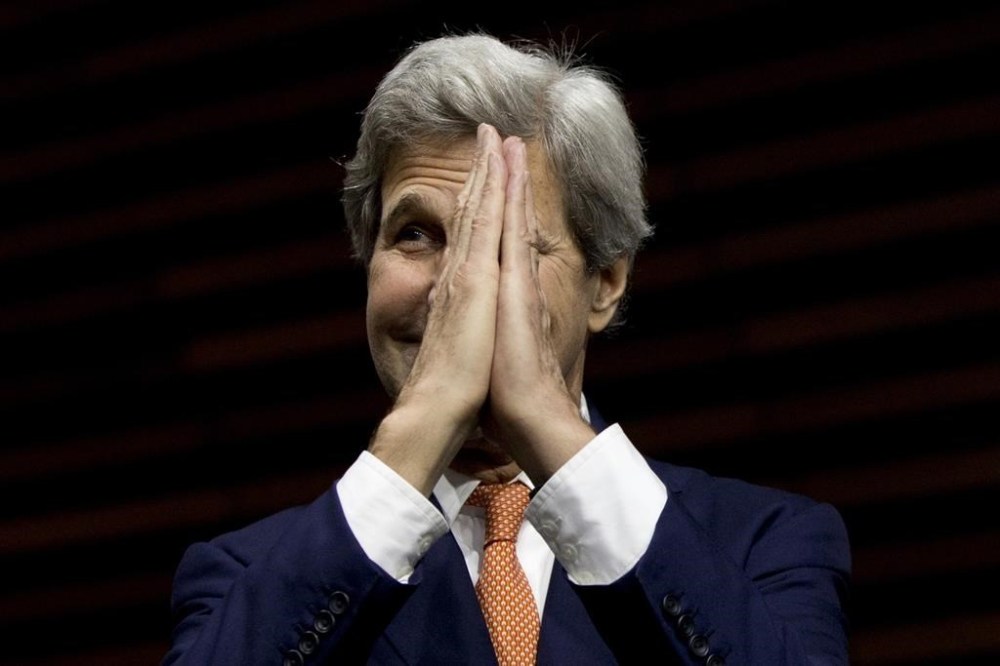
While Kerry will continue with climate developments in some capacity, he won’t be joined by Xie, raising questions about future deals, as the relationship between the two was key in accomplishing so much.
Former United Nations climate chief Christiana Figueres said the special relationship Kerry had with his Chinese counterpart was something the modern world hasn’t seen in decades. The closest analog was the Camp David accords in the 1970s that brought Israel and Egypt together, she said.
“What was very particular about their relationship was the high degree of trust,” Figueres told the AP. “As we know in geopolitics, especially in the relationship between the U.S. and China over the many years, trust is not a common factor.”
When China and the United States agree on a bilateral climate deal, as they did before the 2015 Paris accord and before Dubai’s agreement, other countries feel more obligated to join in, Kerry said.
After inaction during the Trump administration between 2017 and 2021, Kerry, then in his late 70s and having had prostate cancer, would fly to China during the COVID-19 pandemic.
“Men in moon suits met us,” Kerry recalled. “We were swabbed and separated and isolated, but we met and we worked on the climate issue and we were able to come to agreement.”
Kerry’s more than 40 years in the public eye, which included some agonizing lows, no doubt helped prepare him for the ups and downs of climate negotiations. After decades in the Senate, in 2004 Kerry lost the presidential election to incumbent George W. Bush.
“I simply determined to myself within a day that I wasn’t going to go down a self-pitying, crying-in-your-teacup path,” said Kerry, who has been characterized in the media as stiff. “I was going to go back to work and life goes on.”
Though he said climate is “as close as anything else to my heart,” Kerry ticked off non-climate accomplishments in his career, starting with his work as a prosecutor in Massachusetts and with YouthBuild, a program that trains young people and works on affordable housing in more than 200 communities. He also cited peace efforts in Vietnam, where his military service and protests first thrust him into public life, and El Salvador.
After so many accomplishments, in politics, diplomacy and climate, is he ready to truly retire?
“I know how to veg on a couch and watch the football games. You know, have a good time,” Kerry said with little emotion. “But that doesn’t last that long.”
Instead, he said he is much happier when doing something constructive.
“I think our minds and our souls were meant to be that,” he said.
___
Read more of AP’s climate coverage at http://www.apnews.com/climate-and-environment
___
Follow Seth Borenstein on X at @borenbears
___
The Associated Press’ climate and environmental coverage receives financial support from multiple private foundations. AP is solely responsible for all content. Find AP’s standards for working with philanthropies, a list of supporters and funded coverage areas at AP.org.