Federal disaster aid for Fraser Valley floods, landslides taking too long: B.C. MP

Advertisement

Advertise with us

OTTAWA - The federal government estimates it will need to pay almost $3.4 billion for its share of the disaster recovery bills for flooding and landslides that devastated British Columbia's Fraser Valley in November 2021.

Read this article for free:


or

Already have an account? Log in here »

To continue reading, please subscribe:

Subscribe and receive a limited-edition Free Press branded hat or tote.

Digital Subscription

One year of digital access for only $205*

  • Enjoy unlimited reading on winnipegfreepress.com
  • Read the E-Edition, our digital replica newspaper
  • Access News Break, our award-winning app
  • Play interactive puzzles

*First annual payment billed as $205.00 + GST for one year. This annual subscription will automatically renew at $233.00 + GST every 52 weeks (10% off the regular annual price of $259.35). Offer available to new and qualified returning subscribers only. Cancel any time.

To continue reading, please subscribe:

Add Free Press access to your Brandon Sun subscription for only an additional

$1 for the first 4 weeks*

  • Enjoy unlimited reading on winnipegfreepress.com
  • Read the E-Edition, our digital replica newspaper
  • Access News Break, our award-winning app
  • Play interactive puzzles
Start now

*Your next Brandon Sun subscription payment will increase by $1.00 and you will be charged $17.95 plus GST for four weeks. After four weeks, your payment will increase to $24.95 plus GST every four weeks.

Hey there, time traveller!
This article was published 12/03/2024 (936 days ago), so information in it may no longer be current.

OTTAWA – The federal government estimates it will need to pay almost $3.4 billion for its share of the disaster recovery bills for flooding and landslides that devastated British Columbia’s Fraser Valley in November 2021.

But more than two years after that disaster occurred, only about 40 per cent of that has been paid.

“Our communities need this funding now,” said Brad Vis, the Conservative MP for the sprawling, crescent-shaped riding of Mission—Matsqui—Fraser Canyon.
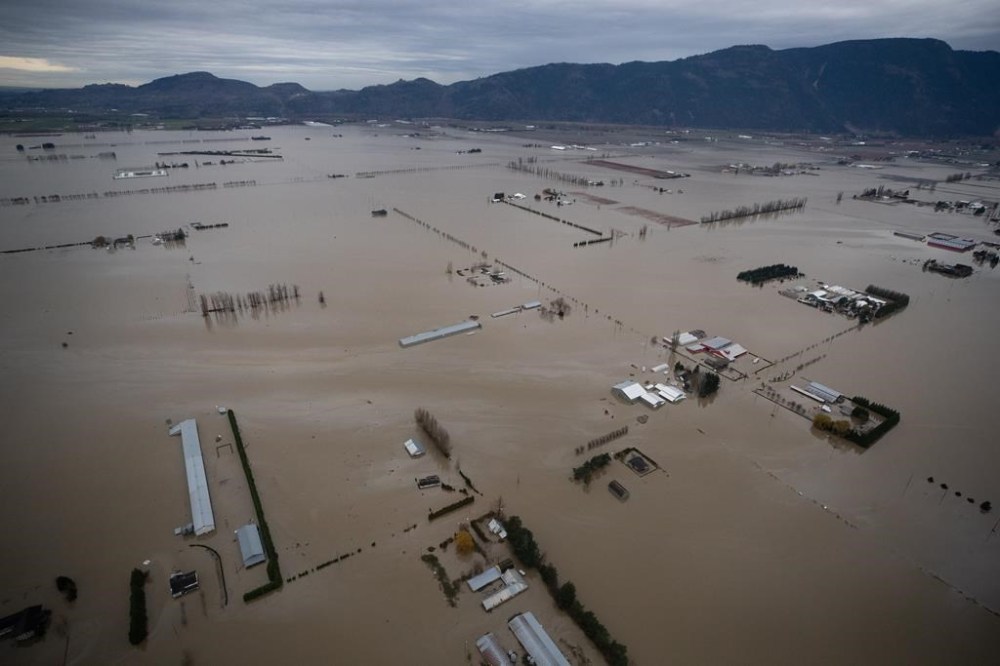
The federal government estimates it will need to pay almost $3.4 billion for its share of the disaster recovery bills for flooding and landslides that devastated British Columbia's Fraser Valley in November 2021. Flooded farmland is seen in an aerial view from a Canadian Forces reconnaissance flight in Abbotsford, B.C., Monday, Nov. 22, 2021. THE CANADIAN PRESS/Darryl Dyck

The need is massive, Vis said in an interview with The Canadian Press: from farmers looking to recover lost blueberry crops and rebuild devastated dairy farms, to homeowners whose houses were washed away, to local and provincial efforts to restore roads, bridges and culverts.

One year would be a “reasonable amount of time” for disaster money to flow, Vis said, allowing for engineering plans to be drafted and reviewed by both the local and federal governments.

Any longer and the area remains even more vulnerable to the next storm, he added. Indeed, less than a year would be ideal, “because we don’t know what’s going to happen the year after.”

Southern B.C. was hit by an atmospheric river — the kind of rainstorm that triggered the 2021 disaster — in both 2022 and 2023, and fresh downpours prompted another flood warning in January.

But some of the area’s infrastructure still hasn’t been fixed, Vis said.

In 2022, an advisory panel — tasked by Ottawa to guide a national plan to better prepare for the impact of climate change — also recommended a timeline of a year or less to ensure disaster-hit communities are promptly “made whole.”

But an analysis of data on the federal Disaster Financial Assistance Arrangements program, or DFAA, shows it takes on average seven years for all disaster aid to flow — and as long as 10 to 15 years in several cases.

The data was provided by the office of Emergency Preparedness Minister Harjit Sajjan. Later this year Sajjan is set to publish an updated DFAA program, following several years of consultation.

Among the changes expected in that overhaul are a focus on flowing money faster, as well as projects that don’t just restore previous infrastructure but make them more resilient to future disasters.

“We know that we need to do more and we are,” Sajjan told a security and defence conference last week in Ottawa.

The program was created in 1970 to better share the recovery costs for natural disasters between the federal government and provinces and territories.

The provinces or territories pay a deductible based on their population, and the federal government pays an increasing share of the bills the higher they go. On average, Ottawa funds about 82 per cent of the recovery costs following a disaster.

The program covers some costs for governments, private homeowners, farmers and businesses, and can include everything from evacuations and emergency medical and security needs to rebuilding and cleanup.

Between 1970 and 2023, 283 disasters have resulted in claims under DFAA. About half have been for flooding, and almost one-third for rainstorms or major storms such as hurricanes.

Wildfires account for less than 10 per cent of events since 1970, but are on the increase, accounting for almost one-fifth of all claims since 2010. Six wildfire claims were made in 2023, the worst fire season in Canada’s history.

Wildfires also cost more, averaging $67 million per claim compared with $29 million for flooding and $35 million for major storms.

Between 1970 and 2016, it took an average of seven years for claims to be fully paid. Six claims from before 2016 remain open, the oldest being a rainstorm and flooding in Saskatchewan in 2014.

Since 2017, 29 events resulted in claims and all but one remain open claims. Saskatchewan wildfires in 2017 are in the “final audit” stage.

Climate change has increased the frequency and severity of natural disasters in Canada, and the claims for disaster assistance are growing exponentially. One-third of the claims have been made in just the last 13 years, including 10 per cent just since 2020.

DFAA has paid out $8.5 billion to date, and 70 per cent of that is since 2010, a number that will rise because there are billions of dollars still owing for 35 claims since 2010.

For the major fires and storms in B.C. in 2021, Ottawa estimates its DFAA share will be $403 million and $3.4 billion respectively. To date $207 million has been paid for the fires and $1.4 billion for the November storms.

In a letter to Vis last month, Abbotsford Mayor Ross Siemens said he’s grateful for the support to date, but that the recovery bills are mounting. He said more than 300 city-owned sites were damaged in the November 2021 deluge.

“Despite making significant progress on these recovery projects, there is still a lot of important work that needs to be done to ensure our families, farmers, businesses and our provincial food system remains secure,” Siemens wrote.

Requests for funding, including interim payments, must come from the province and will be “processed immediately” including a review by federal auditors, a spokeswoman for Sajjan said in an emailed statement.

This report by The Canadian Press was first published March 12, 2024.
Report Error Submit a Tip

More Stories

Moving drama at MTYP gives voice to boy who changed law

Holly Harris 5 minute read Preview

Moving drama at MTYP gives voice to boy who changed law

Holly Harris 5 minute read Yesterday at 2:37 PM CDT

The heroic true tale of Norway House Cree Nation-born Jordan River Anderson came home Friday night, as Manitoba Theatre for Young People presented Yvette Nolan’s Jordan.

The touring production, a collaboration with Geordie Theatre, runs weekends through Oct. 11, with additional stops in Toronto, Vancouver and Ottawa’s National Arts Centre.

Having several of Anderson’s family members witness the local première underscored the evening with poignancy. Elder and Pine Creek First Nation member Barbara Nepinak added her own dignified presence and prayers following MTYP artistic director Pablo Felices-Luna’s welcoming remarks.

The season-opener also marks the Winnipeg-raised playwright’s homecoming; the Algonquin playwright, director, dramaturg, actor and educator was a fixture in our local theatre community for many years before going on to serve as artistic director for Native Earth Performing Arts from 2003 to ‘11, among other contributions.

Read
Yesterday at 2:37 PM CDT

A day on the campaign trail: Winnipeg's mayor, seeking a second term, does double duty

Malak Abas 12 minute read Preview

A day on the campaign trail: Winnipeg's mayor, seeking a second term, does double duty

Malak Abas 12 minute read Friday, Oct. 2, 2026

In the weeks leading up to the civic election, Scott Gillingham has been performing a juggling act: he’s running to be Winnipeg’s 45th mayor, while still serving as its 44th.

“If someone asks me about the campaign, I’m going to answer them. But I think for most people, I’m the mayor of Winnipeg, even if I’m showing up as a candidate,” Gillingham, 58, says. “I try to do all I can to maintain that distinction.”

The Free Press joined Gillingham on a recent rainy September Saturday on the campaign trail, where he served in both roles during an event-laden day. City council’s final meeting before the Oct. 28 election was days earlier.

In Winnipeg, it’s rare for an incumbent to be defeated. But Gillingham knows his win in 2022 wasn’t exactly a landslide — he won with 27.5 per cent of the vote — and he’s been thinking about his second term ever since.

Read
Friday, Oct. 2, 2026

Khan should’ve taken high road: Goertzen

Carol Sanders 5 minute read Preview

Khan should’ve taken high road: Goertzen

Carol Sanders 5 minute read Friday, Oct. 2, 2026

The veteran Progressive Conservative who championed Obby Khan’s leadership bid says the former Blue Bomber dropped the ball by dissing his Tory teammates before he stepped down.

“I wouldn’t recommend it, and I didn’t recommend it,” Kelvin Goertzen (Steinbach) said in an interview Friday.

Khan resigned as PC leader and quit the caucus Monday saying some members were secretly plotting his ouster, even after he won a confidence vote on Sept. 25.

On Tuesday, Khan lashed out in a CJOB interview, naming the alleged plotters, saying constituents deserved to know which of their elected representatives “lacked moral integrity.” Khan told the Free Press he was “deeply emotionally hurt,” and felt stabbed in the back.

Read
Friday, Oct. 2, 2026

Bombers get ‘whopped’ in Montreal

Taylor Allen 5 minute read Preview

Bombers get ‘whopped’ in Montreal

Taylor Allen 5 minute read Yesterday at 11:32 PM CDT

MONTREAL — It’s hard to fathom that the Winnipeg Blue Bombers smacked these Montreal Alouettes five weeks ago.

The team that pulled off that 44-28 upset at Princess Auto Stadium was nowhere to be found in La Belle Province on Saturday night.

You can, however, now find them in the basement of the West Division at 7-8 after getting completely outmatched and outclassed by the Als in a 37-10 beatdown.

“This was bad,” left tackle Stanley Bryant told the Free Press postgame. “They basically had their way all around. They whopped our ass.”

Read
Yesterday at 11:32 PM CDT

Province looks to seize notorious drug den

Erik Pindera 5 minute read Preview

Province looks to seize notorious drug den

Erik Pindera 5 minute read Yesterday at 12:00 PM CDT

Provincial justice officials are trying to seize a Dominion Street drug den that has been the source of trouble in the West End for years.

The owner of 982 Dominion St., 45-year-old Robert Edward Johnson, was most recently arrested in June along with several others after a lengthy Winnipeg Police investigation into thefts and illicit drug sales connected to the house.

“The residence has a reputation within the neighbourhood as being a location where individuals habitually attend for the purpose of purchasing and/or consuming controlled substances,” reads a statement of claim filed by the province’s director of civil forfeiture in the Court of King’s Bench last week.

“For several years, the residence has been associated with criminal activity, violence, and disorder, resulting in numerous police attendances and complaints from members of the surrounding community.”

Read
Yesterday at 12:00 PM CDT

Volunteer pop-up library axed from Manitoba Youth Centre

Matthew Frank 4 minute read Preview

Volunteer pop-up library axed from Manitoba Youth Centre

Matthew Frank 4 minute read Updated: Yesterday at 11:25 AM CDT

Manitoba Corrections has cancelled a pop-up library program at the Manitoba Youth Centre, leaving inmates without librarian services and fewer options to borrow certain books.

The Prison Libraries Committee, part of the non-profit Manitoba Library Association, operated and funded the volunteer program since 2024 before it was shut down by the province last month. The group previously partnered with the province to offer the service because the facility has no dedicated library of its own.

“It is concerning that community members who are incarcerated, especially youth, are losing out on meaningful programming, access to information and rehabilitation efforts, which are offered at no cost to (Manitoba) Corrections. We urge Manitoba Justice to promote more library services and programming, not less,” said a Sept. 24 letter from the non-profit addressed to the justice minister.

Ashley Huot, chair of the Prison Libraries Committee, said she was puzzled when she received an email last month from Manitoba Corrections stating that the pop-up library was no longer needed.

Read
Updated: Yesterday at 11:25 AM CDT