Germany launches bidding for carbon contracts to support climate-friendly industrial production
Advertisement
Read this article for free:
or
Already have an account? Log in here »
To continue reading, please subscribe:
Digital Subscription
One year of digital access for only $1.44 a week*
- Enjoy unlimited reading on winnipegfreepress.com
- Read the E-Edition, our digital replica newspaper
- Access News Break, our award-winning app
- Play interactive puzzles
*Billed as $5.77 plus GST every four weeks. After 52 weeks, price increases to the regular rate of $19.95 plus GST every four weeks. Offer available to new and qualified returning subscribers only. Cancel any time.
To continue reading, please subscribe:
Add Free Press access to your Brandon Sun subscription for only an additional
$1 for the first 4 weeks*
- Enjoy unlimited reading on winnipegfreepress.com
- Read the E-Edition, our digital replica newspaper
- Access News Break, our award-winning app
- Play interactive puzzles
*Your next Brandon Sun subscription payment will increase by $1.00 and you will be charged $17.95 plus GST for four weeks. After four weeks, your payment will increase to $24.95 plus GST every four weeks.
Read unlimited articles for free today:
or
Already have an account? Log in here »
Hey there, time traveller!
This article was published 12/03/2024 (951 days ago), so information in it may no longer be current.
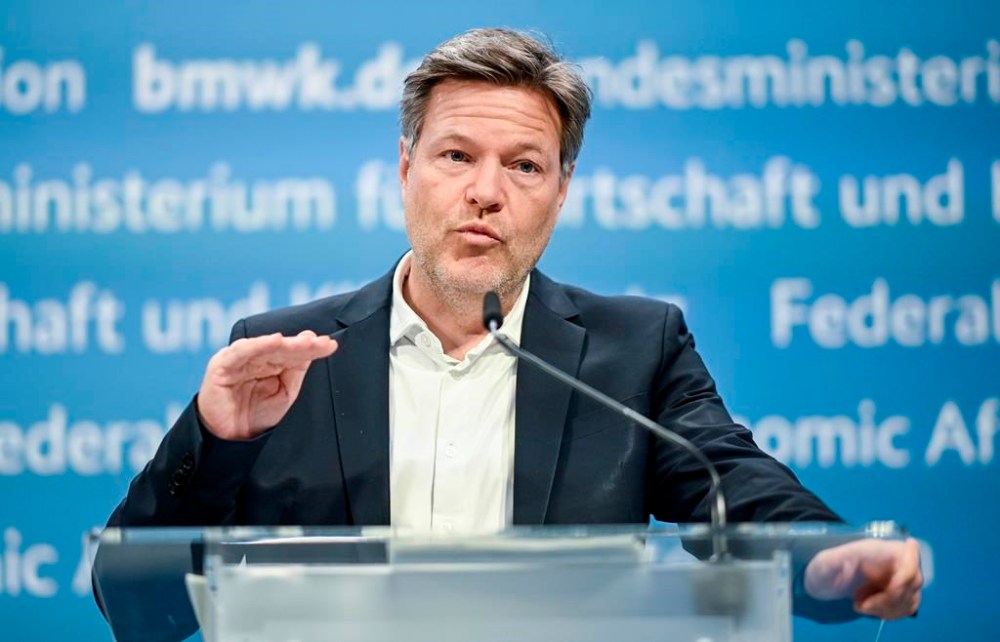
BERLIN (AP) — Germany’s vice chancellor on Tuesday launched a program initially worth up to 4 billion euros ($4.4 billion) to help heavy industry shift to more climate-friendly production over a 15-year period.
Germany, which is home to many energy-intensive industries as Europe’s biggest economy, aims to cut its greenhouse gas emissions to net zero by 2045. The government, which says industry accounts for about one-fifth of the country’s emissions, says Germany is the first in the European Union to launch the so-called “carbon contracts for difference.”
Companies in areas such as paper, glass, steel and chemical production have four months to bid for support under the contracts, which are supposed to compensate for the extra costs of climate-friendly production processes where they otherwise would not be competitive. Support will be capped at 1 billion euros per bidder in an effort to accommodate medium-sized companies.
The government says that switching to new production methods is essential but currently comes with high costs and risks that put companies off investing in them — for example, uncertainty over future hydrogen prices.
Vice Chancellor Robert Habeck, who is also Germany’s economy and climate minister, said the contract system compares with a cumbersome existing application process for support that can take three years to complete.
He said it is “super cost-efficient” because companies will be bidding to make carbon-neutral production as economically as possible.
“For the companies, there is the advantage of being able to plan and calculate with a fixed, green energy price over 15 years,” he added.
Bidding for the first round of support is limited to firms that went through a preparatory procedure last summer. Companies must state how many euros it will take them to avoid a ton of CO2 emissions with new technology.
Habeck’s Economy Ministry hopes that a second round of bidding for support totaling up to 19 billion euros will take place at the end of the year.
The Federation of German Industries welcomed the launch. It said that “extensive state support is necessary if the politically desired transformation to climate neutrality is to succeed in a short time.”
The head of Greenpeace Germany, Martin Kaiser, said that the new contracts could only help modernize industry if they support companies that emit no CO2 by using modern technology and clean energy.
But if “designed wrong, carbon contracts for difference stand completely in the way of this transition” by chaining the country to old, climate-damaging technology, he argued in a statement.
The group has criticized plans Habeck, a member of the environmentalist Green party, announced last month to enable underground carbon storage at offshore sites.