Activists watch for potential impact on environment as Key Bridge cleanup unfolds
Advertisement
Read this article for free:
or
Already have an account? Log in here »
To continue reading, please subscribe:

Digital Subscription
One year of digital access for only $205*
- Enjoy unlimited reading on winnipegfreepress.com
- Read the E-Edition, our digital replica newspaper
- Access News Break, our award-winning app
- Play interactive puzzles
*First annual payment billed as $205.00 + GST for one year. This annual subscription will automatically renew at $233.00 + GST every 52 weeks (10% off the regular annual price of $259.35). Offer available to new and qualified returning subscribers only. Cancel any time.
To continue reading, please subscribe:
Add Free Press access to your Brandon Sun subscription for only an additional
$1 for the first 4 weeks*
- Enjoy unlimited reading on winnipegfreepress.com
- Read the E-Edition, our digital replica newspaper
- Access News Break, our award-winning app
- Play interactive puzzles
*Your next Brandon Sun subscription payment will increase by $1.00 and you will be charged $17.95 plus GST for four weeks. After four weeks, your payment will increase to $24.95 plus GST every four weeks.
Read unlimited articles for free today:
or
Already have an account? Log in here »
Hey there, time traveller!
This article was published 28/03/2024 (915 days ago), so information in it may no longer be current.
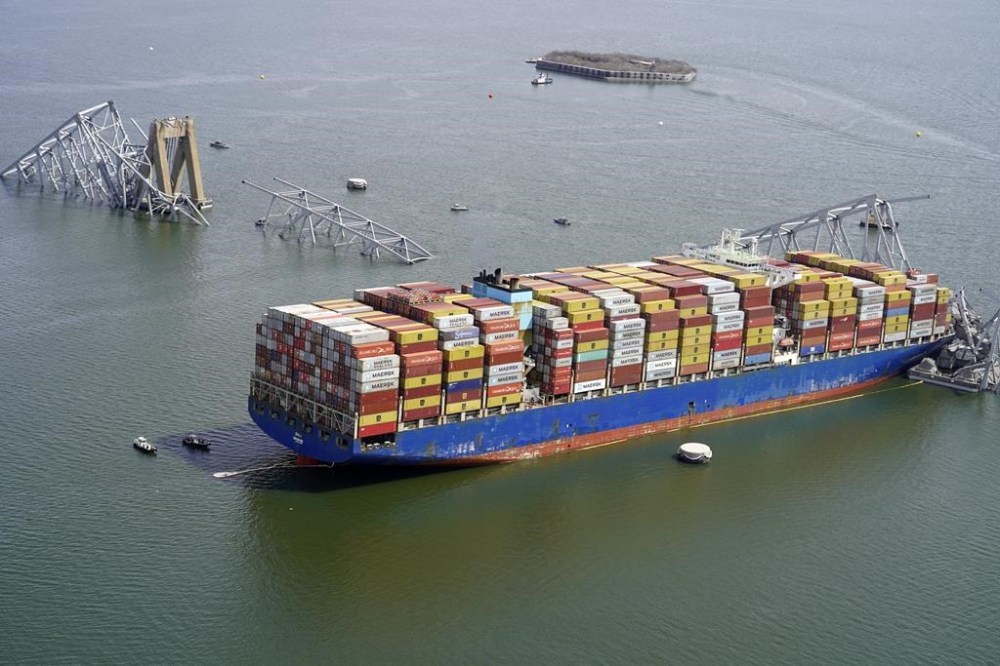
Authorities removing twisted wreckage from the collapse of the Francis Scott Key Bridge are deploying nearly a mile’s worth of barriers in the water, testing samples for contamination and monitoring the Patapsco River for oil and other hazardous spills as they confront the potential for environmental fallout.
The Unified Command, which includes state agencies and the Coast Guard, said Thursday they have unfurled 2,400 feet (732 meters) of an absorbent containment device, along with another 2,400 feet (732 meters) of barrier to try to prevent the spread of any hazardous materials.
It’s a scenario that environmental experts are watching closely for a number of reasons, including the river’s location in a metropolitan area that plays an important role in commercial shipping, as well as for marine life and migratory birds moving northward at this time of year.
“Any time you have something like this happen, there’s a risk of some sort of hazardous material getting in the water. And I think the question really is how much and to what extent,” said Gary Belan of American Rivers, a national nonprofit that focuses on issues affecting rivers across the country.
The possibility for a major environmental problem could arise from the bridge materials that fell into the river or from the containers aboard the cargo ship, the Dali, he said. But a big concern would be if the ship’s fuel container ruptured and spilled into the water.
“If that gets … into the river we’re talking about a pretty strong environmental catastrophe at that point, particularly going out into that part of the Chesapeake Bay,” Belan said.
First responders have observed a sheen in the water near the site, according to the Unified Command, which said Thursday there was “no immediate threat to the environment.”
The ship carried 56 containers with hazardous materials, and of those, 14 that carried perfumes, soaps and unspecified resin had been destroyed. It’s not clear if those materials had spilled into the water.

“We have been conducting air monitoring on the vessel and around the vessel with our contractor. No volatile organic compounds or flammable vapors were observed,” the Unified Command said in a statement posted online.
The Maryland Department of the Environment has begun sampling water up- and down-river and is on scene with first-responders to “mitigate any environmental” concerns, according to department spokesperson Jay Apperson.
Emily Ranson, the Chesapeake regional director for Clean Water Action, an environmental advocacy group, said it was too early to tell what the fallout could be. But she said the federal government should play a key role in enforcing regulations because of the interstate commerce at the port. The federal government has more tools than the state to enforce regulations, she said.
“The big thing to keep in mind is that it certainly reinforces the fact that we need to make sure that we have adequate protections and safety precautions with shipping with our port,” she said.
The crash happened in the early morning hours Tuesday, when the Dali, which had lost power, crashed into a pillar supporting the bridge, collapsing it moments later. The crash has closed off a major U.S. port and left six construction workers on the bridge presumed dead. Two people were rescued from the site.