

Vermont advances bill requiring fossil fuel companies pay for damage caused by climate change
Advertisement
Read this article for free:
or
Already have an account? Log in here »
To continue reading, please subscribe:
Monthly Digital Subscription
$0 for the first 4 weeks*
- Enjoy unlimited reading on winnipegfreepress.com
- Read the E-Edition, our digital replica newspaper
- Access News Break, our award-winning app
- Play interactive puzzles
*No charge for 4 weeks then price increases to the regular rate of $19.95 plus GST every four weeks. Offer available to new and qualified returning subscribers only. Cancel any time.
Monthly Digital Subscription
$4.99/week*
- Enjoy unlimited reading on winnipegfreepress.com
- Read the E-Edition, our digital replica newspaper
- Access News Break, our award-winning app
- Play interactive puzzles
*Billed as $19.95 plus GST every four weeks. Cancel any time.
To continue reading, please subscribe:
Add Free Press access to your Brandon Sun subscription for only an additional
$1 for the first 4 weeks*
*Your next subscription payment will increase by $1.00 and you will be charged $16.99 plus GST for four weeks. After four weeks, your payment will increase to $23.99 plus GST every four weeks.
Read unlimited articles for free today:
or
Already have an account? Log in here »
Hey there, time traveller!
This article was published 01/04/2024 (647 days ago), so information in it may no longer be current.
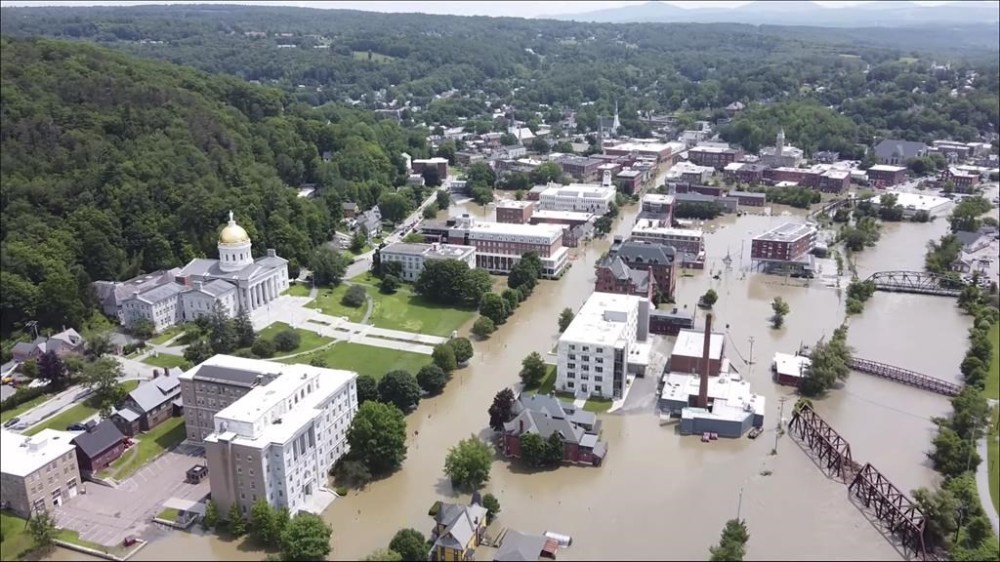
The Vermont Legislature is advancing legislation requiring big fossil fuel companies pay a share of the damage caused by climate change after the state suffered catastrophic summer flooding and damage from other extreme weather.
The state Senate is expected to give final approval this week to the proposal, which would create a program that fossil fuel companies would pay into for climate change adaption projects in Vermont. It will then be considered in the House.
“In order to remedy the problems created by washed out roads, downed electrical wires, damaged crops and repeated flooding, the largest fossil fuel entities that have contributed to climate change should also contribute to fixing the problem that they caused,” Sen. Nader Hashim, a Democrat from Windham County, said to Senate colleagues on Friday.
Maryland, Massachusetts and New York are considering similar measures, but Vermont’s bill is moving quicker through the Legislature.
Critics, including Republican Gov. Phil Scott, who is up against a veto-proof Democratic majority, warn that it could be a costly legal battle for the small state to go first.
“Of all the fossil fuel companies in the world, we’re a mosquito compared to a giant,” said Republican state Sen. Randy Brock on Friday after he voted against it. “We might win but the cost in doing so alone is huge.”
He referenced the fact that Exxonmobil’s annual sales are $344.6 billion, while Vermont’s annual budget is about $8.5 billion, saying he’d rather see New York or California or another state be first.
Under the legislation, the Vermont state treasurer, in consultation with the Agency of Natural Resources, would provide a report by Jan. 15, 2026, on the total cost to Vermonters and the state from the emission of greenhouse gases from Jan. 1, 1995, to Dec. 31, 2024.
The assessment would look at the affects on public health, natural resources, agriculture, economic development, housing and other areas.
It’s a polluter-pays model affecting companies engaged in the trade or business of extracting fossil fuel or refining crude oil attributable to more than 1 billion metric tons of greenhouse gas emissions during the time period. The funds could be used by the state for such things as upgrading stormwater drainage systems; upgrading roads, bridges and railroads; relocating, elevating or retrofitting sewage treatment plants and making energy efficient weatherization upgrades to public and private buildings.
Exxonmobil did not immediately provide a comment. The American Petroleum Institute sent a letter to the state Senate last week opposing the bill, saying it believes it’s bad public policy and may be unconstitutional.
The top lobbying group for the oil and gas industry said it’s extremely concerned the legislation “retroactively imposes costs and liability on prior activities that were legal, violates equal protection and due process rights by holding companies responsible for the actions of society at large; and is preempted by federal law,” the letter states. “Additionally, the bill does not provide potentially impacted parties with notice as to the magnitude of potential fees that can result from its passage.”
Jennifer Rushlow, dean of the Maverick Lloyd School for the Environment and a professor of law at the Vermont Law and Graduate School, said Monday that she thinks Vermont will face legal challenges if the bill becomes law but expects the state to win. Several environmental law clinics have offered to provide support, which could offset the costs, she said.
“Somebody has to go first. And I think the conditions for passage in Vermont are pretty optimal for depressing reasons … because the costs we’ve incurred recently as a result of climate change are very significant and really top of mind and visible,” she said.
House Speaker Jill Krowinski said in a statement on Monday that she looks forward to reviewing the bill and assessing its impact toward the state’s climate change goals. She said she’s eager for House committees to look at this and other climate change policies in the second half of the legislative session.
Hashim, the Democratic senator from Windham County, said the reality is that severe weather patterns are here and will happen more frequently and become more damaging over time. Adapting and becoming more resilient costs money and Vermont has few options to pay for the damage.
“We can place the burden on Vermont taxpayers or we can keep our fingers crossed that the federal government will help us or we can have fossil fuel companies pay their fair share,” he said.