West Coast whale population recovers 5 years after hundreds washed up ashore

Advertisement

Advertise with us

SEATTLE (AP) — Federal researchers indicate the gray whale population along the West Coast is showing signs of recovery five years after hundreds washed up dead on beaches from Alaska to Mexico.

Read this article for free:


or

Already have an account? Log in here »

To continue reading, please subscribe:

Subscribe and receive a limited-edition Free Press branded hat or tote.

Digital Subscription

One year of digital access for only $205*

  • Enjoy unlimited reading on winnipegfreepress.com
  • Read the E-Edition, our digital replica newspaper
  • Access News Break, our award-winning app
  • Play interactive puzzles

*First annual payment billed as $205.00 + GST for one year. This annual subscription will automatically renew at $233.00 + GST every 52 weeks (10% off the regular annual price of $259.35). Offer available to new and qualified returning subscribers only. Cancel any time.

To continue reading, please subscribe:

Add Free Press access to your Brandon Sun subscription for only an additional

$1 for the first 4 weeks*

  • Enjoy unlimited reading on winnipegfreepress.com
  • Read the E-Edition, our digital replica newspaper
  • Access News Break, our award-winning app
  • Play interactive puzzles
Start now

*Your next Brandon Sun subscription payment will increase by $1.00 and you will be charged $17.95 plus GST for four weeks. After four weeks, your payment will increase to $24.95 plus GST every four weeks.

Hey there, time traveller!
This article was published 01/04/2024 (910 days ago), so information in it may no longer be current.

SEATTLE (AP) — Federal researchers indicate the gray whale population along the West Coast is showing signs of recovery five years after hundreds washed up dead on beaches from Alaska to Mexico.

The increase in population numbers comes after the National Oceanic and Atmospheric Association determined in November that the “unusual mortality event” that began in 2019 has ended.

“It’s nice to be able to report some good news the last couple of years,” Aimee Lang, a research biologist with NOAA’s Southwest Fisheries Science Center, told The Seattle Times.
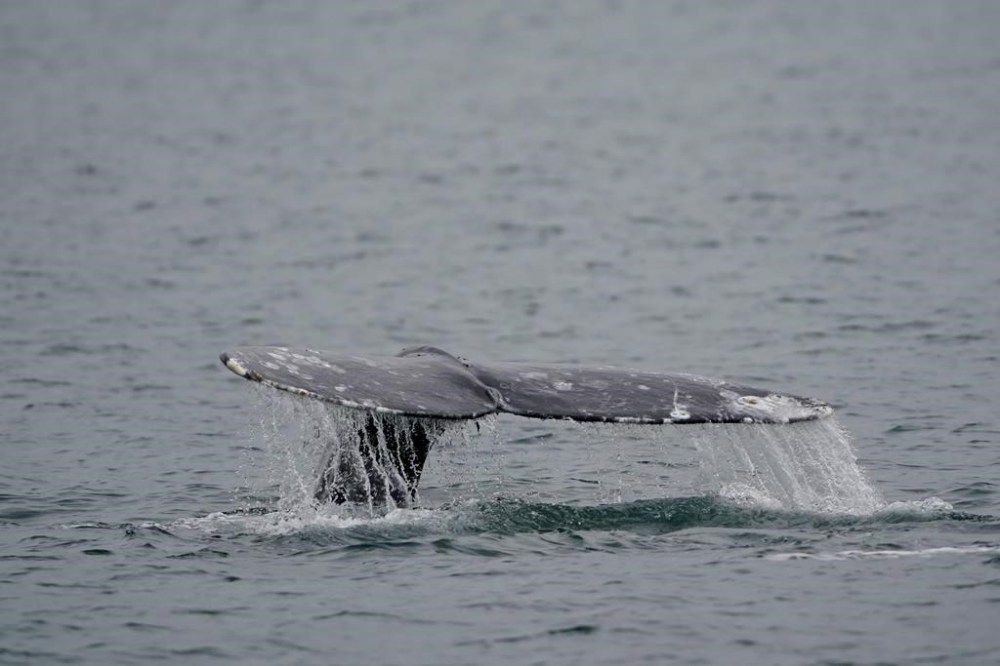
FILE - A gray whale dives near Whidbey Island as seen from a Pacific Whale Watch Association vessel, May 4, 2022, in Washington state. Federal researchers indicate the gray whale population along the West Coast is showing signs of recovery five years after hundreds washed up dead on West Coast beaches, from Alaska to Mexico. (AP Photo/Ted S. Warren, File)

The agency has estimated the total number of eastern north Pacific Gray whales to be between 17,400 to 21,300, an increase from an estimated 13,200 to 15,960 whales last year.

The population began to decline after numbering about 27,000 whales in 2016. The mortality event hits its peak between Dec. 17, 2018, and Dec. 31, 2020, the agency said. It involved 690 dead gray whales that washed ashore from Alaska to Mexico. Of those, 347 were in the U.S., 316 in Mexico and 27 in Canada.

In an average year, about 35 whales washed up dead in the U.S. Five years ago, those whales washed up on coastlines in California, Oregon, Washington state and Alaska.

Every year in late September, whales migrate 10,000 miles (16,093 km) from feeding grounds in the Arctic to birth their calves along Mexico’s Baja Peninsula.

NOAA researchers said the mortality event was due to ecosystem changes in the northern Bering and Chukchi seas off northern Alaska, which changed access to and quality of prey.

“These changes contributed to the poor nutritional condition observed in live whales in the wintering areas of Mexico and dead stranded gray whales in all three countries,” NOAA said. “This malnutrition led to increased mortality during the whales’ annual northward migration (from Mexico to Alaska) and decreased production of calves. This resulted in an overall decline in population abundance.”

The eastern North Pacific gray whales were removed from the endangered species list in 1994, after recovering from the whaling era.


Report Error Submit a Tip

More Stories

Museum warehouse holds the history of electrical power in Manitoba

Sheldon Birnie 8 minute read Preview

Museum warehouse holds the history of electrical power in Manitoba

Sheldon Birnie 8 minute read 6:00 AM CDT

The work it takes to bring any endeavour to light is rarely, if ever, seen by those who look upon the final result — be that a creative work such as a feature film or a museum display.

Since 2001, the Manitoba Electrical Museum and Education Centre, located at 680 Harrow St., has provided thousands of visitors with a century’s worth of history on electrical power in Manitoba.

“Everyone who comes in here is amazed at how much we can pack into such a small space,” says executive director Beryth Strong, who took on the role last November.

The museum is open to the public Tuesday to Saturday from 1 to 4 p.m. and hosts large groups of students throughout the school year. While the museum itself boasts numerous displays featuring approximately 220 electrical artifacts, including household appliances, computers, telephones, technical gear and much more, along with a collection of nearly 20,000 photos documenting major electrical construction projects, its warehouse just south of McGillivray Boulevard houses thousands more unique items.

Read
6:00 AM CDT

Province invests $3.8M in culinary arts training facility for francophone high school students

Kelly-Anne Riess 3 minute read Preview

Province invests $3.8M in culinary arts training facility for francophone high school students

Kelly-Anne Riess 3 minute read Yesterday at 12:10 PM CDT

A new dedicated culinary arts training facility will give francophone high school students a place to learn the trade in French.

Read
Yesterday at 12:10 PM CDT

Canada resorting to its tried and true playbook

Niigaan Sinclair 5 minute read Preview

Canada resorting to its tried and true playbook

Niigaan Sinclair 5 minute read 6:00 AM CDT

In 1846, Britain faced an emergency influenced by the Irish famine, so leaders repealed the country’s “Corn Laws” and restrictions on imported food and grain, transitioning to a system of free trade.

This created a crisis in the then Province of Canada, which had relied on British “preferential” status to prop up its agricultural and resource industries.

As a result, Canada looked south for new markets and eventually negotiated a free trade agreement with the United States.

This required land to be acquired and converted for industrial use quickly, so Canada quickly dispatched Commissioner William Robinson to negotiate with Indigenous communities along Lake Huron and Lake Superior for land.

Read
6:00 AM CDT

Signs of local neo-Nazi recruiting efforts spark concern

Conrad Sweatman 7 minute read Preview

Signs of local neo-Nazi recruiting efforts spark concern

Conrad Sweatman 7 minute read Saturday, Sep. 26, 2026

A far-right canvassing push in Manitoba this month is raising concerns among Winnipeg residents.

Stickers promoting Nationalist-13, a men’s-only neo-Nazi group also known as NS-13 based primarily in Hamilton, Ont., have appeared in Winnipeg and parts of southern Manitoba. The stickers bear national socialist branding and messages such as “White Man, Fight Back” and “White Community, Political Action, Training and Fitness.”

Winnipeg writer Jess Woolford recently encountered an NS-13 poster on Pembina Highway.

“It was appalling,” Woolford said. “It has the Nazi death heads covering people’s faces. It was pretty disturbing to come across this … I just didn’t expect to see it so blatantly displayed in my neighbourhood.”

Read
Saturday, Sep. 26, 2026

The wheels on the bus burned down, down, down…

Russell Wangersky 7 minute read Preview

The wheels on the bus burned down, down, down…

Russell Wangersky 7 minute read Saturday, Sep. 26, 2026

Up on the high ground, a year after the big forest fire in Newfoundland’s Conception Bay North, and the bare rock is startling.

It’s ghostly. The little birds flit and chirp from the naked silver bare-wood branches, and a solitary northern flicker makes its call from — somewhere. But mostly, it’s still, and silent. With the underbrush gone, you can see how little animal life is here right now.

But the most astounding thing is underfoot. On the high rock behind Adam’s Cove and away from the sea, not only are the trees and low brush gone, but much of the soil has burned away as well.

It burned very, very hot.

Read
Saturday, Sep. 26, 2026

Wab Kinew as ‘communicator in chief’

Paul G. Thomas 6 minute read Preview

Wab Kinew as ‘communicator in chief’

Paul G. Thomas 6 minute read 2:00 AM CDT

Premier Wab Kinew and his party have been riding high in the polls longer than normal for a government one year or less away from its first re-election contest. One reason is his ubiquitous, dominating communications presence as NDP leader and premier.

The argument here is that Kinew has supplemented his prerogatives as premier and party leader (such as appointing cabinet ministers and approving party nominations) with the skilful use of communications to advance his policy agenda, boost his personal popularity and maintain the competitive advantage of his party over the opposition Progressive Conservatives.

Communications has always been a significant part of politics and policy making. However, in the contemporary political and media environments, communications considerations have moved from the background to the foreground of decision-making by political parties, including when they are performing in the role of government. Campaigning and governing now overlap in what has been described as a permanent election campaign.

Political parties use communications strategies for several purposes: to establish an image of the leader which makes a positive emotional connection with voters; to promote a coherent message and to keep party members on message; and to gain favourable media coverage for its policies and other actions on almost a daily basis.

Read
2:00 AM CDT