Federal review of forestry sector emissions falling short, environmental groups warn
Advertisement
Read this article for free:
or
Already have an account? Log in here »
To continue reading, please subscribe:

Digital Subscription
One year of digital access for only $205*
- Enjoy unlimited reading on winnipegfreepress.com
- Read the E-Edition, our digital replica newspaper
- Access News Break, our award-winning app
- Play interactive puzzles
*First annual payment billed as $205.00 + GST for one year. This annual subscription will automatically renew at $233.00 + GST every 52 weeks (10% off the regular annual price of $259.35). Offer available to new and qualified returning subscribers only. Cancel any time.
To continue reading, please subscribe:
Add Free Press access to your Brandon Sun subscription for only an additional
$1 for the first 4 weeks*
- Enjoy unlimited reading on winnipegfreepress.com
- Read the E-Edition, our digital replica newspaper
- Access News Break, our award-winning app
- Play interactive puzzles
*Your next Brandon Sun subscription payment will increase by $1.00 and you will be charged $17.95 plus GST for four weeks. After four weeks, your payment will increase to $24.95 plus GST every four weeks.
Read unlimited articles for free today:
or
Already have an account? Log in here »
Hey there, time traveller!
This article was published 02/04/2024 (887 days ago), so information in it may no longer be current.
A federal review of Canada’s forestry sector emissions needs to go much further than currently proposed or it could jeopardize its credibility, nearly a dozen environmental groups said as they ramped up pressure over what they claim is the sector’s underreported carbon footprint.
In an open letter shared Tuesday, the groups say the federal government must broaden the review’s scope to consider how forestry emissions are estimated in the first place.
“The review’s failure to address Canada’s approach to estimating and reporting emissions calls into question its ability to deliver on its goals of ensuring ‘comparable, transparent and credible GHG accounting,'” reads the letter, signed by representatives from 11 groups, including Nature Canada and the David Suzuki Foundation.
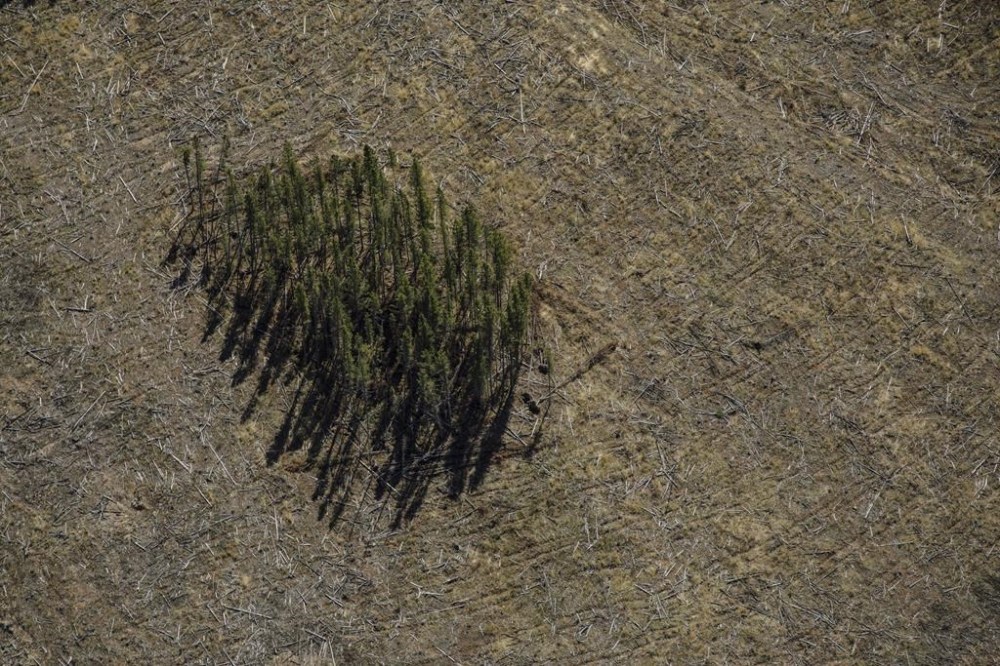
Nearly a dozen environmental groups are calling on the federal government to expand its review of Canada's forestry sector emissions, saying the current scope fails to address their concerns about underreporting. Logged areas within the Valory Resources Black Eagle Mining Corporation site west of Rocky Mountain House, Alta., Tuesday, June 1, 2021. THE CANADIAN PRESS/Amber Bracken
The letter adds to recent scrutiny over Canada’s oversight of the forestry sector. A peer-reviewed study published in January suggested Canada underestimates the sector’s emissions, crediting it as a small carbon sink when by the authors’ counts its emissions are broadly comparable with the electricity and agricultural sectors.
While the groups that authored the letter welcome the government’s ongoing review of how it accounts for forestry sector emissions, they say the review is incomplete if it doesn’t also address how they are estimated, said Michael Polanyi, a policy and campaign manager with Nature Canada.
“That’s what groups, scientists, the environment commissioner, and even the (United Nations) have raised concerns about, is that Canada is understating the greenhouse gas emissions from the logging sector,” he said in an interview.
The government initiated a review of how it accounts for forestry sector emissions after the European Union announced it would do away by 2026 with the same benchmark Ottawa uses, leaving Canada as one of the last developed countries to use the reference-level approach.
That approach is based on measuring progress in a given year against what emissions would have looked like if “business-as-usual” logging practices went unchanged. Any progress above the business-as-usual reference level is then reported as a contribution towards Canada’s climate targets.
The federal environment commissioner reported last year that benchmark assumes historical harvest rates would continue, presenting the forestry sector with an “artificial emissions reduction” without any mitigation action or policy changes. In the same report, the commissioner recommended Ottawa initiate an independent review to look at how it estimates and reports on emission related to logging.
Polanyi says with the federal accounting review still in its early stages, there’s time for the government to expand its scope to include how it estimates emissions.
“We hope they’ll do that,” he said.
Natural Resources Canada did not immediately respond to a request for comment.
In response to the commissioner’s report, the government agreed that independent review was important but noted that the science underlying its carbon reporting was peer-reviewed.
A study co-authored by researchers at three Canadian universities, however, appeared to complicate the sector’s claims to carbon neutrality.
By the authors’ count, Canada’s forestry sector contributed the equivalent of about 91 million tonnes of CO2 per year on average between 2005 and 2021, broadly comparable with the electricity and agriculture sectors. But the federal government credited the sector with absorbing the equivalent of 4.7 million tonnes CO2 per year on average, over the same period, the study found.
The discrepancy, the authors argued in the journal Frontiers in Forests and Global Change, largely comes down to a reporting mechanism they suggest makes Canada an outlier among most other industrialized nations. Canada does not charge the sector with any emissions released by disturbances, such as wildfires, but then credits it for the emissions absorbed by forests once they are old enough to be harvested, even if those trees naturally grew back after a wildfire.
Polanyi, the Nature Canada campaigner, says that discrepancy leads to “all sorts of distorted policy solutions,” because it portrays the sector as a carbon sink and a climate solution.
“It doesn’t make logical sense because there’s no human intervention. In terms of the regrowth of these trees, it’s totally natural. There’s no real justification for counting and crediting the logging sector with that,’ said Polanyi.
This report by The Canadian Press was first published April 2, 2024.