Austria likely to be largely ice-free within 45 years as glaciers recede quickly, experts say

Advertisement

Advertise with us

VIENNA (AP) — Austrian glaciers receded last year at a rapid pace and the Alpine country is likely to be largely ice-free in 40 to 45 years as the process continues, experts said Friday.

Read this article for free:


or

Already have an account? Log in here »

To continue reading, please subscribe:

Subscribe and receive a limited-edition Free Press branded hat or tote.

Digital Subscription

One year of digital access for only $205*

  • Enjoy unlimited reading on winnipegfreepress.com
  • Read the E-Edition, our digital replica newspaper
  • Access News Break, our award-winning app
  • Play interactive puzzles

*First annual payment billed as $205.00 + GST for one year. This annual subscription will automatically renew at $233.00 + GST every 52 weeks (10% off the regular annual price of $259.35). Offer available to new and qualified returning subscribers only. Cancel any time.

To continue reading, please subscribe:

Add Free Press access to your Brandon Sun subscription for only an additional

$1 for the first 4 weeks*

  • Enjoy unlimited reading on winnipegfreepress.com
  • Read the E-Edition, our digital replica newspaper
  • Access News Break, our award-winning app
  • Play interactive puzzles
Start now

*Your next Brandon Sun subscription payment will increase by $1.00 and you will be charged $17.95 plus GST for four weeks. After four weeks, your payment will increase to $24.95 plus GST every four weeks.

Hey there, time traveller!
This article was published 05/04/2024 (910 days ago), so information in it may no longer be current.

VIENNA (AP) — Austrian glaciers receded last year at a rapid pace and the Alpine country is likely to be largely ice-free in 40 to 45 years as the process continues, experts said Friday.

The Austrian Alpine Club said that, of the 93 glaciers its volunteers measured and observed, all but one receded in 2022-2023.

The 79 glaciers measured both last year and the previous year were an average 23.9 meters (78 feet) shorter than a year earlier, it said in an annual report. That was the third-highest figure of shrinkage in both the club’s 133 years of measurements and in the past seven years. The retreat of 14 other glaciers was observed less precisely, for example by comparing photos.
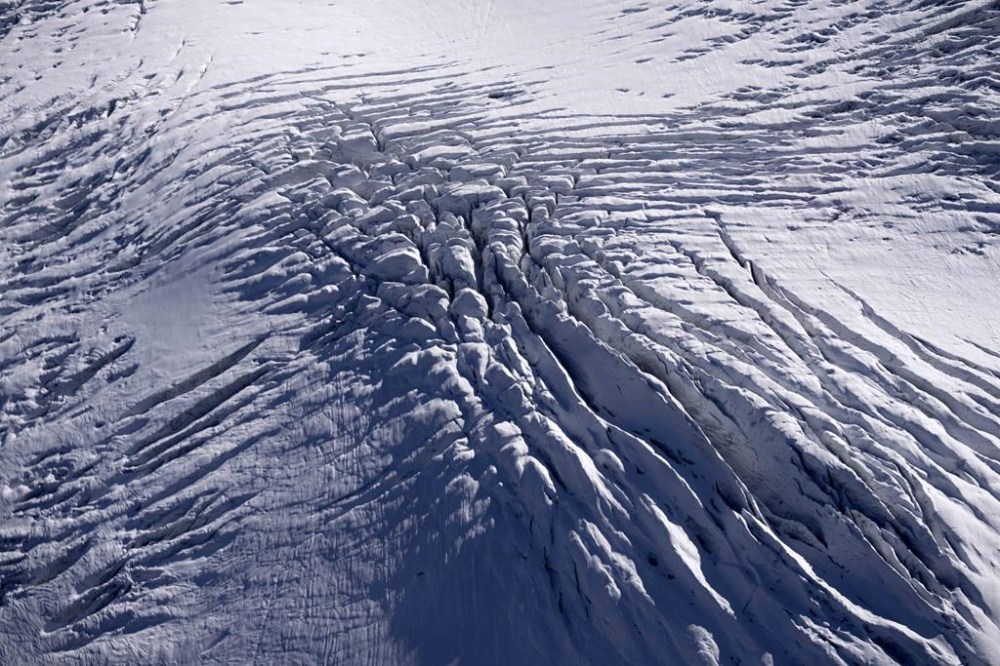
FILE - The Sulzenauferner Glacier is visible near Innsbruck, Austria, on Sept. 25, 2023. Austrian glaciers receded last year at a rapid pace, and the Alpine country is likely to be largely ice-free in 40 to 45 years as the process continues, experts said Friday April 5, 2024. (AP Photo/Matthias Schrader, File)

The biggest retreat was that of Austria’s biggest glacier — the Pasterze, in the Glockner mountain group in the southern province of Carinthia — which shrank by 203.5 meters (668 feet), a record for that glacier.

Gerhard Lieb, the co-leader of the club’s glacier measurement service, said Austria’s glaciers can no longer be saved and their disappearance in the coming decades is “unstoppable.”

The process of forming snow reserves at the upper ends of glaciers so that they can stabilize takes decades, “and the time is up,” he added. “That means nothing can be done anymore.”

“There might be some remnants in shadowed locations — maybe at the Glockner glacier on the north-east side, some areas in the Oetztal valley,” said the service’s other co-leader, Andreas Kellerer-Pirklbauer. “But de facto, in 40 to 45 years all of Austria will be pretty much ice-free.”

The experts, both of whom work at the University of Graz’s geography institute, said that the continued existence of Austria’s glaciers is down entirely to ice reserves from the past.

Kellerer-Pirklbauer said that “a late but very long and warm melting period in 2023” was the main culprit in the latest numbers.

Last year’s average figure for glacier retreat fell short of the record set in 2021-2022 of 28.7 meters (94.2 feet). But no glacier receded by more than 100 meters that year, and two did in the latest report: Alongside the Pasterze, Tyrol province’s Rettenbachferner glacier was 127 meters (416.7 feet) shorter. Only one glacier, the Baerenkopfkees in the Glockner group, was unchanged in length last year.

Glaciers are masses of ice that form as snow and ice compact over centuries and then flow slowly over land. Their melting is one of the most notable indications of human-caused climate change, with glaciers around the world rapidly retreating.

Experts in neighboring Switzerland said in September that that country saw 4% of its total glacier volume disappear in 2023, the second-biggest decline in a single year on top of a 6% drop in 2022.

Report Error Submit a Tip

More Stories

Port of Churchill signs agreement with Dutch port

Aaron Epp 2 minute read Preview

Port of Churchill signs agreement with Dutch port

Aaron Epp 2 minute read Tuesday, Sep. 29, 2026

Arctic Gateway Group, operator of the Port of Churchill, has signed an agreement with the Port of Rotterdam in the Netherlands to attract business and strengthen supply chains linking Western Canada and Europe.

The agreement enables the two ports to work together to develop new trade in critical minerals and energy products, connect Canadian producers with European buyers, and identify opportunities to improve the supply chain from Western Canadian resource projects through Churchill and into European markets.

The Port of Rotterdam is Europe’s largest port and home to more than 3,000 businesses across its industrial complex, serving as a major gateway for critical raw materials and energy.

Meanwhile, the Port of Churchill has been identified as a transformative national strategy for Canada and is emerging as a northern trade corridor connecting Western Canada’s resources to global markets.

Read
Tuesday, Sep. 29, 2026

Jets new backup Stevenson ‘stoked’ to be in tandem with Skinner

Mike McIntyre 6 minute read Preview

Jets new backup Stevenson ‘stoked’ to be in tandem with Skinner

Mike McIntyre 6 minute read Wednesday, Sep. 30, 2026

It didn’t take long to get the dirt on the newest member of the Winnipeg Jets.

Meet Clay Stevenson, who has no problem if you prefer to refer to him by his long-standing nickname of “Mud.”

“You know, Clay is in the mud, and there you go. That’s it, right there,” Stevenson said Wednesday with a laugh. “I got it in juniors when I was playing in Coquitlam, and kind of stuck ever since.”

Stevenson is now hoping to make a name for himself in a city that, quite fittingly, translates to “muddy water” in Cree. The 27-year-old from Alberta was placed on waivers by the Washington Capitals and claimed by the Jets, who were looking to clarify a goaltending situation which was as murky as the Red River.

Read
Wednesday, Sep. 30, 2026

As political jockeying begins, don’t forget job No. 1

Editorial 4 minute read Preview

As political jockeying begins, don’t forget job No. 1

Editorial 4 minute read Yesterday at 2:01 AM CDT

The goal, for all parties in a democracy, is to make the best legislation and bring in the strongest policy forward for voters and citizens.

Read
Yesterday at 2:01 AM CDT

Confidence vote was gamble for MLA, Tories: political expert

Alex Lambert 5 minute read Preview

Confidence vote was gamble for MLA, Tories: political expert

Alex Lambert 5 minute read Yesterday at 7:30 PM CDT

BRANDON — A Progressive Conservative MLA’s decision to put forward a confidence motion against the party’s former leader carries a lot of risk for her and the Tories, a political science expert says.

Obby Khan resigned as leader of the PCs on Monday after Jodie Byram (Agassiz) initiated a confidence vote against him the previous week.

The majority of the PC caucus voted in favour of Khan, but he resigned a few days later, citing continued efforts to undermine him by a minority of MLAs.

Brandon University political science Prof. Kelly Saunders said while she doesn’t know what Byram’s motivations were for triggering the vote, such a move carries a lot of risk.

Read
Yesterday at 7:30 PM CDT

Who protects collegiate athletes?

Brian Ramsay 4 minute read 2:00 AM CDT

College athletes need advocacy, before another life is lost.

They need an independent voice because, as the system stands, athletes speaking out for personal safety would end their positions on their teams. They need an advocate when their voices cannot be heard — and, more importantly, when they are being ignored or silenced.

What happened on Aug. 20 — when Arizona State University hockey player Matthew Mayich collapsed during a high-intensity outdoor workout — was not an accident. Mayich is still in hospital in critical condition.

When established processes and safeguards are alleged not to have been followed, the response cannot begin and end with the institution investigating itself and declaring nothing went wrong. Serious incidents demand transparency, accountability and independent scrutiny.

Gillingham talks trash, pledges big bin boost

Joyanne Pursaga 4 minute read Preview

Gillingham talks trash, pledges big bin boost

Joyanne Pursaga 4 minute read 2:01 AM CDT

Scott Gillingham says he would add hundreds of locked garbage bins downtown to prevent unsightly trash piles if re-elected as mayor.

Read
2:01 AM CDT