

Cloning makes three: Two more endangered ferrets are gene copies of critter frozen in 1980s
Advertisement
Read this article for free:
or
Already have an account? Log in here »
To continue reading, please subscribe:
Monthly Digital Subscription
$0 for the first 4 weeks*
- Enjoy unlimited reading on winnipegfreepress.com
- Read the E-Edition, our digital replica newspaper
- Access News Break, our award-winning app
- Play interactive puzzles
*No charge for 4 weeks then price increases to the regular rate of $19.00 plus GST every four weeks. Offer available to new and qualified returning subscribers only. Cancel any time.
Monthly Digital Subscription
$4.75/week*
- Enjoy unlimited reading on winnipegfreepress.com
- Read the E-Edition, our digital replica newspaper
- Access News Break, our award-winning app
- Play interactive puzzles
*Billed as $19 plus GST every four weeks. Cancel any time.
To continue reading, please subscribe:
Add Free Press access to your Brandon Sun subscription for only an additional
$1 for the first 4 weeks*
*Your next subscription payment will increase by $1.00 and you will be charged $16.99 plus GST for four weeks. After four weeks, your payment will increase to $23.99 plus GST every four weeks.
Read unlimited articles for free today:
or
Already have an account? Log in here »
Hey there, time traveller!
This article was published 17/04/2024 (610 days ago), so information in it may no longer be current.
CHEYENNE, Wyo. (AP) — Two more black-footed ferrets have been cloned from the genes used for the first clone of an endangered species in the U.S., bringing to three the number of slinky predators genetically identical to one of the last such animals found in the wild, the U.S. Fish and Wildlife Service announced Wednesday.
Efforts to breed the first clone, a female named Elizabeth Ann born in 2021, have failed, but the recent births of two more cloned females, named Noreen and Antonia, in combination with a captive breeding program launched in the 1980s, is boosting hopes of diversifying the endangered species. Genetic diversity can improve a species’ ability to adapt and survive despite disease outbreaks and changing environmental conditions.
Energetic and curious, black-footed ferrets are a nocturnal type of weasel with dark eye markings resembling a robber’s mask. Their prey is prairie dogs, and the ferrets hunt the rodents in often vast burrow colonies on the plains.
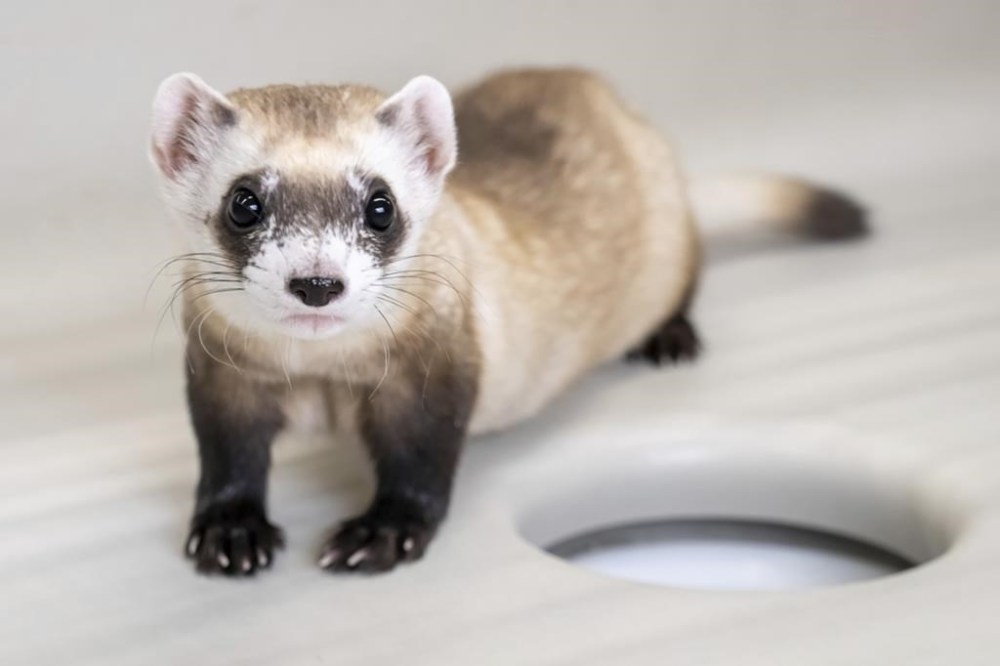
Black-footed ferrets are now a conservation success story — after being all but wiped out in the wild, thousands of them have been bred in captivity and reintroduced at dozens of sites in the western U.S., Canada and Mexico since the 1990s.
Because they feed exclusively on prairie dogs, they have been victims of farmer and rancher efforts to poison and shoot the land-churning rodents — so much so that they were thought to be extinct, until a ranch dog named Shep brought a dead one home in western Wyoming in 1981. Conservationists then managed to capture seven more, and establish a breeding program.
But their gene pool is small — all known black-footed ferrets today are descendants of those seven animals — so diversifying the species is critically important.
Noreen and Antonia, like Elizabeth Ann, are genetically identical to Willa, one of the original seven. Willa’s remains — frozen back in the 1980s and kept at the San Diego Zoo Wildlife Alliance’s Frozen Zoo — could help conservation efforts because her genes contain roughly three times more unique variations than are currently found among black-footed ferrets, according to the Fish and Wildlife Service.
Elizabeth Ann still lives at the National Black-footed Ferret Conservation Center in Fort Collins, Colorado, but she’s been unable to breed, due to a reproductive organ issue that isn’t a result of being cloned, the Fish and Wildlife Service said in a statement.
Biologists plan to try to breed Noreen and Antonia after they reach maturity later this year.
The ferrets were born at the ferret conservation center last May. The Fish and Wildlife Service waited almost year to announce the births amid ongoing scientific work, other black-footed ferret breeding efforts and the agency’s other priorities, Fish and Wildlife Service spokesman Joe Szuszwalak said by email.
“Science takes time and does not happen instantaneously,” Szuszwalak wrote.
Cloning makes a new plant or animal by copying the genes of an existing animal. To clone these three ferrets, the Fish and Wildlife Service worked with zoo and conservation organizations and ViaGen Pets & Equine, a Texas business that clones horses for $85,000 and pet dogs for $50,000.
The company also has cloned a Przewalski’s wild horse, a species from Mongolia.