Growing wildfire risk leaves states grappling with how to keep property insurers from fleeing

Advertisement

Advertise with us

BOISE, Idaho (AP) — Months after a catastrophic fire burned more than 2,200 homes in Hawaii, some property owners are getting more bad news — their property insurance won't be renewed because their insurance company has deemed the risk too high.

Read this article for free:


or

Already have an account? Log in here »

To continue reading, please subscribe:

Subscribe and receive a limited-edition Free Press branded hat or tote.

Digital Subscription

One year of digital access for only $205*

  • Enjoy unlimited reading on winnipegfreepress.com
  • Read the E-Edition, our digital replica newspaper
  • Access News Break, our award-winning app
  • Play interactive puzzles

*First annual payment billed as $205.00 + GST for one year. This annual subscription will automatically renew at $233.00 + GST every 52 weeks (10% off the regular annual price of $259.35). Offer available to new and qualified returning subscribers only. Cancel any time.

To continue reading, please subscribe:

Add Free Press access to your Brandon Sun subscription for only an additional

$1 for the first 4 weeks*

  • Enjoy unlimited reading on winnipegfreepress.com
  • Read the E-Edition, our digital replica newspaper
  • Access News Break, our award-winning app
  • Play interactive puzzles
Start now

*Your next Brandon Sun subscription payment will increase by $1.00 and you will be charged $17.95 plus GST for four weeks. After four weeks, your payment will increase to $24.95 plus GST every four weeks.

Hey there, time traveller!
This article was published 29/04/2024 (888 days ago), so information in it may no longer be current.

BOISE, Idaho (AP) — Months after a catastrophic fire burned more than 2,200 homes in Hawaii, some property owners are getting more bad news — their property insurance won’t be renewed because their insurance company has deemed the risk too high.

It’s a problem that has played out in states across the U.S. as climate change and increasing development has raised the risks of wildfires and other natural disasters damaging communities. Insurance providers, state regulators and researchers are grappling with how to keep the insurance companies in business while keeping residents and their properties insured and protected.

“I think most of the insurers, you know, I’m very grateful that they’re committed to the Hawaii market, so we haven’t seen wholesale withdrawals,” after the Aug. 8, 2023 fire burned through Lahaina and killed 101 people, Hawaii Insurance Commissioner Gordon Ito said during a Wildfire Risk Forum for insurance commissioners held at the National Interagency Fire Center in Boise, Idaho.
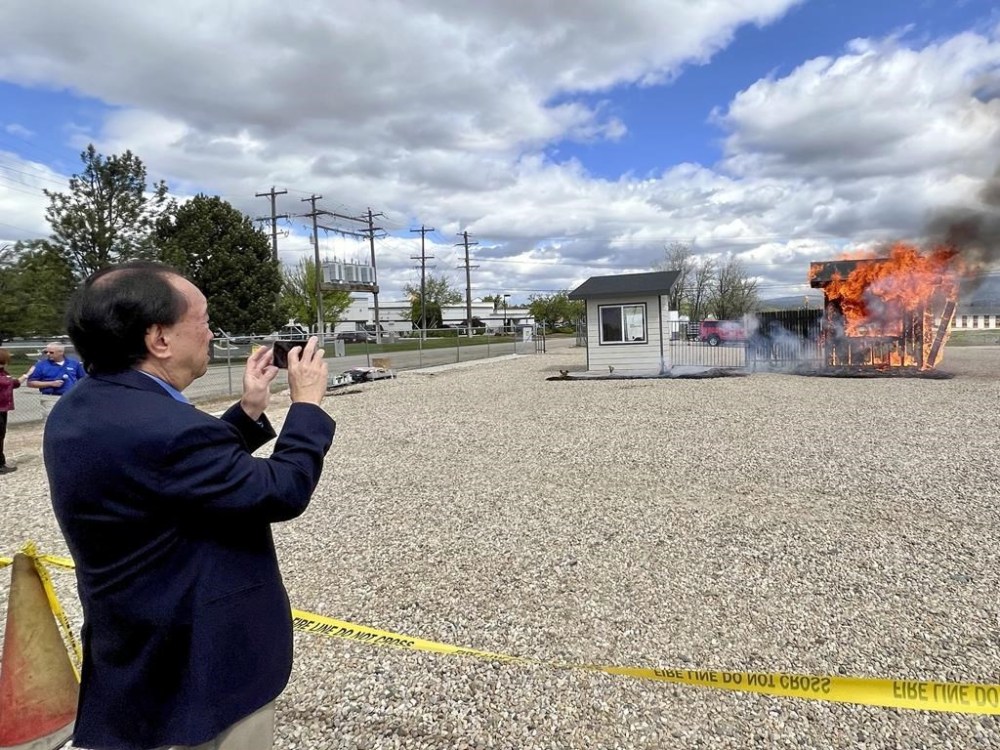
Hawaii Insurance Commissioner Gordon Ito films a wildfire burn risk demonstration at the National Interagency Fire Center in Boise, Idaho, Monday, April 29, 2024. Some property insurance companies in Hawaii and other states have stopped providing coverage to residents because of increasing wildfire risk and climbing construction costs. The Idaho Department of Insurance hosted the burn demonstration as part of a forum for western Insurance commissioners on the impact wildfires are having on the nation’s insurance market. (AP Photo/Rebecca Boone)

But one or two insurance companies have stopped renewing policies for wood structures like townhomes that are in wildfire risk areas, Ito said Monday, in part because the companies have seen their own insurance costs climb. Property insurers typically have their own insurance coverage to help when there are big payouts, like the roughly $3 billion in claims that have been paid so far on an estimated $6 billion in damages from the Lahaina fire. But those “reinsurance” rates are climbing, Ito said, and that’s forcing some companies to reevaluate the policies they are willing to issue to residents.

The same thing happened in Colorado after the 2021 Marshall Fire destroyed 1,100 homes in Boulder County, causing an estimated $2 billion in damage, said Colorado Division of Insurance deputy commissioner Jason Lapham. Last year, Colorado lawmakers authorized the creation of the Fair Access to Insurance Requirements (FAIR) Plan, which is expected to provide bare-bones property insurance coverage for residents who can’t get insurance from a private company starting in 2025. Other states like California, Louisiana and Florida have also resorted to providing their own state-affiliated “insurers of last resort,” which can fill in the gap when when the private insurance market abandons an area because of natural disaster risk.

Insurance industry researchers say part of the solution could come from homeowners taking steps to make their properties more fire-resistant.

“This peril is a preventable peril, and it will take a will to change and do something different,” said Anne Cope, the chief engineer for the Insurance Institute for Business & Home Safety. She later demonstrated her point by taking the commissioners to two nearly identical buildings — one made out of fire-resistant materials with plenty of space between landscaping and the structure, and the other built with traditional materials and landscaping. Small fires were started next to each building, and the fire-resistant one remained mostly undamaged while the traditional building was quickly engulfed and burned to the ground.

Research shows that protecting homes from blowing embers using fire-resistant roofs and gutters and keeping the area around a home free of easily flammable material makes a big difference, Cope said.

In the early 1970s, the U.S. had more annual fire deaths than any other industrialized nation, Cope told the insurance commissioners, but a 1973 government-commissioned report on the problem called “America Burning” led to dramatic improvements, in part because of the widespread adoption of smoke detectors and building codes.

“We can do that here with suburban conflagration,” Cope said, by protecting homes from blowing embers using fire-resistant roofs and gutters and taking other basic steps like keeping defensible space around a home. Wood roofing materials are not only more statistically likely to lead to the destruction of their own building in a fire but also to the destruction of 10 other buildings nearby, she said. Juniper bushes and wooden fences and decks near homes are also likely fire entry points, as are gutters that are filled with debris.

Once one building in a community catches fire, the problem quickly compounds — while forest fires and other wildland fires generally produce small blowing embers that are quickly extinguished, structure fires create much larger embers that can be as big as a human hand, Cope said. Those big, chunky embers carry enough fuel with them to keep burning once they land on another structure, quickly setting it aflame.

The economic effects of a catastrophic fire last for years, said Ito. Insurance companies in Hawaii have already paid roughly 80% of the claims filed for personal property, nearly 100% of the claims filed for motor vehicles and about half of the commercial insurance claims, he said. Commercial insurance claims typically take longer because additional records are needed to document the losses sustained by a business.

But that’s just the recoverable losses. The economy has been devastated by the lack of tax revenue, more than 2,000 displaced residents are still living in hotels, and rebuilding hasn’t started yet, Ito said. Lahaina was a major destination for visitors, and the fires will likely lead to an ongoing reduction of about 10% or 15% in revenue for the state’s tourism industry, he said.

“And to me, the heartbreaking thing … there’s quite a few Lahaina survivors that cannot afford to stay and have chosen to leave the islands because of the lack of housing availability,” said Ito. “And so that’s, I think, the biggest impact.”

Report Error Submit a Tip

More Stories

Mayoral candidate Vogiatzakis criticized for living outside Winnipeg

Malak Abas 4 minute read Preview

Mayoral candidate Vogiatzakis criticized for living outside Winnipeg

Malak Abas 4 minute read Friday, Oct. 2, 2026

A mayoral hopeful took heat from other candidates Friday for living outside Winnipeg while running in the civic election.

Mike Vogiatzakis’s primary residence is in the Rural Municipality of St. Andrews, about 25 kilometres north of Winnipeg — a community with its own mayor and councillors.

But the funeral director said he owns a home in Winnipeg where he divides his time, and he would move to the city full-time if elected mayor.

“It doesn’t matter where a person lives. Why are we dividing St. Andrews and Manitoba and Winnipeg? I’ve met the criteria to run for mayor,” Vogiatzakis said Friday morning.

Read
Friday, Oct. 2, 2026

Khan should’ve taken high road: Goertzen

Carol Sanders 5 minute read Preview

Khan should’ve taken high road: Goertzen

Carol Sanders 5 minute read Friday, Oct. 2, 2026

The veteran Progressive Conservative who championed Obby Khan’s leadership bid says the former Blue Bomber dropped the ball by dissing his Tory teammates before he stepped down.

“I wouldn’t recommend it, and I didn’t recommend it,” Kelvin Goertzen (Steinbach) said in an interview Friday.

Khan resigned as PC leader and quit the caucus Monday saying some members were secretly plotting his ouster, even after he won a confidence vote on Sept. 25.

On Tuesday, Khan lashed out in a CJOB interview, naming the alleged plotters, saying constituents deserved to know which of their elected representatives “lacked moral integrity.” Khan told the Free Press he was “deeply emotionally hurt,” and felt stabbed in the back.

Read
Friday, Oct. 2, 2026

Winnipeggers witness unveiling of Japanese Canadian monument in B.C.

Morgan Modjeski 6 minute read Preview

Winnipeggers witness unveiling of Japanese Canadian monument in B.C.

Morgan Modjeski 6 minute read Yesterday at 8:39 PM CDT

As Miki Stewart gathered with her family at the Japanese Cultural Association of Manitoba on Saturday afternoon, she was thinking of her parents, Yoshimaru and Yoshi Abe.

Both Stewart, 80, and her sister Yumi Falk, 81, alongside an older brother, were born in the Tashme internment camp in British Columbia. They were among more than 2,600 Japanese Canadians who were forcefully removed and interred at the camp following the bombing of Pearl Harbour and Canada’s declaration of war on Japan in 1941.

“They didn’t talk much about how they suffered,” Stewart said of her parents. “But they did.”

She was amongst a group of more than 150 people who gathered at the association’s McPhillips headquarters on Saturday afternoon to watch the unveiling of the Japanese Canadian Monument in Victoria B.C.

Read
Yesterday at 8:39 PM CDT

Growing wildfire risk leaves states grappling with how to keep property insurers from fleeing

Rebecca Boone, The Associated Press 5 minute read Preview

Growing wildfire risk leaves states grappling with how to keep property insurers from fleeing

Rebecca Boone, The Associated Press 5 minute read Monday, Apr. 29, 2024

BOISE, Idaho (AP) — Months after a catastrophic fire burned more than 2,200 homes in Hawaii, some property owners are getting more bad news — their property insurance won't be renewed because their insurance company has deemed the risk too high.

It's a problem that has played out in states across the U.S. as climate change and increasing development has raised the risks of wildfires and other natural disasters damaging communities. Insurance providers, state regulators and researchers are grappling with how to keep the insurance companies in business while keeping residents and their properties insured and protected.

“I think most of the insurers, you know, I’m very grateful that they’re committed to the Hawaii market, so we haven’t seen wholesale withdrawals,” after the Aug. 8, 2023 fire burned through Lahaina and killed 101 people, Hawaii Insurance Commissioner Gordon Ito said during a Wildfire Risk Forum for insurance commissioners held at the National Interagency Fire Center in Boise, Idaho.

But one or two insurance companies have stopped renewing policies for wood structures like townhomes that are in wildfire risk areas, Ito said Monday, in part because the companies have seen their own insurance costs climb. Property insurers typically have their own insurance coverage to help when there are big payouts, like the roughly $3 billion in claims that have been paid so far on an estimated $6 billion in damages from the Lahaina fire. But those “reinsurance” rates are climbing, Ito said, and that’s forcing some companies to reevaluate the policies they are willing to issue to residents.

Read
Monday, Apr. 29, 2024

’Disgusting’ posters being investigated by police

Morgan Modjeski 4 minute read Yesterday at 2:22 PM CDT

The Winnipeg Police Service major crimes unit is investigating what some have labelled offensive and hateful posters on full-display at a Winnipeg home.

One of the people irked by the display is Gracie Garrett. She’s has lived on Ashburn Street in Winnipeg’s Minto neighbourhood for almost ten years. She’s never felt unsafe in the neighbourhood before, but now, a set of posters plastered on a nearby house are making her feel uneasy.

The five signs, posted facing the street prominently on a front window, contain a slur, refer to Nazis as “heroes” and call Muslims, Christians and other groups “evil.”

Learning of the signs Friday, Garrett said she’ll be reporting the posters to police, as she worries they incite and promote violence.

Broadening prediction-market gambling a bad idea

Editorial 4 minute read Preview

Broadening prediction-market gambling a bad idea

Editorial 4 minute read Yesterday at 2:01 AM CDT

Let’s make a prediction: sooner or later, when Canadian governments find a way to take their own cut of the action, prediction-contract gambling on everything from sports to entertainment to political decisions is going to come to Canada.

And that’s a horrible, dangerous, pernicious idea.

Unless you have particular access to information — either inside information or strategic information based on skills or education — you’re not likely to make money at it. In fact, structurally, you’re likely to lose. In prediction markets, you basically pay an amount, plus fees from the company involved, to bet on whether something will or will not happen within a certain time frame. The amount you pay for your contract depends on how other people are also betting.

As Wealthsimple describes it, “You buy whichever side you think is right. Prices move with demand, so if the market leans towards one outcome, the more that side costs. If a lot of people are backing the TSX to finish above 38,000, yes gets more expensive and no gets cheaper.”

Read
Yesterday at 2:01 AM CDT