Climate change: P.E.I. introduces new risk assessment tools for flooding, erosion

Advertisement

Advertise with us

CHARLOTTETOWN - The P.E.I. government has introduced new online tools to help Islanders assess flooding and erosion risks associated with climate change.

Read this article for free:


or

Already have an account? Log in here »

To continue reading, please subscribe:

Subscribe and receive a limited-edition Free Press branded hat or tote.

Digital Subscription

One year of digital access for only $205*

  • Enjoy unlimited reading on winnipegfreepress.com
  • Read the E-Edition, our digital replica newspaper
  • Access News Break, our award-winning app
  • Play interactive puzzles

*First annual payment billed as $205.00 + GST for one year. This annual subscription will automatically renew at $233.00 + GST every 52 weeks (10% off the regular annual price of $259.35). Offer available to new and qualified returning subscribers only. Cancel any time.

To continue reading, please subscribe:

Add Free Press access to your Brandon Sun subscription for only an additional

$1 for the first 4 weeks*

  • Enjoy unlimited reading on winnipegfreepress.com
  • Read the E-Edition, our digital replica newspaper
  • Access News Break, our award-winning app
  • Play interactive puzzles
Start now

*Your next Brandon Sun subscription payment will increase by $1.00 and you will be charged $17.95 plus GST for four weeks. After four weeks, your payment will increase to $24.95 plus GST every four weeks.

Hey there, time traveller!
This article was published 10/05/2024 (828 days ago), so information in it may no longer be current.

CHARLOTTETOWN – The P.E.I. government has introduced new online tools to help Islanders assess flooding and erosion risks associated with climate change.

The tools include a mapping portal that allows users to see areas at risk of coastal and inland flooding, as well as coastal erosion.

The Climate Hazard and Risk Information System (CHRIS) shows a detailed, interactive map of the Island that can display coastal flooding and erosion scenarios between 2020 and 2100.
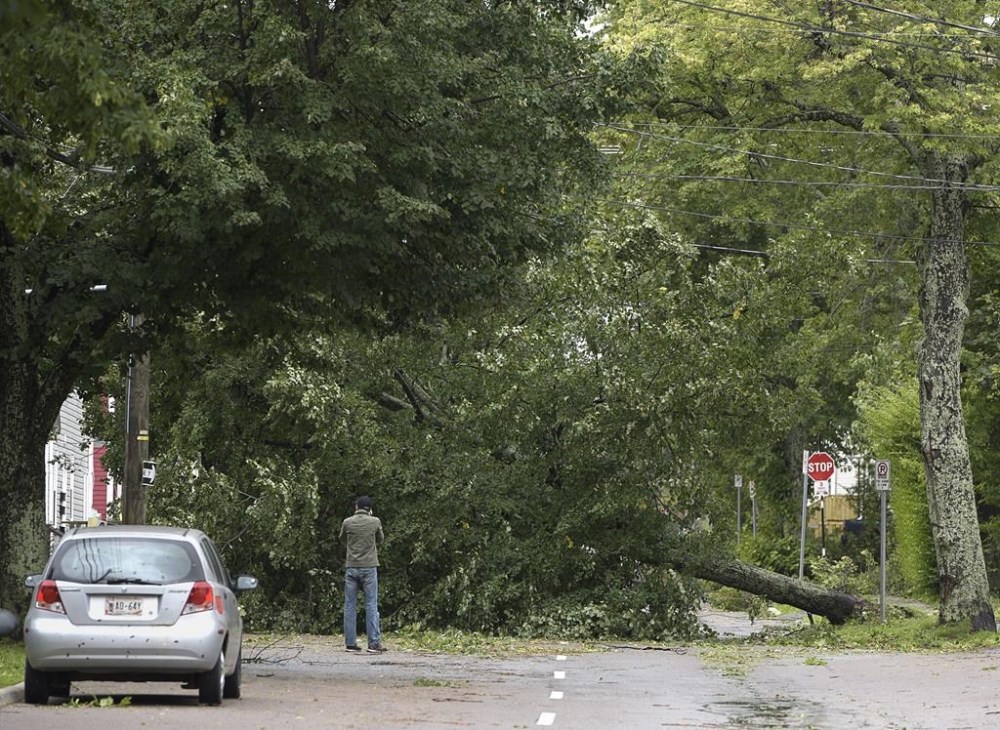
The P.E.I. government has introduced a new suite of online tools to help Islanders assess flooding and erosion risks associated with climate change. A man takes a photo of a fallen tree in Charlottetown on Sunday, Sept. 8, 2019, in the aftermath of Hurricane Dorian. THE CANADIAN PRESS/Nathan Rochford

As for inland flooding, CHRIS offers two climate scenarios over the next 10 to 100 years: a “current climate” scenario based on existing rainfall patterns, and a “future climate” scenario based on the predicted influence of climate change.

Users can also zoom in to witness changes along the province’s 3,000-kilometre coastline since 1968.

For those considering buying or building on the coast, the government has produced an updated property guide that offers advice about creating buffer zones, obtaining insurance and adapting to risks posed by erosion and flooding.

“The Island’s coastline is constantly subject to the natural processes of erosion,” the government said in a statement. “These normal processes become hazards when people choose to build homes, roads or other lasting infrastructure too close to the shore. The risk increases due to sea-level rise and increasing storm frequency and intensity.”

The new P.E.I. flood guide provides guidance to decision-makers drafting flood policies and reviewing development applications. The guide explains how to interpret flood hazard data and how land-use planning can reduce flood risks.

A study published in March 2020 by the European Commission Joint Research Centre said almost half the world’s sandy beaches face near extinction by the end of the century because of coastal erosion and rising sea levels.

Australia stands to lose the most, followed closely by Canada, the paper suggests. Models show Canada stands to lose between 6,400 and 14,400 kilometres of sandy beach by 2100. Canada’s total coastline is about 243,000 kilometres.

And that rate of loss can be exacerbated by fierce weather events like post-tropical storm Fiona, which battered Atlantic Canada in September 2022.

Fiona was the most costly extreme weather event ever recorded in Atlantic Canada, causing an estimated $660 million in insured damage, according to the Insurance Bureau of Canada.

With gusts reaching over 100 kilometres per hour, Fiona also unleashed torrential rainfall, large waves and storm surges that caused heavy damage along P.E.I.’s north coast. Island residents and businesses reported $220 million in insured damage.

The Intergovernmental Panel on Climate Change has said it was “virtually certain” that there had been an increase in intense tropical cyclone activity in the North Atlantic since the 1970s, and it’s likely that storm activity will increase, causing even more damage to P.E.I.’s coastline.

A coastal risk assessment by University of Prince Edward Island’s Climate Lab concluded that more than 1,000 homes, 450 outbuildings and 17 lighthouses remain vulnerable to coastal erosion.

Data show that between 1911 and 2011, the sea level measured at Charlottetown increased by 36 centimetres, and it is anticipated to increase by a further 100 centimetres over the next 100 years, according to the climate panel.

This report by The Canadian Press was first published May 10, 2024.

Report Error Submit a Tip

More Stories

Revered Broadway rail anchors Winnipeg’s resilient skateboarding scene

Benjamin Waldman 11 minute read Preview

Revered Broadway rail anchors Winnipeg’s resilient skateboarding scene

Benjamin Waldman 11 minute read Yesterday at 11:13 AM CDT

The Woodsworth Building at the corner of Broadway and Kennedy Street is an accidental, unofficial mecca of Winnipeg skateboarding.

Read
Yesterday at 11:13 AM CDT

Big Loser’s latest a winning mix of country, folk

Ben Waldman 4 minute read Preview

Big Loser’s latest a winning mix of country, folk

Ben Waldman 4 minute read 6:00 AM CDT

The yellow trucker hat for sale on Facebook Marketplace said “Selkirk Lumber,” so Adam Wayne Brown knew he had to hammer home a deal.

Like the other millennial members of Winnipeg folk-country band Big Loser, the bassist has an affinity for the nostalgic, taking every opportunity — through music, through lyrics and through wardrobe — to recall the unique circumstances of growing up in a changing Interlake.

“I remember the matte yellow trucks driving around — the lumber trucks — and so I’ve had this strange memory of something disappearing from my youth and then persisting,” says Brown, who, like the band’s frontman Alex Paradoski, moved to Winnipeg more than a decade ago.

“I have a photo of the Lockport Bridge in my dining room,” chimes in Paradoski, whose first job as a teenager was bunning wieners and chopping fries at Skinner’s, a drive-in mainstay since 1929 along Highway 44.

Read
6:00 AM CDT

WRHA directs three care homes to accommodate surge of hospital patients

Malak Abas 5 minute read Preview

WRHA directs three care homes to accommodate surge of hospital patients

Malak Abas 5 minute read Updated: Yesterday at 5:01 PM CDT

The Winnipeg Regional Health Authority has directed three long-term care centres to make space for hospital patients, citing “exceptionally high demand for care across the health-care system.”

Read
Updated: Yesterday at 5:01 PM CDT

PCs say Hutterite colonies singled out by Bill 21

Alex Lambert 4 minute read Preview

PCs say Hutterite colonies singled out by Bill 21

Alex Lambert 4 minute read Yesterday at 2:01 AM CDT

SOURIS — Members of Hutterite colonies in the province took aim at the NDP government’s proposed changes to drinking water legislation during a public meeting Thursday in Souris.

The meeting was hosted by Progressive Conservative MLA Colleen Robbins (Spruce Woods) to hear from rural residents about their concerns over Bill 21, which the government says will improve oversight on wells and other water systems in the province.

“There’s not enough clarity, but I feel that the overreach that this bill will bring is not clearly defined, and it could have a lot of negative consequences,” attendee Gilbert Hofer, a member of Green Acres colony near Wawanesa, said after the meeting, which drew about 20 people.

The legislation would allow public health officers to designate the type of water source based on its intended use, water quality and use duration rather than solely the number of connections it has.

Read
Yesterday at 2:01 AM CDT

‘Disrespectful’: residents frustrated after Wyatt arrives hour late to committee meeting

Joyanne Pursaga 3 minute read Preview

‘Disrespectful’: residents frustrated after Wyatt arrives hour late to committee meeting

Joyanne Pursaga 3 minute read Updated: Yesterday at 1:00 PM CDT

Several Winnipeggers attending a city development hearing on Thursday expressed frustration that one councillor arrived about an hour late, delaying the matter from being heard.

Coun. Russ Wyatt, who continues to attend city hall while facing criminal charges, began participating in the 9:30 a.m. East Kildonan-Transcona community committee meeting at 10:35 a.m.

A resident who hoped to speak at the meeting about a development plan in south Transcona noted the tardiness led the committee to bump the topic down on its agenda, while dozens waited to speak on it.

Christina Pyra eventually opted to leave city hall instead of waiting for her turn to make a presentation, to avoid missing a work commitment.

Read
Updated: Yesterday at 1:00 PM CDT

Manitoba supports MAID delay: Asagwara

Carol Sanders 5 minute read Preview

Manitoba supports MAID delay: Asagwara

Carol Sanders 5 minute read Yesterday at 2:00 AM CDT

The number of Manitobans receiving medical assistance in dying in 2026 is on track with previous years while the plan to extend it to those suffering from mental illness is delayed indefinitely by the federal government — a move Manitoba’s health minister supports.

“There’s so much more work that needs to be done,” Uzoma Asagwara said.

The parliamentary committee that issued its recommendation in June was the third special committee of Parliament struck to assess the eligibility of people with mental illness since 2021, when MAID eligibility was expanded to include people who were not at the end of their lives.

A key condition for MAID eligibility is that a patient must be suffering from a grievous and irremediable medical condition.

Read
Yesterday at 2:00 AM CDT