DeSantis, amid criticism, signs Florida bill making climate change a lesser state priority
Advertisement
Read this article for free:
or
Already have an account? Log in here »
To continue reading, please subscribe:

Digital Subscription
One year of digital access for only $205*
- Enjoy unlimited reading on winnipegfreepress.com
- Read the E-Edition, our digital replica newspaper
- Access News Break, our award-winning app
- Play interactive puzzles
*First annual payment billed as $205.00 + GST for one year. This annual subscription will automatically renew at $233.00 + GST every 52 weeks (10% off the regular annual price of $259.35). Offer available to new and qualified returning subscribers only. Cancel any time.
To continue reading, please subscribe:
Add Free Press access to your Brandon Sun subscription for only an additional
$1 for the first 4 weeks*
- Enjoy unlimited reading on winnipegfreepress.com
- Read the E-Edition, our digital replica newspaper
- Access News Break, our award-winning app
- Play interactive puzzles
*Your next Brandon Sun subscription payment will increase by $1.00 and you will be charged $17.95 plus GST for four weeks. After four weeks, your payment will increase to $24.95 plus GST every four weeks.
Read unlimited articles for free today:
or
Already have an account? Log in here »
Hey there, time traveller!
This article was published 15/05/2024 (878 days ago), so information in it may no longer be current.
TALLAHASSEE, Fla. (AP) — Climate change will be a lesser priority in Florida and largely disappear from state statutes under legislation signed Wednesday by Florida Gov. Ron DeSantis that also bans power-generating wind turbines offshore or near the state’s lengthy coastline.
Critics said the measure made law by the former Republican presidential hopeful ignores the reality of climate change threats in Florida, including projections of rising seas, extreme heat and flooding and increasingly severe storms.
It takes effect July 1 and would also boost expansion of natural gas, reduce regulation on gas pipelines in the state and increase protections against bans on gas appliances such as stoves, according to a news release from the governor’s office.
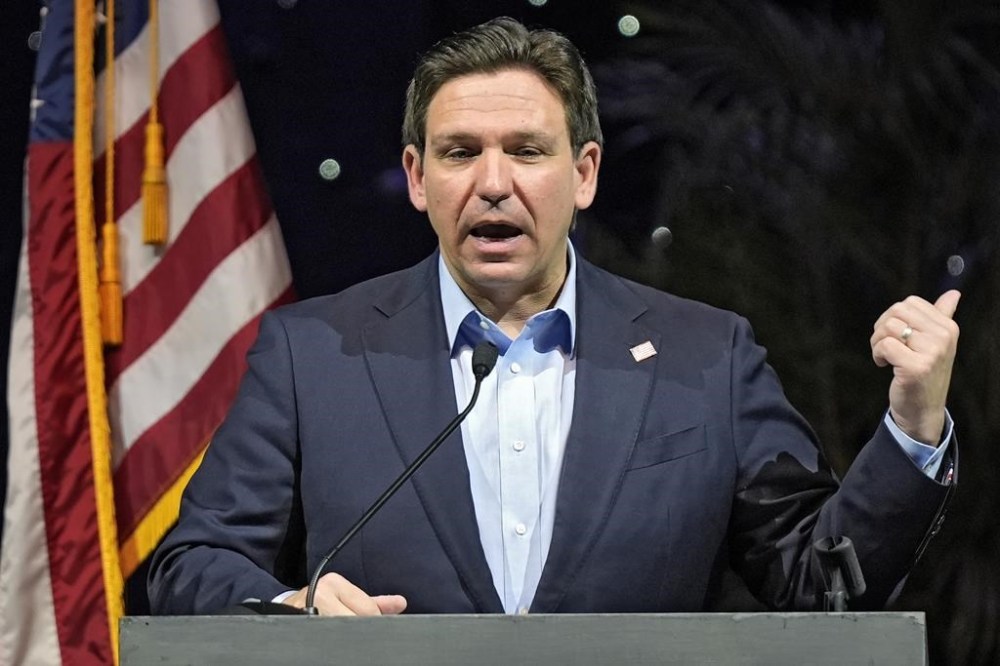
DeSantis, who suspended his presidential campaign in January and later endorsed his bitter rival Donald Trump, called the bill a common-sense approach to energy policy.
“We’re restoring sanity in our approach to energy and rejecting the agenda of the radical green zealots,” DeSantis said in a post on the X social media platform.
Florida is already about 74% reliant on natural gas to power electric generation, according to the U.S. Energy Information Administration. Opponents of the bill DeSantis signed say it removes the word “climate’ in nine different places, moves the state’s energy goals away from efficiency and the reduction of greenhouse gases blamed for a warming planet.
“This purposeful act of cognitive dissonance is proof that the governor and state Legislature are not acting in the best interests of Floridians, but rather to protect profits for the fossil fuel industry,” said Yoca Arditi-Rocha, executive director of the nonprofit Cleo Institute, which advocates for climate change education and engagement.

The legislation also eliminates requirements that government agencies hold conferences and meetings in hotels certified by the state’s environmental agency as “green lodging” and that government agencies make fuel efficiency the top priority in buying new vehicles. It also ends a requirement that Florida state agencies look at a list of “climate-friendly” products before making purchases.
In 2008, a bill to address climate change and promote renewable energy passed unanimously in both legislative chambers and was signed into law by then-Gov. Charlie Crist, at the time a Republican. Former Gov. Rick Scott, now a Republican U.S. senator, took steps after taking the governor’s office in 2011 to undo some of that measure and this latest bill takes it even further.
The measure signed by DeSantis would also launch a study of small nuclear reactor technology, expand the use of vehicles powered by hydrogen and enhance electric grid security, according to the governor’s office.
___
This story has been updated to correct the spelling of Yoca Arditi-Rocha’s first name.