Acadian groups say Chignecto Isthmus should be designated national park
Advertisement
Read this article for free:
or
Already have an account? Log in here »
To continue reading, please subscribe:

Digital Subscription
One year of digital access for only $205*
- Enjoy unlimited reading on winnipegfreepress.com
- Read the E-Edition, our digital replica newspaper
- Access News Break, our award-winning app
- Play interactive puzzles
*First annual payment billed as $205.00 + GST for one year. This annual subscription will automatically renew at $233.00 + GST every 52 weeks (10% off the regular annual price of $259.35). Offer available to new and qualified returning subscribers only. Cancel any time.
To continue reading, please subscribe:
Add Free Press access to your Brandon Sun subscription for only an additional
$1 for the first 4 weeks*
- Enjoy unlimited reading on winnipegfreepress.com
- Read the E-Edition, our digital replica newspaper
- Access News Break, our award-winning app
- Play interactive puzzles
*Your next Brandon Sun subscription payment will increase by $1.00 and you will be charged $17.95 plus GST for four weeks. After four weeks, your payment will increase to $24.95 plus GST every four weeks.
Read unlimited articles for free today:
or
Already have an account? Log in here »
Hey there, time traveller!
This article was published 29/05/2024 (868 days ago), so information in it may no longer be current.
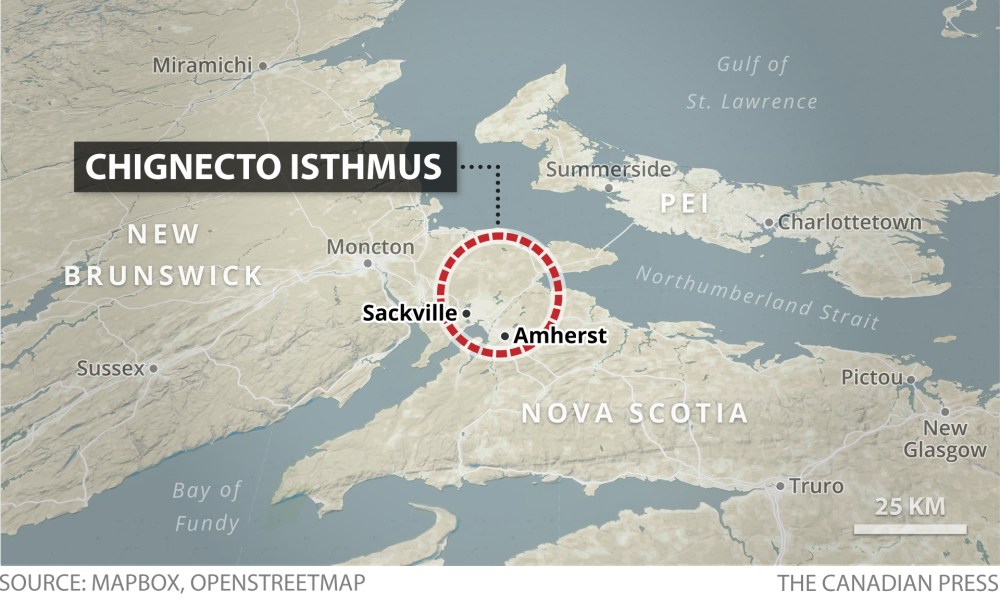
HALIFAX – Organizations representing Acadians in Atlantic Canada are proposing the Chignecto Isthmus, which links New Brunswick and Nova Scotia, be turned into a national park.
The proposal is contained in a brief submitted this month to the Senate committee currently considering a bill that, if passed by Parliament, would make Ottawa responsible for work to protect the narrow low-lying land corridor. The Fédération acadienne de la Nouvelle-Écosse and the Société Nationale de l’Acadie were also part of the brief submitted to the standing committee on transport and communications.
In an interview Wednesday, Nicole Arseneau-Sluyter, acting president of the Société de l’Acadie du Nouveau Brunswick, said the national park designation would help protect an area of cultural significance to Acadians.

“The Acadians built the aboiteaux and dikes …. and a lot of Acadians irrigated the marshland, and there was a lot of trade from there with Europe,” said Arseneau-Sluyter. She added that her organization believes it’s up to the federal government to bolster the current infrastructure against the effects of climate change.
The isthmus has had large dikes since 1671, when Acadian settlers arrived, and there are currently about 35 kilometres of dikes that help protect roads, railways, farms and communities.
Arseneau-Sluyter said the national park idea also makes sense because of the number of national historic sites that are already in the area, including Fort Beausejour-Fort Cumberland National Historic Site in New Brunswick and the Fort Lawrence and Beaubassin sites in Nova Scotia.
“At this point we have just planted the seed,” she said. “There are a lot of different ways this can go, but if it becomes a national park the federal government would become responsible to fix the problem with the rising waters.”
Both the Nova Scotia and New Brunswick governments want Ottawa to foot the bill for the estimated $650-million infrastructure project, but the federal government has said it will only cover half the cost. The work would strengthen the dike system and rail line against rising sea levels.
The political squabble over who should pay remains contentious after the Nova Scotia government began legal proceedings last July to determine whether the federal government has exclusive responsibility to maintain structures along the corridor.
The back-and-forth continued earlier this month, after Nova Scotia Premier Tim Houston noted Ottawa’s acquisition of the Quebec Bridge and its commitment to spend $1 billion over the next 25 years to repair, repaint and maintain the Quebec City span. Houston said he wanted to see consistent criteria applied to federal funding of important transportation links.
In their submission to the Senate committee, the Acadian groups also noted the importance of the Quebec Bridge purchase and linked it to funding for the isthmus.
“This is an important road and railroad that connects Nova Scotia to the rest of Canada,” said Arseneau-Sluyter.
This report by The Canadian Press was first published May 29, 2024.