Panama prepares to evacuate first island in face of rising sea levels
Advertisement
Read this article for free:
or
Already have an account? Log in here »
To continue reading, please subscribe:

Digital Subscription
One year of digital access for only $205*
- Enjoy unlimited reading on winnipegfreepress.com
- Read the E-Edition, our digital replica newspaper
- Access News Break, our award-winning app
- Play interactive puzzles
*First annual payment billed as $205.00 + GST for one year. This annual subscription will automatically renew at $233.00 + GST every 52 weeks (10% off the regular annual price of $259.35). Offer available to new and qualified returning subscribers only. Cancel any time.
To continue reading, please subscribe:
Add Free Press access to your Brandon Sun subscription for only an additional
$1 for the first 4 weeks*
- Enjoy unlimited reading on winnipegfreepress.com
- Read the E-Edition, our digital replica newspaper
- Access News Break, our award-winning app
- Play interactive puzzles
*Your next Brandon Sun subscription payment will increase by $1.00 and you will be charged $17.95 plus GST for four weeks. After four weeks, your payment will increase to $24.95 plus GST every four weeks.
Read unlimited articles for free today:
or
Already have an account? Log in here »
Hey there, time traveller!
This article was published 01/06/2024 (866 days ago), so information in it may no longer be current.
GARDI SUGDUB, Panama (AP) — On a tiny island off Panama’s Caribbean coast, about 300 families are packing their belongings in preparation for a dramatic change. Generations of Gunas who have grown up on Gardi Sugdub in a life dedicated to the sea and tourism will trade that next week for the mainland’s solid ground.
They go voluntarily — sort of.
The Gunas of Gardi Sugdub are the first of 63 communities along Panama’s Caribbean and Pacific coasts that government officials and scientists expect to be forced to relocate by rising sea levels in the coming decades.
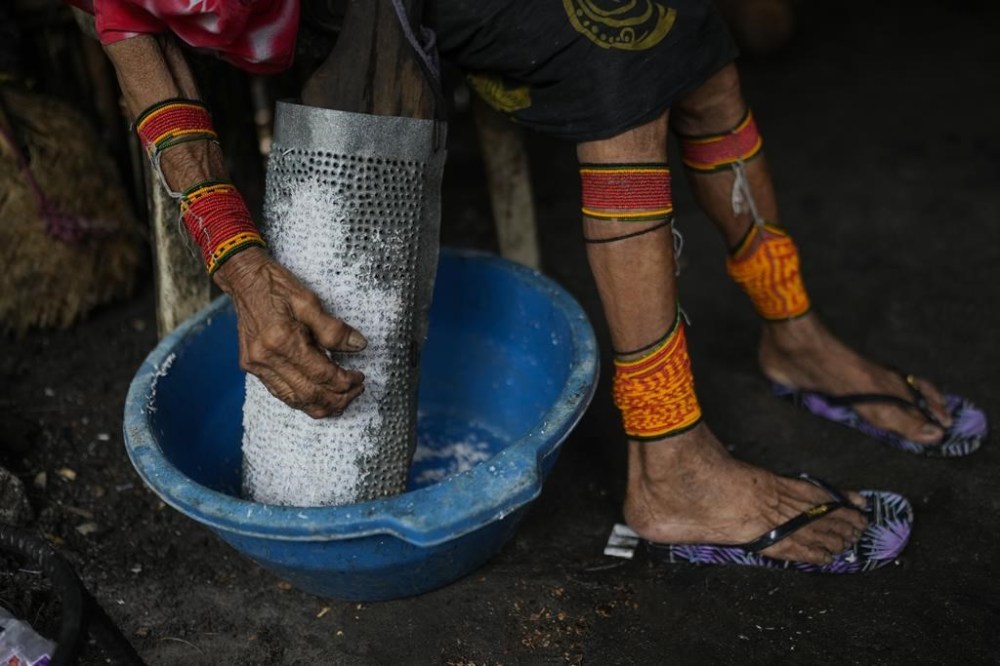
On a recent day, the island’s Indigenous residents rowed or sputtered off with outboard motors to fish. Children, some in uniforms and others in the colorful local textiles called “molas,” chattered as they hustled through the warren of narrow dirt streets on their way to school.
“We’re a little sad, because we’re going to leave behind the homes we’ve known all our lives, the relationship with the sea, where we fish, where we bathe and where the tourists come, but the sea is sinking the island little by little,” said Nadín Morales, 24, who prepared to move with her mother, uncle and boyfriend.
An official with Panama’s ministry of housing said that some people have decided to stay on the island until it’s no longer safe, without revealing a specific number. Authorities won’t force them to leave, the official said on condition of anonymity to discuss the issue.
Gardi Sugdub is one of about 50 populated islands in the archipelago of the Guna Yala territory. It is only about 400 yards (366 meters) long and 150 yards (137 meters) wide. From above, it’s roughly a prickly oval surrounded by dozens of short docks where residents tie up their boats.
Every year, especially when the strong winds whip up the sea in November and December, water fills the streets and enters the homes. Climate change isn’t only leading to a rise in sea levels, but it’s also warming oceans and thereby powering stronger storms.
The Gunas have tried to reinforce the island’s edge with rocks, pilings and coral, but seawater keeps coming.
“Lately, I’ve seen that climate change has had a major impact,” Morales said. “Now the tide comes to a level it didn’t before, and the heat is unbearable.”
The Guna’s autonomous government decided two decades ago that they needed to think about leaving the island, but at that time it was because the island was getting too crowded. The effects of climate change accelerated that thinking, said Evelio López, a 61-year-old teacher on the island.
He plans to move with relatives to the new site on the mainland that the government developed at a cost of $12 million. The concrete houses sit on a grid of paved streets carved out of the lush tropical jungle just over a mile (2 kilometers) from the port, where an eight-minute boat ride carries them to Gardi Sugdub.
Leaving the island is “a great challenge, because more than 200 years of our culture is from the sea, so leaving this island means a lot of things,” López said. “Leaving the sea, the economic activities that we have there on the island, and now we’re going to be on solid ground, in the forest. We’re going to see what the result is in the long run.”
Steven Paton, director of the Smithsonian Institution’s physical monitoring program in Panama, said that the upcoming move “is a direct consequence of climate change through the increase in sea level.”
“The islands on average are only a half-meter above sea level, and as that level rises, sooner or later the Gunas are going to have to abandon all of the islands almost surely by the end of the century or earlier.”
“All of the world’s coasts are being affected by this at different speeds,” Paton said.

Residents of a small coastal community in Mexico moved inland last year after storms continued to take away their homes. Governments are being forced to take action, from the Italian lagoon city of Venice to the coastal communities of New Zealand.
A recent study by Panama’s Environmental Ministry’s Climate Change directorate, with support from universities in Panama and Spain, estimated that by 2050, Panama would lose about 2.01% of its coastal territory to increases in sea levels.
Panama estimates that it will cost about $1.2 billion to relocate the 38,000 or so inhabitants who will face rising sea levels in the short- and medium-term, said Ligia Castro, climate change director for the Environmental Ministry.
On Gardi Sugdub, women who make the elaborately embroidered molas worn by Guna women hang them outside their homes when finished, trying to catch the eye of visiting tourists.
The island and others along the coast have benefitted for years from year-round tourism.

Braucilio de la Ossa, the deputy secretary of Carti, the port facing Gardi Sugdub, said that he planned to move with his wife, daughter, sister-in-law and mother-in-law. Some of his wife’s relatives will stay on the island.
He said the biggest challenge for those moving would be the lifestyle change of moving from the sea inland even though the distance is relatively small.
“Now that they will be in the forest their way of living will be different,” he said.
___
Juan Zamorano reported from Panama City.