
UN official highlights how better preparation has shrunk disaster deaths despite worsening climate

Advertisement

Advertise with us

As climate change makes disasters such as cyclones, floods and droughts more intense, more frequent and striking more places, fewer people are dying from those catastrophes globally because of better warning, planning and resilience, a top United Nations official said.

Read this article for free:


or

Already have an account? Log in here »

To continue reading, please subscribe:

Subscribe and receive a limited-edition Free Press branded hat or tote.

Digital Subscription

One year of digital access for only $205*

  • Enjoy unlimited reading on winnipegfreepress.com
  • Read the E-Edition, our digital replica newspaper
  • Access News Break, our award-winning app
  • Play interactive puzzles

*First annual payment billed as $205.00 + GST for one year. This annual subscription will automatically renew at $233.00 + GST every 52 weeks (10% off the regular annual price of $259.35). Offer available to new and qualified returning subscribers only. Cancel any time.

To continue reading, please subscribe:

Add Free Press access to your Brandon Sun subscription for only an additional

$1 for the first 4 weeks*

  • Enjoy unlimited reading on winnipegfreepress.com
  • Read the E-Edition, our digital replica newspaper
  • Access News Break, our award-winning app
  • Play interactive puzzles
Start now

*Your next Brandon Sun subscription payment will increase by $1.00 and you will be charged $17.95 plus GST for four weeks. After four weeks, your payment will increase to $24.95 plus GST every four weeks.

Hey there, time traveller!
This article was published 01/06/2024 (863 days ago), so information in it may no longer be current.

As climate change makes disasters such as cyclones, floods and droughts more intense, more frequent and striking more places, fewer people are dying from those catastrophes globally because of better warning, planning and resilience, a top United Nations official said.

The world hasn’t really noticed how the type of storms that once killed tens or hundreds of thousands of people now only claim handfuls of lives, new United Nations Assistant Secretary-General Kamal Kishore, who heads the UN’s office for disaster risk reduction told The Associated Press. But he said much more needs to be done to keep these disasters from pushing people into abject poverty.

“Fewer people are dying of disasters and if you look at that as a proportion of total population, it’s even fewer,” Kishore said in his first interview since taking office in mid-May. “We often take for granted the progress that we’ve made.”
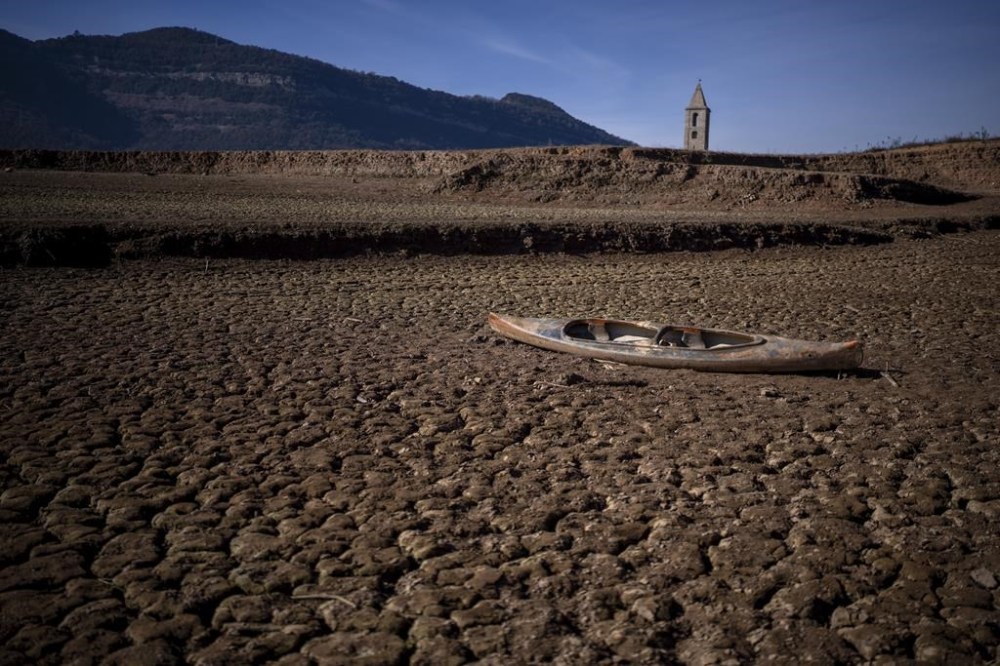
FILE - An abandoned canoe sits on the cracked ground amid a drought at the Sau reservoir, north of Barcelona, Spain, Monday, Jan. 22, 2024. A top United Nations official says even though climate change makes disasters such as cyclones, floods and droughts more intense, more frequent and striking more places, fewer people are dying from those catastrophes globally. Thats because of better warning, planning and resilience. (AP Photo/Emilio Morenatti, File)

“Twenty years ago there was no tsunami early warning system except for one small part of the world. Now the whole world is covered by a tsunami warning system” after the 2004 tsunami that killed about 230,000 people in Indonesia, Sri Lanka, India and Thailand, Kishore said.

People are getting better warnings about tropical cyclones — also called hurricanes and typhoons — so now the chances of dying in a tropical cyclone in a place like the Philippines are about one-third of what they were 20 years ago, Kishore said.

As the former disaster chief for India, Kishore points to how his country has cut deaths thanks to better warnings and community preparedness such as hospitals being ready for a surge in births during a cyclone. In 1999, a supercyclone hit eastern India, killing almost 10,000 people. Then a nearly similar sized storm hit in 2013, but killed only a few dozen people. Last year, on Kishore’s watch, Cyclone Biparjoy killed fewer than 10 people.

The same goes for flood deaths, Kishore said.

The data backs up Kishore, said disaster epidemiologist Debarati Guha-Sapir of the Catholic University of Louvain in Brussels, who created a global disaster database. Her database — which she acknowledges has missing pieces — shows that global deaths per storm event has dropped from about a ten-year average of 24 in 2008 to ten-year average of about 8 in 2021. Flood deaths per event have gone from ten-year averages of nearly 72 to about 31, her data indicates.

While there are fewer deaths globally from disasters, there are still pockets in the poorest of countries, especially in Africa, where deaths are worsening or at least staying the same, Guha-Sapir said. It’s much like public health’s efforts to eradicate measles, success in most places, but areas that can least cope are not improving, she said.

India and Bangladesh are poster nations for better dealing with disasters and preventing deaths, especially in cyclones, Guha-Sapir said. In 1970, a cyclone killed more than 300,000 people in Bangladesh in one of the 20th century’s greatest natural disasters and now “Bangladesh has done fantastic work in disaster risk reduction for years and years and years,” she said.

Pointing out wins is important, Guha-Sapir said: “Gloom and doom will never get us anywhere.”

While countries such as India and Bangladesh have created warning systems, strengthened buildings such as hospitals and know what to do to prepare for and then react to disasters, a lot of it is also just because these countries are getting richer and better educated and so they can handle disasters better and protect themselves, Guha-Sapir said. Poorer countries and people can’t.

“Fewer people are dying, but that’s not because climate change is not happening,” Kishore said ”That is despite the climate change. And that is because we have invested in resilience, invested in early warning systems.”

Kishore said climate change is making his job tougher, yet he said doesn’t feel like Sisyphus, the mythical man pushing a giant boulder up a hill.

“You are getting more intense hazards, more frequently and (in) new geographies,” Kishore said, saying places, like Brazil that used to not worry too much about floods now are getting devastated. The same goes for extreme heat, which he said used to be an issue for only certain countries, but now has gone global, pointing to nearly 60,000 heat wave deaths in Europe in 2022.

India, where temperatures have been flirting with 122 degrees (50 degrees Celsius), has reduced heat deaths with specific regional plans, Kishore said.

“However with the new extreme temperatures we are seeing, every country needs to double its efforts to save lives,” he said. And that means looking at the built environment of cities, he added.
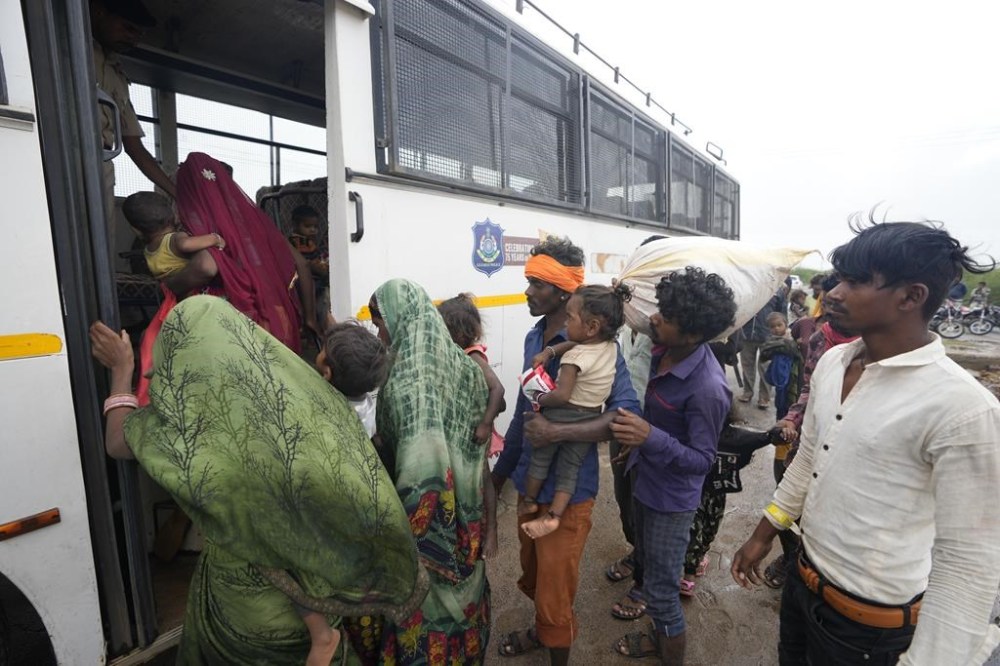
FILE - People evacuated from a village near Jakhau board a bus to travel to a shelter in Kutch district, India, Wednesday, June 14, 2023. A top United Nations official says even though climate change makes disasters such as cyclones, floods and droughts more intense, more frequent and striking more places, fewer people are dying from those catastrophes globally. Thats because of better warning, planning and resilience. (AP Photo/Ajit Solanki, File)

Cutting deaths is only part of the battle to reduce risk, Kishore said.

“We are doing a better job of saving lives but not of livelihoods,” Kishore said.

While fewer people are dying “you look at people who are losing their houses, people who are losing their businesses, a small farmer that is running a poultry farm,” Kishore said. When they get flooded or hit by a storm, they may survive but they’ve got nothing, no seeds, no fishing boats.

“On that we’re not doing as well as we should,” Kishore said. “We cannot accept that losses will occur. Of course they will occur, but they could be minimized by an order of magnitude.”

___

Read more of AP’s climate coverage at http://www.apnews.com/climate-and-environment

___

Follow Seth Borenstein on X at @borenbears

______

The Associated Press’ climate and environmental coverage receives financial support from multiple private foundations. AP is solely responsible for all content. Find AP’s standards for working with philanthropies, a list of supporters and funded coverage areas at AP.org.


Report Error Submit a Tip

More Stories

A Rocky day on the mayoral campaign trail for Kevin Klein

Malak Abas 12 minute read Preview

A Rocky day on the mayoral campaign trail for Kevin Klein

Malak Abas 12 minute read Friday, Oct. 9, 2026

Kevin Klein acknowledges it’s hard to foresee what he’ll wake up to each morning in the final weeks of a mayoral campaign.

But the seasoned politician, who has served as both a city councillor and a provincial cabinet minister, couldn’t have predicted the events — what he describes as “drama” — that unfolded last Sunday.

Fellow mayoral candidate Mike Vogiatzakis accused Klein’s campaign team of offering him a job to drop out of the race, while a guest writer’s column in the Winnipeg Sun that questioned the deaths of Indigenous children at residential schools, just days after the National Day for Truth and Reconciliation, sparked condemnation from a prominent Indigenous organization. (Klein is the CEO of the Klein Group, the company that owns the Sun. He has maintained he is not involved in its operations while running for mayor.)

The Free Press had already been scheduled to join Klein on the campaign trail Monday, intending to document a day in the life of the front-running candidate to unseat incumbent Scott Gillingham, before the controversies hit.

Read
Friday, Oct. 9, 2026

Jets encouraged by play through first five games

Mike McIntyre 6 minute read Preview

Jets encouraged by play through first five games

Mike McIntyre 6 minute read Yesterday at 4:21 PM CDT

Turkey. Stuffing. And a heaping helping of rest and recovery.

The Winnipeg Jets have plenty to be thankful for this holiday weekend, including a solid 3-1-1 start to the NHL campaign. Players and coaches are also counting their blessings at finally getting a breather after a busy stretch of five games in eight days.

“We don’t have another (break like this) until a week before Christmas. So we’re going to take advantage of it,” head coach Scott Arniel said following the club’s first regulation loss, a 5-1 stinker on Friday night against the visiting Anaheim Ducks.

To borrow a funny old Thanksgiving-related phrase from former defenceman Nate Schmidt, the hockey club was “leaking gravy.” They looked like a group that could use a timeout — which they’ll get since they don’t play again until hosting the Minnesota Wild on Tuesday night.

Read
Yesterday at 4:21 PM CDT

Today’s horoscope

Georgia Nicols 4 minute read Preview

Today’s horoscope

Georgia Nicols 4 minute read 2:00 AM CDT

MOON ALERT: Avoid shopping (except food and gas) and important decisions until after 10:45 a.m. After that, the moon moves from Libra into Scorpio.

ARIES (March 21-April 19)

You have a choice. You can either get embroiled in disputes about shared property, debt, insurance issues or inheritances; or instead, relax and have a playful day featuring sporting events, social outings and fun activities with kids.

TAURUS (April 20-May 20)

Read
2:00 AM CDT

Towing company hands stolen car back, but not to owner

By Matthew Frank 4 minute read Preview

Towing company hands stolen car back, but not to owner

By Matthew Frank 4 minute read Friday, Oct. 9, 2026

A Manitoba man says he is dumbfounded after his car was stolen, impounded by a Winnipeg towing company and given back — to someone that wasn’t him.

Cody Lamb lives in the western Manitoba community of Douglas, about 18 kilometres east of Brandon, but spends weeks away from home working on oil rigs in Alberta.

The 24-year-old says on Sept. 11, while away for work, he heard from his girlfriend who told him his car wasn’t in their driveway. Lamb reported the car stolen to Brandon RCMP the same day.

After filing the report, he heard from Steinbach RCMP on Oct. 1 that his car was recovered that day in the community of Mitchell, roughly five km west of Steinbach.

Read
Friday, Oct. 9, 2026

Jets’ game flies south against Ducks

Mike McIntyre 7 minute read Preview

Jets’ game flies south against Ducks

Mike McIntyre 7 minute read Friday, Oct. 9, 2026

The Winnipeg Jets sure looked like a team that was running on fumes Friday night.

Playing for the fifth time in eight days, the club suffered its first regulation loss of the young season — a lacklustre 5-1 showing against the Anaheim Ducks at Canada Life Centre.

While we won’t question the effort, the execution was a different story. Sloppy plays, missed passes, porous defensive-zone coverage and iffy goaltending made this a tough watch for the 13,693 fans in attendance.

“Just some mental things that happened. Obviously some physical things as well,” said head coach Scott Arniel.

Read
Friday, Oct. 9, 2026

Chopped trees will leave a ‘blight’ on Windsor Park

Kelly-Anne Riess 3 minute read Preview

Chopped trees will leave a ‘blight’ on Windsor Park

Kelly-Anne Riess 3 minute read Friday, Oct. 9, 2026

Robert Gordon has watched the trees grow along a popular Windsor Park walking path for nearly six decades.

Now, as Manitoba Hydro cuts them down to protect nearby power lines, he says a familiar part of his childhood neighbourhood is disappearing.

Although he no longer lives in the area, Gordon regularly returns to walk or cycle along the tree-lined path, which runs parallel to Archibald Street.

He was concerned when he recently spotted crews clearing vegetation near the entrance to the path, but initially assumed they were removing brush. When he returned, he discovered the clearing had extended farther along the corridor.

Read
Friday, Oct. 9, 2026
