Here’s what seems to work in Miami to keep deaths down as temperatures soar
Advertisement
Read this article for free:
or
Already have an account? Log in here »
To continue reading, please subscribe:

Digital Subscription
One year of digital access for only $205*
- Enjoy unlimited reading on winnipegfreepress.com
- Read the E-Edition, our digital replica newspaper
- Access News Break, our award-winning app
- Play interactive puzzles
*First annual payment billed as $205.00 + GST for one year. This annual subscription will automatically renew at $233.00 + GST every 52 weeks (10% off the regular annual price of $259.35). Offer available to new and qualified returning subscribers only. Cancel any time.
To continue reading, please subscribe:
Add Free Press access to your Brandon Sun subscription for only an additional
$1 for the first 4 weeks*
- Enjoy unlimited reading on winnipegfreepress.com
- Read the E-Edition, our digital replica newspaper
- Access News Break, our award-winning app
- Play interactive puzzles
*Your next Brandon Sun subscription payment will increase by $1.00 and you will be charged $17.95 plus GST for four weeks. After four weeks, your payment will increase to $24.95 plus GST every four weeks.
Read unlimited articles for free today:
or
Already have an account? Log in here »
Hey there, time traveller!
This article was published 11/07/2024 (812 days ago), so information in it may no longer be current.
Despite a record 46-day streak of triple digit feels-like temperatures, Miami’s unprecedented brutal summer last year wasn’t that deadly, contrasting with the rest of the nation where federal records show heat fatalities nationally spiked to a 45-year high.
One of the reasons is that Miami takes heat seriously, not just reacting when temperatures soar, but planning months in advance. Officials talk to vulnerable people, install air conditioning units early and essentially figure out what to do when things get nasty and practice at it. The Miami-Dade government and the local National Weather Service office team up to treat heat like something more scary, but often less deadly.
When Jane Gilbert took over three years ago as the county’s heat officer, one of the first in an increasingly warmer nation, she said Mayor Daniella Levine Cava told her “I want you to prepare our people on the level that we do our hurricane season.”
Because Miami averages a hurricane landfall nearby every six years or so, according to the National Hurricane Center, getting ready for storm season is a big and quite public deal with media, stores and government all talking about preparations.
When it comes to heat, the county first determined who was vulnerable and where they were, Gilbert said.
“We looked at emergency department visits and hospitalizations by zip code and there are some zip codes that have four or five times the rates of others,” Gilbert said. Because of the urban heat island effect, poverty rates, amount of asphalt and greenery, some places can be more than 10 degrees hotter than measured temperatures, she said. Those zip codes tend have higher percentages of families with children.
While Miami has a high rate of air conditioning in homes, it’s expensive and many poor people can’t afford it or have inefficient units so they don’t use them as often as needed, Gilbert said. Before last year’s heat season started, the county installed 1,700 efficient air conditioning units “to make sure everyone under the county’s care had access to efficient cooling,” she said.
With the designation of a heat season starting May 31, officials now prepare for three different weather hazards from May to October: heat, hurricanes and floods.
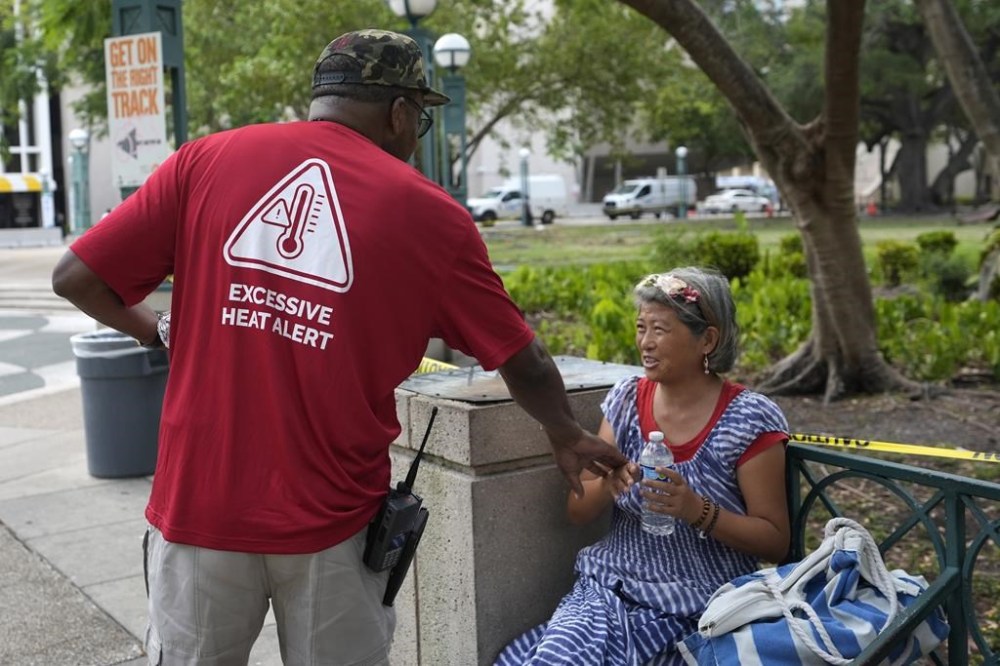
“We’re calling them trifecta trainings,” Gilbert said. Volunteers go to homeless encampments, summer camps, health care clinics and vulnerable neighborhoods to talk with people, organizers, doctors and others about what to do when the high heat kicks in, what danger signs to look for. This year, Miami has 14 different trainings in English, Spanish and Haitian Creole.
The county provides cooling towels to homeless, helps coordinate water donations, hands out maps of where cooling sites are and even offers transportation when the heat gets really bad.
Also, the county and the local weather service office changed the thresholds for when heat advisories and warnings kick in and communication to the public ramps up, said National Weather Service meteorologist Sammy Hadi. Before last year, the feels-like heat index, which combines temperature and humidity, had to reach 113 degrees to be a heat warning that activates more county resources and action. That had never happened in Miami before, he said.
Last year, due to community wishes and scientific data, the weather service dropped that heat warning threshold to 110 degrees. Miami-Dade got its first heat warning. In fact, the county had a heat warning on seven days last year, Hadi said.
The lower heat advisory used to be only triggered at 108 degrees, but now gets declared at 105 degrees. Last year, Miami-Dade had a record 38 days under that heat advisory.
The experiment in lower heat thresholds in Miami worked so well that neighboring suburban Broward County joined Dade, Hadi said. So far this year, South Florida has had 13 days of heat advisories, he said.
People in vulnerable communities should know what to do, because the county has targeted those zip codes with digital ads at gas stations, grocery stores, bus shelters and billboards, Gilbert said.
“Getting the word out is half the battle,” Hadi said.
It seems to work.
While Maricopa County in Arizona had at least 645 deaths where heat was a factor in 2023 and Texas had 450 and Nevada had 226, the official heat-related death count for Miami-Dade was so low — 10 or fewer — that it didn’t register with the Centers for Disease Control and Prevention. Health experts say heat deaths are widely underreported because it is a factor that triggers other more direct causes and often doctors and medical examiners don’t think to see if temperature played a role.
Gilbert is quick to say it’s unfair to compare Phoenix’s high death count to South Florida’s minimal one because the Arizona city has made it a priority to make sure heat-related deaths are recorded that way, where other cities, including Miami, don’t. The way Miami tracks heat deaths is not nearly as comprehensive, she said. Also, Phoenix has more homeless who are more vulnerable because they don’t escape the heat indoors, she said.
And it was hot.
“Completely unprecedented. It was like an entirely different climate regime,” said University of Miami tropical weather expert Brian McNoldy who was tracking the warmth daily. “The number of records we broke and the margins we broke them by was unimaginable… In the four months from mid-June to mid-October, the heat index record was broken 40% of the days.”
The heat index, which combines heat and humidity, hit 105 degrees or above on 40 days from June 1 to September 1 last year with the city sweltering for 108 hours of that level of “particularly oppressive” conditions, according to the National Weather Service. The summer warm season was the hottest on record.
But heat has become a political issue.
Gov. Ron DeSantis in April signed a bill that bars county and city governments from requiring heat and water breaks for outdoor workers. It was a direct response to Miami-Dade County’s effort to require shade and water for construction, farm and other outdoor workers.
Still, several experts — doctors, public health officials and meteorologists — point to Miami, along with Phoenix and Houston, as model cities for dealing with worsening heat waves and higher death tolls triggered by human-caused climate change.
“Miami’s kind of a poster child because they have a chief heat officer to begin with, so they’re already ahead of the curve,” said Morgan Zabow, community heath and health coordinator at the National Oceanic and Atmospheric Administration. “Jane Gilbert with Miami-Dade County is just a rock star to begin with. And there, she’s implementing so many different things across the county.”
___
Terry Spencer in Fort Lauderdale, Fla. and Mary Katherine Wildeman in Hartford, Conn. contributed to this report.
___

Read more of AP’s climate coverage at http://www.apnews.com/climate-and-environment
___
Follow Seth Borenstein on X at @borenbears
___
The Associated Press’ climate and environmental coverage receives financial support from multiple private foundations. AP is solely responsible for all content. Find AP’s standards for working with philanthropies, a list of supporters and funded coverage areas at AP.org.