US would keep more hydropower under agreement with Canada on treaty governing Columbia River
Advertisement
Read this article for free:
or
Already have an account? Log in here »
To continue reading, please subscribe:

Digital Subscription
One year of digital access for only $205*
- Enjoy unlimited reading on winnipegfreepress.com
- Read the E-Edition, our digital replica newspaper
- Access News Break, our award-winning app
- Play interactive puzzles
*First annual payment billed as $205.00 + GST for one year. This annual subscription will automatically renew at $233.00 + GST every 52 weeks (10% off the regular annual price of $259.35). Offer available to new and qualified returning subscribers only. Cancel any time.
To continue reading, please subscribe:
Add Free Press access to your Brandon Sun subscription for only an additional
$1 for the first 4 weeks*
- Enjoy unlimited reading on winnipegfreepress.com
- Read the E-Edition, our digital replica newspaper
- Access News Break, our award-winning app
- Play interactive puzzles
*Your next Brandon Sun subscription payment will increase by $1.00 and you will be charged $17.95 plus GST for four weeks. After four weeks, your payment will increase to $24.95 plus GST every four weeks.
Read unlimited articles for free today:
or
Already have an account? Log in here »
Hey there, time traveller!
This article was published 11/07/2024 (812 days ago), so information in it may no longer be current.
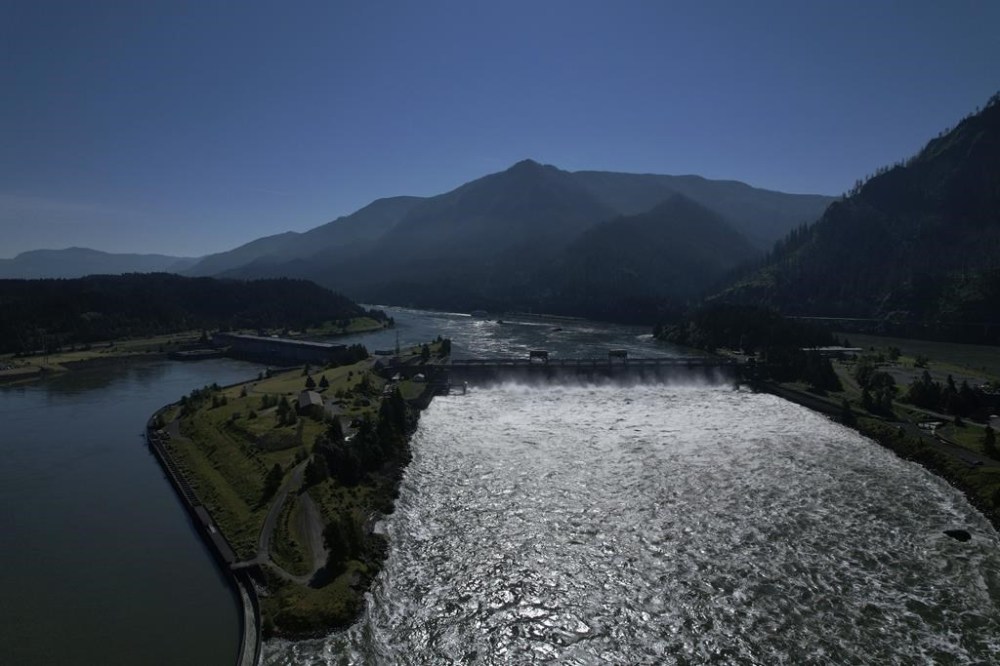
SEATTLE (AP) — The U.S. and Canada said Thursday they have agreed to update a six-decade-old treaty that governs the use of one of North America’s largest rivers, the Columbia, with provisions that officials said would provide for effective flood control, irrigation, and hydropower generation and sharing between the countries.
The “agreement in principle,” reached after six years of talks, provides a framework for updating the Columbia River Treaty. It calls for the U.S. to keep more of the power generated by its dams while improving cooperation between the Bonneville Power Administration, which markets power from dams in the northwestern U.S., and Canadian utilities, to help avoid blackouts.
The U.S. would pay Canada for reservoir capacity to hold back water during flood seasons, protecting downstream communities, at a rate that would begin at $37.6 million per year and increase with inflation. And the agreement would provide Canada with more flexibility in using the water stored in its reservoirs.
“After 60 years, the Treaty needs updating to reflect our changing climate and the changing needs of the communities that depend on this vital waterway,” U.S. President Joe Biden said in a written statement Thursday.
But environmental groups lamented the deal as a missed opportunity to provide more water for imperiled salmon and steelhead runs that have been decimated by dam operations in the Columbia River basin over the past century. While the original treaty ratified in 1964 was designed to cover flood control and hydropower generation, conservationists and Indigenous tribes have long argued that it should be updated to include river health and salmon restoration as a third principle.
“Our community is frustrated and disappointed today,” said Joseph Bogaard, of the nonprofit Save Our Wild Salmon. “The treaty needs to be a tool to address challenges for these fish. There are benefits and certainty for the power sector and for flood risk management, while salmon basically get status quo treatment.”
The Biden administration earlier this year brokered a $1 billion plan to boost salmon runs in the Northwest.
The Columbia River begins in Canada but flows mostly in the U.S. on its 1243-mile (2000.41 kilometer) journey to the Pacific Ocean. It forms most of the border between Washington state and Oregon. Its tributaries account for 40% of U.S. hydropower, irrigate $8 billion in agriculture products, and move 42 million tons of commercial cargo annually, officials noted Thursday.
The Columbia River Treaty came together after a 1948 flood washed away the Oregon community of Vanport, leaving more than 18,000 people homeless.
It provided for the construction of one dam in Montana, which flooded land in Canada, and three in British Columbia, completed between 1968 and 1973, that together more than doubled the amount of reservoir storage in the basin, providing benefits for both flood prevention and hydropower. The British Columbia dams also flooded tribal lands and retained much spring runoff that would otherwise be available for migrating salmon.
The treaty provided for what came to be known as the “Canadian Entitlement,” under which Canada receives $250 million to $350 million a year worth of electrical power in exchange for storing water in huge reservoirs that can be released to boost U.S. hydropower generation. The cost is higher than anticipated by the United States when the treaty was signed, and it increased prices for U.S. customers, lawmakers in the Pacific Northwest long complained.
Under the agreement announced Thursday, the U.S. will immediately reduce by 37 percent the amount of Columbia Basin hydropower it delivers to Canada, with further cuts amounting to 50 percent by 2033. BPA administrator John Hairston said Thursday that will save the agency about $70 million next year and about $1.2 billion over the next two decades.
“These new terms will go a long way toward helping meet the growing demand for energy in the region and avoid building unnecessary fossil fuel-based generation,” Hairston told reporters during a briefing Thursday.
U.S. Sens. Maria Cantwell, D-Washington, and Jim Risch, R-Idaho, who have pushed for updates to the treaty, called the agreement a positive step, but said they would need to review the details. Government negotiators will finalize details before the treaty is submitted to the U.S. Senate for ratification.
Indigenous tribes have long wanted the Columbia to flow more like a natural river, instead of a series of reservoirs with slow-moving water that often heat up to temperatures that kill migrating salmon.
U.S. and Canadian officials said the agreement would establish a tribal-led body that will provide recommendations on how treaty operations can better support ecosystem needs and tribal and indigenous cultural values.
In a written statement, Chief Keith Crow, of the Syilx Okanagan Nation in British Columbia, said the agreement gave him hope that one day his grandchildren might harvest salmon in the upper Columbia River region.
“We still have lots of work to do with Canada and B.C. to start addressing the past and ongoing impacts to our lands, waters and people,” Crow said.
Canada has been providing up to 1 million acre-feet of water a year to help juvenile salmon on their migration to the Pacific, with up to an additional half-million acre-feet in dry years, subject to negotiation between the countries, Bogaard, of Save Our Wild Salmon, said.
Researchers insist that the fish need 3 million to 5 million acre-feet per year released by Canada, but the agreement announced Thursday would reinforce the current amount, with the minor improvement that in dry years Canada would automatically provide the extra half-million acre-feet if available, he said.
“Salmon have suffered tremendous losses through the industrialization of the Columbia Basin’s rivers, in part, as a result of this Treaty,” Neil Brandt, executive director of WaterWatch of Oregon, said in a written statement. “A modernized Treaty must do better for salmon.”