Scientists seeing change in puffins as the tuxedo birds adapt to climate change

Advertisement

Advertise with us

FREDERICTON - The puffins of Machias Seal Island are feeling the heat.

Read this article for free:


or

Already have an account? Log in here »

To continue reading, please subscribe:

Subscribe and receive a limited-edition Free Press branded hat or tote.

Digital Subscription

One year of digital access for only $205*

  • Enjoy unlimited reading on winnipegfreepress.com
  • Read the E-Edition, our digital replica newspaper
  • Access News Break, our award-winning app
  • Play interactive puzzles

*First annual payment billed as $205.00 + GST for one year. This annual subscription will automatically renew at $233.00 + GST every 52 weeks (10% off the regular annual price of $259.35). Offer available to new and qualified returning subscribers only. Cancel any time.

To continue reading, please subscribe:

Add Free Press access to your Brandon Sun subscription for only an additional

$1 for the first 4 weeks*

  • Enjoy unlimited reading on winnipegfreepress.com
  • Read the E-Edition, our digital replica newspaper
  • Access News Break, our award-winning app
  • Play interactive puzzles
Start now

*Your next Brandon Sun subscription payment will increase by $1.00 and you will be charged $17.95 plus GST for four weeks. After four weeks, your payment will increase to $24.95 plus GST every four weeks.

Hey there, time traveller!
This article was published 28/07/2024 (797 days ago), so information in it may no longer be current.

FREDERICTON – The puffins of Machias Seal Island are feeling the heat.

Scientists say there is a link between warming waters and changes in the birds’ size and their beaks, as well as fluctuations in reproduction and the survival of chicks.

Machias Seal Island is a flat, treeless piece of rock located about 19 kilometres southwest of New Brunswick’s Grand Manan Island at the mouth of the Bay of Fundy. It is a sanctuary for seabirds, including about 8,600 breeding pairs of puffins.
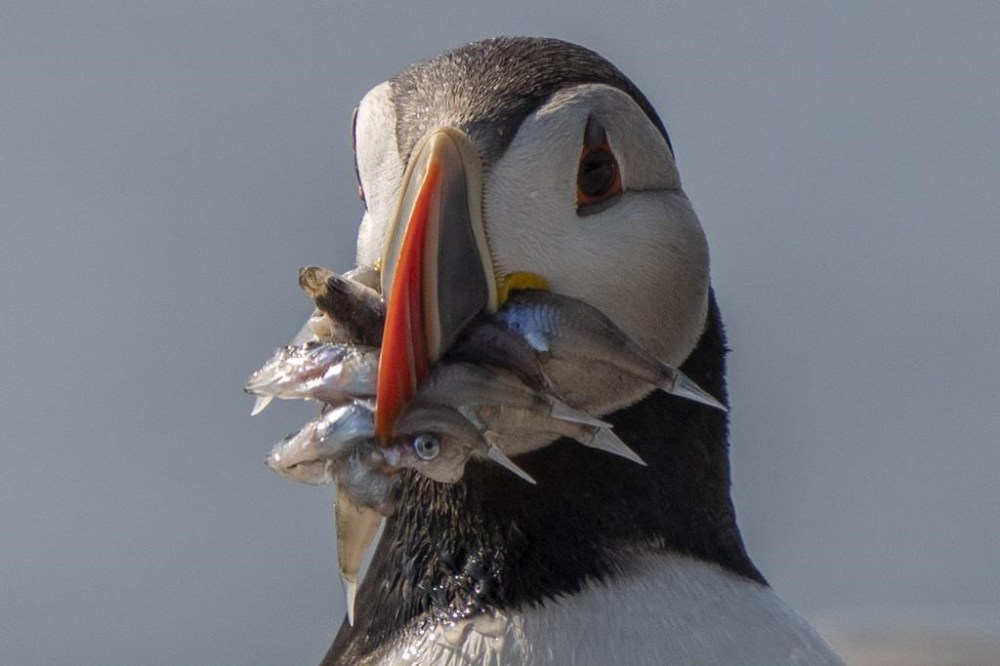
Puffins are feeling the heat. These defining birds of Machias Seal Island off the coasts of New Brunswick and Maine are feeling the effects of warming waters with scientists seeing changes in size of puffins, their bills and also fluctuations in reproduction and survival of chicks.An Atlantic puffin clamps down on baitfish it will feed to a chick on Eastern Egg Rock, Maine, Sunday, Aug. 5, 2023. THE CANADIAN PRESS/AP/Robert F. Bukaty

Heather Major, a marine biology professor at the University of New Brunswick, and her team are studying puffins and other birds on the island with a focus on the impacts of climate change.

Data on puffins on Machias Seal Island have been collected since 1995 and one of the most notable observations made by scientists is that when the birds are old enough to leave the island to go to sea, they are smaller than they used to be.

“We don’t know what that means for their survival, or their probability of returning as adults,” Major said in a video interview last week from the island.

“And that’s really interesting because that is one of the changes that you expect to see in a warming environment. A smaller body size means you’re able to dump heat more effectively.”

As Major spoke outside the research centre, razorbills, common murres, Arctic terns and other birds flew behind her, keeping up a stream of chirps and trills.

Over the past 10 years, she said, scientists have noted the puffins’ hatch date has become later, with chicks emerging toward the end of June rather than mid-June. And the birds’ distinctive brightly coloured beaks — which they use to carry fish and possibly to attract mates — are getting larger, she said.

The reason for the bigger beaks is unclear, but one hypothesis is that puffins may be using them to get rid of body heat; the larger the beak the more heat that can be shed.

On average, Major said, about 55 per cent of the island’s puffin chicks survive to go out into the ocean at the end of summer. Many then return to the island as adults to breed.

Over the past 10 years, scientists have seen a concerning trend, as the number of birds making it out to sea fluctuates wildly.

“What’s happening is that we’re getting these really, really good years followed by really, really bad years,” Major said. “We see these really big fluctuations that we don’t see earlier in the data set, and that seems to be related to things that are happening in the ocean.”

Puffins can live up to 30 years, and a stable population requires each pair successfully produce two chicks that survive to adulthood, which works out to one chick every few years. So far, that threshold is being met. But Major worries that if the fluctuations continue, the puffin population may start to fall.

The drops in reproductive success coincide with years where the ocean was “really” warm, which leads to a decrease in food for the chicks, she said.

Puffins are listed as “vulnerable” by the International Union for Conservation of Nature, which means they face a high risk of extinction in the wild.

Andrew Allyn, a researcher at the Gulf of Maine Research Institute, said the waters in the region have warmed by about 1.6 C since the 1980s, with the area heating up most during the summer. He said the region has seen marine heat waves over the past 10 to15 years.

“Marine heat wave events at the surface are becoming more frequent, more intense, and longer lasting, both globally and in the Gulf of Maine,” he said.

Major said a favoured food for puffins is Atlantic herring, which is rich in fat and helps chicks grow enough to be able to leave the island. But scientists are seeing less herring in chicks’ diets and more prey with a lower energy content, such as squid and sand eels.

“It’s interesting because it could be that there’s herring out there, but that for some reason, the puffins can’t find it,” she said.

Allyn said just as humans adapt their behaviour on land when temperatures soar — cranking on the air conditioner or jumping in the water to cool off — marine species may have similar coping mechanisms. For example, he said herring might choose to temporarily seek out cooler, or deeper waters and then limit their movements, which could explain why puffins can’t find them.

Major and her team have put tracking tags on puffins to see how far out the birds are going to get their food, including how deep they have to dive. It is stressful for parents to have to search further and dive deeper to find fish for their chicks, carrying the food in their beaks back to the chicks, she said.

“It adds more energy that the adults have to spend, and then reduces their body condition and can impact their survival.”

This report by The Canadian Press was first published July 28, 2024.

Report Error Submit a Tip

More Stories

Province looks to seize notorious drug den

Erik Pindera 5 minute read Preview

Province looks to seize notorious drug den

Erik Pindera 5 minute read 12:00 PM CDT

Provincial justice officials are trying to seize a Dominion Street drug den that has been the source of trouble in the West End for years.

The owner of 982 Dominion St., 45-year-old Robert Edward Johnson, was most recently arrested in June along with several others after a lengthy Winnipeg Police investigation into thefts and illicit drug sales connected to the house.

“The residence has a reputation within the neighbourhood as being a location where individuals habitually attend for the purpose of purchasing and/or consuming controlled substances,” reads a statement of claim filed by the province’s director of civil forfeiture in the Court of King’s Bench last week.

“For several years, the residence has been associated with criminal activity, violence, and disorder, resulting in numerous police attendances and complaints from members of the surrounding community.”

Read
12:00 PM CDT

Khan should’ve taken high road: Goertzen

Carol Sanders 5 minute read Preview

Khan should’ve taken high road: Goertzen

Carol Sanders 5 minute read Yesterday at 6:39 PM CDT

The veteran Progressive Conservative who championed Obby Khan’s leadership bid says the former Blue Bomber dropped the ball by dissing his Tory teammates before he stepped down.

“I wouldn’t recommend it, and I didn’t recommend it,” Kelvin Goertzen (Steinbach) said in an interview Friday.

Khan resigned as PC leader and quit the caucus Monday saying some members were secretly plotting his ouster, even after he won a confidence vote on Sept. 25.

On Tuesday, Khan lashed out in a CJOB interview, naming the alleged plotters, saying constituents deserved to know which of their elected representatives “lacked moral integrity.” Khan told the Free Press he was “deeply emotionally hurt,” and felt stabbed in the back.

Read
Yesterday at 6:39 PM CDT

Volunteer pop-up library axed from Manitoba Youth Centre

Matthew Frank 4 minute read Preview

Volunteer pop-up library axed from Manitoba Youth Centre

Matthew Frank 4 minute read Updated: 11:25 AM CDT

Manitoba Corrections has cancelled a pop-up library program at the Manitoba Youth Centre, leaving inmates without librarian services and fewer options to borrow certain books.

The Prison Libraries Committee, part of the non-profit Manitoba Library Association, operated and funded the volunteer program since 2024 before it was shut down by the province last month. The group previously partnered with the province to offer the service because the facility has no dedicated library of its own.

“It is concerning that community members who are incarcerated, especially youth, are losing out on meaningful programming, access to information and rehabilitation efforts, which are offered at no cost to (Manitoba) Corrections. We urge Manitoba Justice to promote more library services and programming, not less,” said a Sept. 24 letter from the non-profit addressed to the justice minister.

Ashley Huot, chair of the Prison Libraries Committee, said she was puzzled when she received an email last month from Manitoba Corrections stating that the pop-up library was no longer needed.

Read
Updated: 11:25 AM CDT

Health minister warns $1.2 billion in annual federal funding set to expire in March

Scott Billeck 4 minute read Preview

Health minister warns $1.2 billion in annual federal funding set to expire in March

Scott Billeck 4 minute read Thursday, Oct. 1, 2026

Manitoba’s health minister is warning of possible cuts to health care with $1.2 billion in annual funding from Ottawa set to expire next year.

“We’re very concerned that what would be the largest cut to health care in a generation is right in front of us,” Health Minister Uzoma Asagwara said Thursday at the Manitoba legislature. “It means that services that Manitobans depend on will be in jeopardy and be at risk.

“Any reductions, any cuts from Canada, will have direct impacts on the health outcomes of Manitobans.”

Asagwara, who serves as the provincial and territorial health minister lead, chaired a virtual meeting Tuesday with provincial and territorial health ministers to discuss federal funding for health care, mental health care and substance use services, which is scheduled to expire March 31, 2027.

Read
Thursday, Oct. 1, 2026

May be whiff of truth to ex’s odour ardour

Maureen Scurfield 5 minute read 2:01 AM CDT

DEAR MISS LONELYHEARTS: I ran into an old boyfriend I used to curl on a team with, and we went for drinks. We’ve been almost eight years apart, and I couldn’t remember why we broke up, as we always had such a great time together.

It wasn’t until the second date — this time on a weekend — that it came back to me, with a jolt. Pee-yew! I remembered he doesn’t use deodorant on weekends. Why? He enjoys his own body odour. I recalled that a bit too late, and it was just as awful as ever! I went home early.

Tonight, he called and I refused him another date. I said, “Think back. You remember why we broke up?” Then he said, “Oh yeah, you hated my no-deodorant weekend policy. Well, guess what? Some women don’t mind!” I said I really doubted that, and that ended the conversation. Miss L., wouldn’t any women find stinky underarms offensive?

— Sensitive Nose, Fort Richmond

Manitoba marks end of sending simple workplace problems to doctor’s office

Tory McNally 7 minute read Preview

Manitoba marks end of sending simple workplace problems to doctor’s office

Tory McNally 7 minute read 2:01 AM CDT

There are some changes in the workplace that make you think: “Well, it’s about time.”

This is one of them.

Starting Oct. 1, Manitoba changed the rules around sick notes. I think it is going to be a wonderful change — not just for doctors and patients, but for employers, employees and the way we think about accountability at work.

The change comes from Bill 11, the Employment Standards Code Amendment Act (Sick Notes for Employee Absences), which received royal assent on June 1 and came into force Thursday. Under the new rules, employers generally cannot require a sick note for an illness or injury unless the employee is away for more than one week or has been absent because of illness or injury for more than 10 scheduled workdays in the calendar year.

Read
2:01 AM CDT