

Greek-flagged tanker is burning after Houthi attacks, but no sign of oil spill
Advertisement
Read this article for free:
or
Already have an account? Log in here »
To continue reading, please subscribe:
Monthly Digital Subscription
$0 for the first 4 weeks*
- Enjoy unlimited reading on winnipegfreepress.com
- Read the E-Edition, our digital replica newspaper
- Access News Break, our award-winning app
- Play interactive puzzles
*No charge for 4 weeks then price increases to the regular rate of $19.00 plus GST every four weeks. Offer available to new and qualified returning subscribers only. Cancel any time.
Monthly Digital Subscription
$4.75/week*
- Enjoy unlimited reading on winnipegfreepress.com
- Read the E-Edition, our digital replica newspaper
- Access News Break, our award-winning app
- Play interactive puzzles
*Billed as $19 plus GST every four weeks. Cancel any time.
To continue reading, please subscribe:
Add Free Press access to your Brandon Sun subscription for only an additional
$1 for the first 4 weeks*
*Your next subscription payment will increase by $1.00 and you will be charged $16.99 plus GST for four weeks. After four weeks, your payment will increase to $23.99 plus GST every four weeks.
Read unlimited articles for free today:
or
Already have an account? Log in here »
Hey there, time traveller!
This article was published 26/08/2024 (467 days ago), so information in it may no longer be current.
DUBAI, United Arab Emirates (AP) — A Greek-flagged tanker repeatedly attacked by Yemen’s Houthi rebels in the Red Sea remains ablaze but hasn’t sprung a major oil leak in the waterway, a European Union naval command said Monday.
The attack on the Sounion marks the most serious assault in weeks by the rebels, who continue to target shipping through the Red Sea corridor over the Israel-Hamas war in the Gaza Strip. The attacks have disrupted the $1 trillion in trade that typically passes through the region, as well as halting some aid shipments to conflict-ravaged Sudan and Yemen.
Images published by the EU’s Operation Aspides, whose mission is to protect shipping in the area, showed smoke rising from multiple points along the Sounion’s deck and its bridge Sunday. Fires could be seen burning in at least nine different locations on the deck of the vessel, which had been loaded with 150,000 tons of Iraqi crude oil — roughly 1 million barrels. Some flames appeared near hatches of the tanker’s oil tanks.
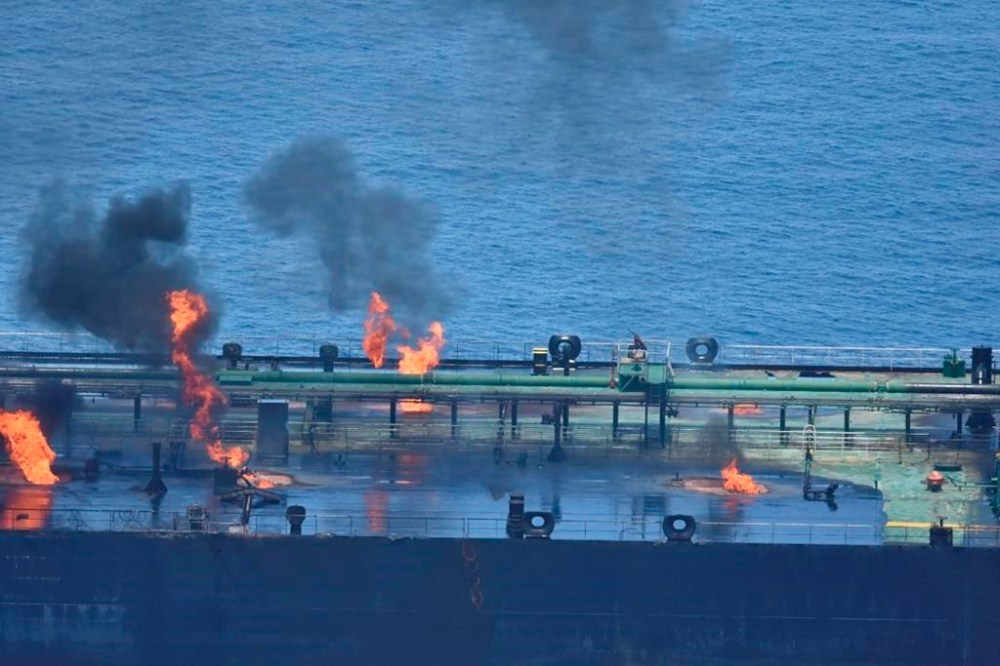
“So far there are no obvious signs of an oil spill,” the EU mission said. The Sounion “is both a navigational and an imminent environmental hazard. This situation underlines that these kinds of attacks pose not only a threat against the freedom of navigation but also to the lives of seafarers, the environment, and subsequently the life of all citizens living in that region.”
The U.S. State Department similarly warned about the ecological danger to the Red Sea, home to coral reefs and other natural habitats and wildlife. Footage showing explosions on board the Sounion released earlier by the Houthis and later analyzed by The Associated Press suggested that the rebels again boarded an abandoned vessel and rigged it with explosives in an attempt to sink it.
“While the crew has been evacuated, the Houthis appear determined to sink the ship and its cargo into the sea,” State Department spokesperson Matthew Miller said in a statement Saturday. “Through these attacks, the Houthis have made clear they are willing to destroy the fishing industry and regional ecosystems that Yemenis and other communities in the region rely on for their livelihoods, just as they have undermined the delivery of vital humanitarian aid to the region through their reckless attacks.”
For their part, the Houthis’ al-Masirah satellite news channel highlighted the EU’s photographs and described the Sounion as being targeted for “punishment to the company that owns the ship for violating the decision to ban access to the ports” of Israel.
The Sounion came under repeated attack last week by the Houthis. A French destroyer operating as part of Operation Aspides later rescued the Sounion’s crew of 25 Filipinos and Russians, as well as four private security personnel, and took them to nearby Djibouti.

The Houthis have targeted more than 80 vessels with missiles and drones since the war in Gaza started in October. They seized one vessel and sank two in the campaign that also killed four sailors. Other missiles and drones have either been intercepted by a U.S.-led coalition in the Red Sea or failed to reach their targets.
The rebels maintain that they target ships linked to Israel, the U.S. or the U.K. to force an end to Israel’s campaign against Hamas in Gaza. However, many of the ships attacked have little or no connection to the conflict, including some bound for Iran.