

Seeking to counter China, US awards $3 billion for EV battery production in 14 states
Advertisement
Read this article for free:
or
Already have an account? Log in here »
To continue reading, please subscribe:
Monthly Digital Subscription
$0 for the first 4 weeks*
- Enjoy unlimited reading on winnipegfreepress.com
- Read the E-Edition, our digital replica newspaper
- Access News Break, our award-winning app
- Play interactive puzzles
*No charge for 4 weeks then price increases to the regular rate of $19.95 plus GST every four weeks. Offer available to new and qualified returning subscribers only. Cancel any time.
Monthly Digital Subscription
$4.99/week*
- Enjoy unlimited reading on winnipegfreepress.com
- Read the E-Edition, our digital replica newspaper
- Access News Break, our award-winning app
- Play interactive puzzles
*Billed as $19.95 plus GST every four weeks. Cancel any time.
To continue reading, please subscribe:
Add Free Press access to your Brandon Sun subscription for only an additional
$1 for the first 4 weeks*
*Your next subscription payment will increase by $1.00 and you will be charged $16.99 plus GST for four weeks. After four weeks, your payment will increase to $23.99 plus GST every four weeks.
Read unlimited articles for free today:
or
Already have an account? Log in here »
Hey there, time traveller!
This article was published 20/09/2024 (473 days ago), so information in it may no longer be current.
WASHINGTON (AP) — The Biden administration is awarding over $3 billion to U.S. companies to boost domestic production of advanced batteries and other materials used for electric vehicles, part of a continuing push to reduce China’s global dominance in battery production for EVs and other electronics.
The grants will fund a total of 25 projects in 14 states, including battleground states such as Michigan and North Carolina, as well as Ohio, Texas, South Carolina and Louisiana.
The grants announced Friday mark the second round of EV battery funding under the bipartisan infrastructure law approved in 2021. An earlier round allocated $1.8 billion for 14 projects that are ongoing. The totals are down from amounts officials announced in October 2022 and reflect a number of projects that were withdrawn or rejected by U.S. officials during sometimes lengthy negotiations.
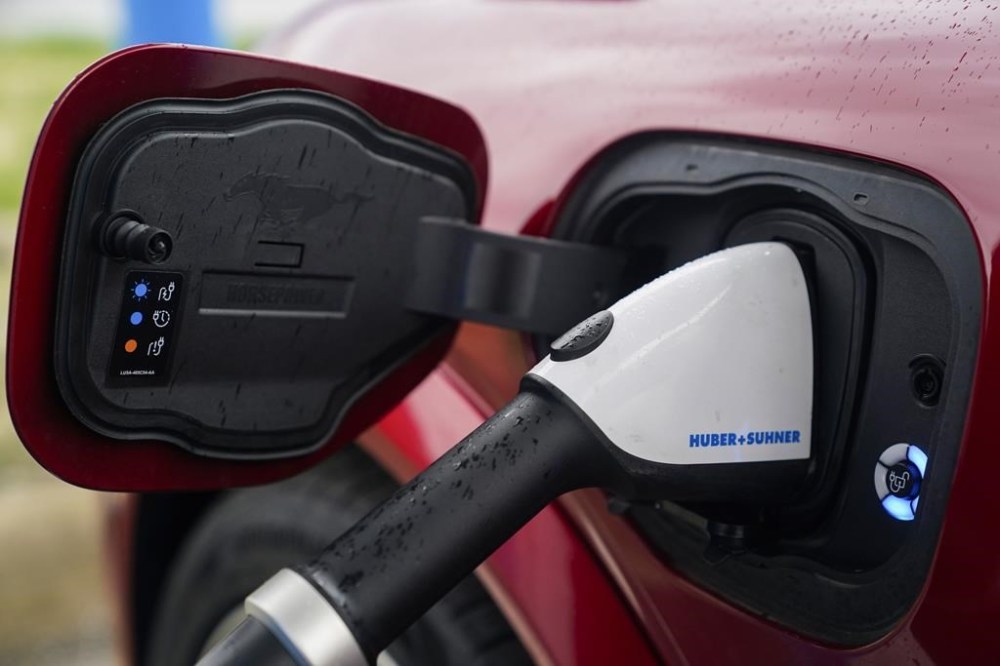
The money is part of a larger effort by President Joe Biden and Vice President Kamala Harris to boost production and sales of electric vehicles as a key element of their strategy to slow climate change and build up U.S. manufacturing. Companies receiving awards process lithium, graphite or other battery materials, or manufacture components used in EV batteries.
“Today’s awards move us closer to achieving the administration’s goal of building an end-to-end supply chain for batteries and critical minerals here in America, from mining to processing to manufacturing and recycling, which is vital to reduce China’s dominance of this critical sector,” White House economic adviser Lael Brainard said.
The Biden-Harris administration is “committed to making batteries in the United States that are going to be vital for powering our grid, our homes and businesses and America’s iconic auto industry,” Brainard told reporters Thursday during a White House call.
The awards announced Friday bring to nearly $35 billion total U.S. investments to bolster domestic critical minerals and battery supply chains, Brainard said, citing projects from major lithium mines in Nevada and North Carolina to battery factories in Michigan and Ohio to production of rare earth elements and magnets in California and Texas.
“We’re using every tool at our disposal, from grants and loans to allocated tax credits,” she said, adding that the administration’s approach has leveraged more $100 billion in private sector investment since Biden took office.
In recent years, China has cornered the market for processing and refining key minerals such as lithium, rare earth elements and gallium, and also has dominated battery production, leaving the U.S. and its allies and partners “vulnerable,” Brainard said.
The U.S. has responded by taking what she called “tough, targeted measures to enforce against unfair actions by China.” Just last week, officials finalized higher tariffs on Chinese imports of critical minerals such as graphite used in EV and grid-storage batteries. The administration also has acted under the 2022 climate law to incentivize domestic sourcing for EVs sold in the U.S. and placed restrictions on products from China and other adversaries labeled by the U.S. as foreign entities of concern.
“We’re committed to making batteries in the United States of America,” Energy Secretary Jennifer Granholm said.
If finalized, awards announced Friday will support 25 projects with 8,000 construction jobs and over 4,000 permanent jobs, officials said. Companies will be required to match grants on a 50-50 basis, with a minimum $50 million investment, the Energy Department said.
While federal funding may not be make-or-break for some projects, the infusion of cash from the infrastructure and climate laws has dramatically transformed the U.S. battery manufacturing sector in the past few years, said Matthew McDowell, associate professor of engineering at Georgia Institute of Technology.
McDowell said he is excited about the next generation of batteries for clean energy storage, including solid state batteries, which could potentially hold more energy than lithium ion.