Hot days and methamphetamine are now a deadlier mix
Advertisement
Read this article for free:
or
Already have an account? Log in here »
To continue reading, please subscribe:

Digital Subscription
One year of digital access for only $205*
- Enjoy unlimited reading on winnipegfreepress.com
- Read the E-Edition, our digital replica newspaper
- Access News Break, our award-winning app
- Play interactive puzzles
*First annual payment billed as $205.00 + GST for one year. This annual subscription will automatically renew at $233.00 + GST every 52 weeks (10% off the regular annual price of $259.35). Offer available to new and qualified returning subscribers only. Cancel any time.
To continue reading, please subscribe:
Add Free Press access to your Brandon Sun subscription for only an additional
$1 for the first 4 weeks*
- Enjoy unlimited reading on winnipegfreepress.com
- Read the E-Edition, our digital replica newspaper
- Access News Break, our award-winning app
- Play interactive puzzles
*Your next Brandon Sun subscription payment will increase by $1.00 and you will be charged $17.95 plus GST for four weeks. After four weeks, your payment will increase to $24.95 plus GST every four weeks.
Read unlimited articles for free today:
or
Already have an account? Log in here »
Hey there, time traveller!
This article was published 08/10/2024 (732 days ago), so information in it may no longer be current.
PHOENIX (AP) — On just one sweltering day during the hottest June on record in Phoenix, a 38-year-old man collapsed under a freeway bridge and a 41-year-old woman was found slumped outside a business. Both had used methamphetamine before dying from an increasingly dangerous mix of soaring temperatures and stimulants.
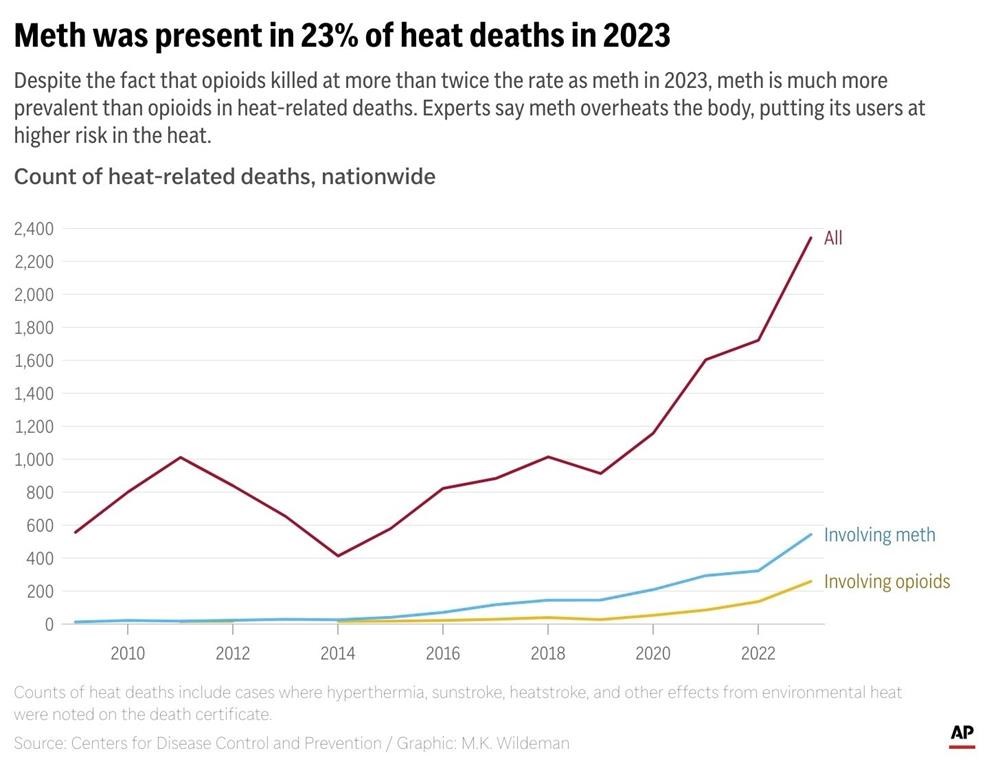
Meth is showing up more often as a factor in the deaths of people who died from heat-related causes in the U.S., according to an Associated Press analysis of data from the U.S. Centers for Disease Control and Prevention. Death certificates show about one in five heat-related deaths in recent years involved methamphetamine. In Arizona, Texas, Nevada and California, officials found the drug in nearly a third of heat deaths in 2023.
Meth is more common in heat-related deaths than the deadly opioid fentanyl. As a stimulant, it increases body temperature, impairs the brain’s ability to regulate body heat and makes it harder for the heart to compensate for extreme heat.

If hot weather has already raised someone’s body temperature, consuming alcohol or opioids can exacerbate the physical effects, “but meth would be the one that you would be most concerned about,” said Bob Anderson, chief of statistical analysis at the National Center for Health Statistics.
The trend has emerged as a synthetic drug manufactured south of the border by Mexican drug cartels has largely replaced the domestic version of meth fictionalized in the TV series “Breaking Bad.” Typically smoked in a glass pipe, a single dose can cost as little as a few dollars.
At the same time, human-caused climate change has made it much easier to die from heat-related causes in places like Phoenix, Las Vegas and California’s southeastern desert. This has been Earth’s hottest summer on record.
Phoenix baked in triple-digit heat for 113 straight days and hit 117 degrees Fahrenheit (47.2 Celsius) in late September — uncharacteristic even for a city synonymous with heat. The triple digits have carried into October — this week, the National Weather Service again warned of excessive heat.
“Putting on a jacket can increase body temperature in a cold room. If it’s hot outside, we can take off the jacket,” explained Rae Matsumoto, dean of the Daniel K. Inouye College of Pharmacy at the University of Hawaii in Hilo. But people using the stimulant in the outdoor heat “can’t take off the meth jacket.”
These fatalities are particularly prevalent in the Southwest, where meth overdoses overall have risen since the mid-2000s.
In Maricopa County, America’s hottest major metropolitan area, substances including street drugs, alcohol and certain prescription medicines for psychiatric conditions and blood pressure control were involved in about two-thirds, or 419 of the 645 heat-related deaths documented last year. Meth was detected in about three-quarters of these drug cases and was often the primary cause of death, public health data show. Fentanyl was found in just under half of them.
In Pima County, home to Tucson, Arizona’s second most populous city, methamphetamine was a factor in one-quarter of the 84 heat-related deaths reported so far this year, the medical examiner’s office said.
In metro Las Vegas, heat was a factor in 294 deaths investigated last year by the Clark County coroner’s office, and 39% involved illicit and prescription drugs and alcohol. Of those, meth was detected in three-fourths.
The U.S. Drug Enforcement Administration notes in its 2024 National Drug Threat Assessment that 31% of all drug-related deaths in the U.S. are now caused by stimulants that speed up the nervous system, primarily meth. More than 17,000 people in the U.S. died from fatal overdoses and poisonings related to stimulants in the first half of 2023, according to preliminary CDC data.
Although overdoses have been more associated with opiates like fentanyl, medical professionals say overdosing on meth is possible if a large amount is ingested. Higher blood pressure and a quickened heart rate can then provoke a heart attack or stroke.
“All of your normal physiological ways of coping with heat are compromised with the use of methamphetamines,” said Dr. Aneesh Narang, an emergency medicine physician at Banner University Medical Center in downtown Phoenix.
Narang, who sits on a board that reviews overdose fatalities, said the “vast majority” of the heat stroke patients seen in his hospital’s emergency department this summer had used street drugs, most commonly methamphetamine.
Because of its proximity to the U.S.-Mexico border, Phoenix is considered a “source city” where large amounts of newly smuggled meth are stored and packaged into relatively tiny doses for distribution, said Det. Matt Shay, a seasoned narcotics investigator with the Maricopa County Sheriff’s Office.
“It’s an amazing amount that comes in constantly every day,” Shay said. “It’s also very cheap.”
U.S. Customs and Border Protection seized about 164,000 pounds (about 74,000 kilograms) of meth at the U.S.-Mexico border this last fiscal year ending Sept. 30, up from the 140,000 pounds (about 63,500 kilograms) captured in the previous 12 months.
And sellers often target homeless people, Shay said.
“It’s a customer base that is easy to find and exploit,” Shay said. “If you’re an enterprising young drug dealer, all you need is some type of transportation and you just cruise around and they swarm your car.”
Jason Elliott, a 51-year-old unemployed machinist, said he’s heard of several heat-related deaths involving meth during his three years on the streets in Phoenix.

“It’s pretty typical,” said Elliot, noting that stimulants enable people to stay awake and alert to prevent being robbed in shelters or outdoors. “What else can you do? You have stuff; you go to sleep, you wake up and your stuff is gone.”
Dr. Nick Staab, assistant medical director of the Maricopa County Department of Public Health, said brochures were printed this summer and distributed in cooling centers to spread the word about the risk of using stimulants and certain prescription medicines in extreme heat.
But it’s unclear how many are being reached. People who use drugs may not be welcomed at some cooling centers. A better solution, according to Stacey Cope, capacity building and education director for the harm reduction nonprofit Sonoran Prevention Works, is to lower barriers to entry so that people most at risk “are not expected to be absent from drugs, or they’re not expected to leave during the hottest part of the day.”
___
Wildeman reported from Hartford, Connecticut.