Australia and UK make pact to partner on 2050 net-zero climate goal

Advertisement

Advertise with us

APIA, Samoa (AP) — Australia and the United Kingdom have deepened ties by agreeing to collaborate on climate change and energy initiatives, aiming to reach net-zero carbon emissions by 2050, while also reaffirming their mutual commitment to develop nuclear submarines for both nations under the AUKUS treaty.

Read this article for free:


or

Already have an account? Log in here »

To continue reading, please subscribe:

Subscribe and receive a limited-edition Free Press branded hat or tote.

Digital Subscription

One year of digital access for only $205*

  • Enjoy unlimited reading on winnipegfreepress.com
  • Read the E-Edition, our digital replica newspaper
  • Access News Break, our award-winning app
  • Play interactive puzzles

*First annual payment billed as $205.00 + GST for one year. This annual subscription will automatically renew at $233.00 + GST every 52 weeks (10% off the regular annual price of $259.35). Offer available to new and qualified returning subscribers only. Cancel any time.

To continue reading, please subscribe:

Add Free Press access to your Brandon Sun subscription for only an additional

$1 for the first 4 weeks*

  • Enjoy unlimited reading on winnipegfreepress.com
  • Read the E-Edition, our digital replica newspaper
  • Access News Break, our award-winning app
  • Play interactive puzzles
Start now

*Your next Brandon Sun subscription payment will increase by $1.00 and you will be charged $17.95 plus GST for four weeks. After four weeks, your payment will increase to $24.95 plus GST every four weeks.

Hey there, time traveller!
This article was published 24/10/2024 (713 days ago), so information in it may no longer be current.

APIA, Samoa (AP) — Australia and the United Kingdom have deepened ties by agreeing to collaborate on climate change and energy initiatives, aiming to reach net-zero carbon emissions by 2050, while also reaffirming their mutual commitment to develop nuclear submarines for both nations under the AUKUS treaty.

The Climate and Energy Partnership was announced after talks between Australian Prime Minister Anthony Albanese and U.K. Prime Minister Keir Starmer on the sidelines of the Commonwealth leaders meeting in Samoa on Friday.

The partnership focuses on accelerating the development of renewable energy like green hydrogen and offshore wind by sharing technology and innovation.
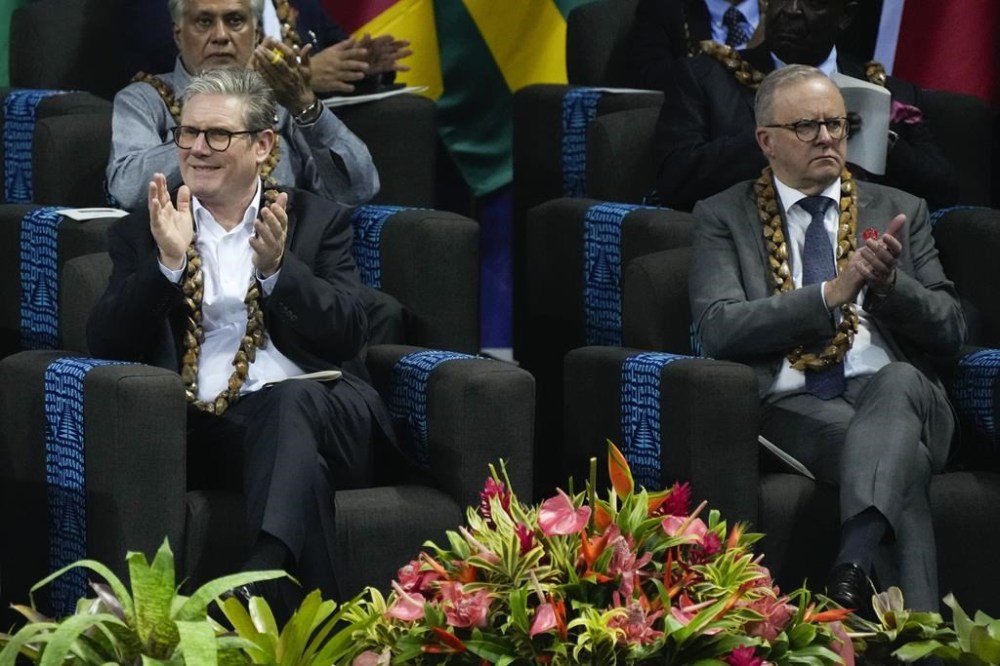
British Prime Minister Keir Starmer, left, and Australian Prime Minister Anthony Albanese react during the opening ceremony for the Commonwealth Heads of Government meeting in Apia, Samoa, Friday, Oct. 25, 2024. (AP Photo/Rick Rycroft/Pool)

“This partnership will ensure we maximize the economic potential of the net zero transition, and build on our long-standing cooperation on international climate action and shared commitment to reach net zero emissions by 2050,” Albanese said in a statement on Friday.

However, the statement was short on specifics for implementing the agreement, and is likely to do little to assuage the fears of several Pacific Island leaders, whose low-lying island nations are at high risk of rising sea levels, and on Thursday called on both countries to do more to tackle climate change.

The Commonwealth Heads of Government Meeting (CHOGM), hosted by Samoan Prime Minister Fiamē Naomi Mataʻafa, is expected to conclude with a strong statement on climate change, ahead of the UN climate summit in November.

Security was another theme of the first meeting between the left-leaning leaders since Starmer’s election victory in July, with defense, the war in Ukraine, the AUKUS security partnership, and issues in the Indo-Pacific discussed according to the joint statement released by the Prime Ministers.

“Together, we’re delivering better futures for our two countries, whether that’s through protecting our national security with projects like AUKUS or delivering on our net zero commitments,” said Starmer in a statement Friday.

King Charles III, attending his first CHOGM as sovereign, is expected to address the gathering.

Report Error Submit a Tip

More Stories

Khan’s abrupt departure presents desperate Tories with a valuable opportunity

Tom Brodbeck 5 minute read Preview

Khan’s abrupt departure presents desperate Tories with a valuable opportunity

Tom Brodbeck 5 minute read Yesterday at 1:06 PM CDT

If the Manitoba Progressive Conservatives are serious about getting out of the political wilderness, they should start by electing a progressive conservative leader.

Read
Yesterday at 1:06 PM CDT

Sidney Crosby sings praises of Jets' Bjorck, summer training partner Barron

Ken Wiebe 6 minute read Preview

Sidney Crosby sings praises of Jets' Bjorck, summer training partner Barron

Ken Wiebe 6 minute read Monday, Oct. 5, 2026

PITTSBURGH — It wasn’t that long ago when the shoe was on the other foot for Sidney Crosby.

Read
Monday, Oct. 5, 2026

Whistleblower pharmacist fined for misconduct after complaint

Nicole Buffie 5 minute read Preview

Whistleblower pharmacist fined for misconduct after complaint

Nicole Buffie 5 minute read Yesterday at 4:57 PM CDT

A Manitoba pharmacist who made complaints against a colleague that led to sanctions against him has now also been fined due to her own conduct.

Read
Yesterday at 4:57 PM CDT

Infill development on minds of all three River Heights-Fort Garry candidates

Joyanne Pursaga 4 minute read Preview

Infill development on minds of all three River Heights-Fort Garry candidates

Joyanne Pursaga 4 minute read Yesterday at 1:07 PM CDT

A trio of candidates will compete to become the first new city councillor in River Heights-Fort Garry since 2009.

Coun. John Orlikow, who won the seat in a byelection, is not running for another term.

Georgina Sabesky, who served as Orlikow’s executive assistant for 17 years, is now one of the candidates vying for the council seat.

Sabesky said that job gave her ample knowledge of the ward.

Read
Yesterday at 1:07 PM CDT

Jets trending in right direction after picking up points in first three games

Ken Wiebe 7 minute read Preview

Jets trending in right direction after picking up points in first three games

Ken Wiebe 7 minute read Yesterday at 5:06 PM CDT

Welcome to a small sample size season, when sweeping observations and hot takes can quickly become outdated and — occasionally — out of touch.

With that as a cautionary backdrop, the Winnipeg Jets are off to a 2-0-1 start that has them temporarily occupying top spot in the Central Division.

“We were optimistic that we’re a better team than we showed last year,” said Jets captain Adam Lowry. “We want to play fast. We want to compete hard, and we want to give ourselves a chance to win every night, so I think we’ve done that.”

As the Jets welcome the Colorado Avalanche on Wednesday to open a three-game homestand, they’ve gotten off to a fast start in a season that required one.

Read
Yesterday at 5:06 PM CDT

AI governance: Canada’s next structural test

Anne Thompson 4 minute read 2:00 AM CDT

Artificial intelligence is accelerating faster than the governance structures meant to contain it. Canada now faces a structural test — whether our institutions can protect autonomy, dignity, and continuity in an era when decision-making is increasingly mediated by systems we did not design, cannot fully audit, and do not yet constitutionally constrain.

This is not a technological problem. It is a governance problem.

AI systems influence how information flows, how institutions behave, and how decisions are made. They shape the conditions under which harm becomes predictable. They amplify both the strengths and weaknesses of the systems into which they are deployed. And they do all of this at a scale and speed that outpaces traditional regulatory tools.

Canada’s current approach to AI governance relies heavily on policy, guidelines, and sector-specific regulation. These are important, but they are not sufficient. What is missing is structural clarity — a constitutional-grade framework that defines authority, responsibility, accountability, and the minimum conditions under which AI systems may operate without undermining human dignity or institutional credibility.