‘Serious risks’: Researchers join push against importing monkeys for drug testing
Advertisement
Read this article for free:
or
Already have an account? Log in here »
To continue reading, please subscribe:

Digital Subscription
One year of digital access for only $205*
- Enjoy unlimited reading on winnipegfreepress.com
- Read the E-Edition, our digital replica newspaper
- Access News Break, our award-winning app
- Play interactive puzzles
*First annual payment billed as $205.00 + GST for one year. This annual subscription will automatically renew at $233.00 + GST every 52 weeks (10% off the regular annual price of $259.35). Offer available to new and qualified returning subscribers only. Cancel any time.
To continue reading, please subscribe:
Add Free Press access to your Brandon Sun subscription for only an additional
$1 for the first 4 weeks*
- Enjoy unlimited reading on winnipegfreepress.com
- Read the E-Edition, our digital replica newspaper
- Access News Break, our award-winning app
- Play interactive puzzles
*Your next Brandon Sun subscription payment will increase by $1.00 and you will be charged $17.95 plus GST for four weeks. After four weeks, your payment will increase to $24.95 plus GST every four weeks.
Read unlimited articles for free today:
or
Already have an account? Log in here »
Hey there, time traveller!
This article was published 13/11/2024 (673 days ago), so information in it may no longer be current.
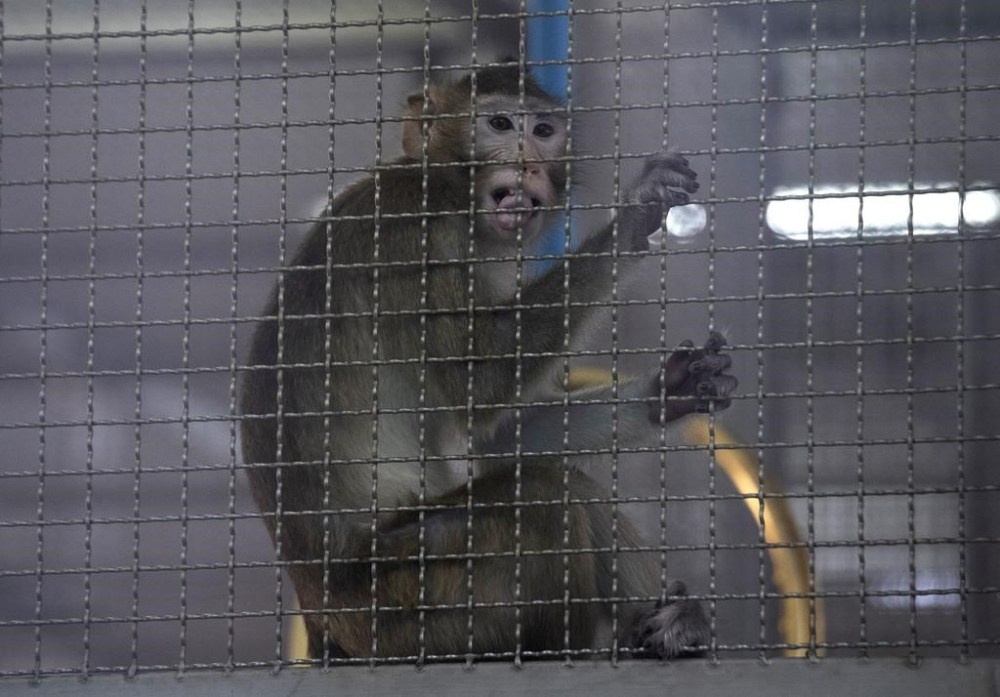
Dozens of researchers across Canada, including renowned environmentalist David Suzuki, have joined a growing chorus of voices urging the federal government to halt the importation of an endangered monkey species for medical research in Quebec.
A letter signed by 80 scientists, academics, doctors and students says testing on long-tailed macaques from Cambodia should be banned due to ethical concerns and potential public-health risks.
“A decade ago, chimpanzees, our closest primate relatives, ceased to be used for experimentation because using such animal ‘models’ could no longer be justified from scientific, ethical, and/or financial perspectives,” says the letter addressed to Prime Minister Justin Trudeau, his environment minister and the premier of Quebec.
The researchers say they are also concerned about “the serious risks of transmission of zoonotic pathogens” that could be associated with transporting macaques.
Their letter urges the federal government to end charter flights that have been bringing the macaques into Canada, and to adopt regulations banning the importation of all primates for biomedical testing.
It’s the latest group to add more pressure on Ottawa to suspend the monkey imports by Charles River Laboratories, a U.S.-based pharmaceutical giant that has a sprawling facility in Montreal.
The company announced in 2023 that it was halting macaque imports into the U.S., after it was subpoenaed in a case that involved the indictment of two senior Cambodian officials over what authorities described as “multiple felonies for their role in bringing wild long-tailed macaques into the United States.”
No charges have been brought against Charles River Laboratories, or any of its officials, and the company has said it will fully co-operate with the U.S. investigation.
At around the same time, imports of monkeys from Cambodia into Canada dramatically surged, with Statistics Canada data showing a 500 per cent increase in 2023 from the year before.
Environment and Climate Change Canada, the federal department responsible for monitoring commercial trade in wildlife, confirmed to the Canadian Press that Charles River Laboratories has imported 6,769 long-tailed macaques into the country between January 2023 and August of this year. The monetary value of these imported macaques is around $120 million dollars, according to Statistics Canada.
The department previously said that officials rigorously and closely inspect imports of foreign animals, including those brought in by Charles River Laboratories, and that all macaque imports so far this year have complied with federal and international wildlife regulations.
The government and the company have both said that no Canadian laws have been broken.
Last month, the Canadian Transportation Authority issued a permit for another shipment on a cargo plane chartered by Charles River Laboratories. A flight tracker shows that a plane with the same flight number as what is shown on the permit departed Phnom Penh, Cambodia last Thursday, and arrived in Montreal on Friday.
Jesse Greener, a professor of chemistry at Laval University who signed the researchers’ letter to the government, said medical technology has developed to a point that makes it unjustifiable for the pharmaceutical industry to continue using live primates for testing.
“The government should take a leadership role and help researchers and surely the private sector to pivot from using these unethical, and I would say old and outdated and unreliable animal models, and embrace these much more efficient and ethical approaches that are … exploding right now,” said Greener, who has done research on methods to replace animals in such experiments.
“It is grotesque,” he said of the animal use. “It is time that we change the page on this chapter of terrible research and commercial activities.”
Canada banned the use of animals for cosmetic testing last year, but it is still legal to use live primates for drug testing purposes.
The federal government said a draft strategy aimed at reducing and replacing the use of animals in drug testing was published in September and open to public consultations for 60 days.
The strategy, which will be revised based on input from researchers, experts and others, is expected to be published in June 2025, it said.
“The government of Canada is committed to advancing efforts to replace, reduce, or refine the use of vertebrate animals in toxicity testing where possible,” Environment and Climate Change Canada said in a statement Tuesday.
Charles River Laboratories previously told The Canadian Press that while it is also committed to reducing its use of live primates, global regulatory bodies require drugs to be tested on animals before they are evaluated in humans.
The company said the use of non-human primates has been vital in developing treatments for various diseases and that the standards it applies in its facilities are exceeding global norms.

Matthew Green, a New Democrat MP who had previously called on the federal government to halt the latest shipment of macaques, said he has “great concern” about importing this exotic animal.
“Generally in Canada, Canadians like to believe that our government has higher regulations and more stringent enforcement protocols when it comes to protecting endangered species, yet this is not the case in comparison to what the United States has done,” he said.
Green and two of his NDP colleagues wrote a letter to three federal ministers last month, demanding an “immediate attention” to the issue.
The Animal Alliance of Canada also sent a letter to the environment minister in August, urging the immediate suspension of monkey importation from Cambodia.
This report by The Canadian Press was first published Nov. 13, 2024.