

Ireland and UK clean up after unprecedented Storm Éowyn brings record winds and damage
Advertisement
Read this article for free:
or
Already have an account? Log in here »
To continue reading, please subscribe:
Monthly Digital Subscription
$1 per week for 24 weeks*
- Enjoy unlimited reading on winnipegfreepress.com
- Read the E-Edition, our digital replica newspaper
- Access News Break, our award-winning app
- Play interactive puzzles
*Billed as $4.00 plus GST every four weeks. After 24 weeks, price increases to the regular rate of $19.95 plus GST every four weeks. Offer available to new and qualified returning subscribers only. Cancel any time.
Monthly Digital Subscription
$4.99/week*
- Enjoy unlimited reading on winnipegfreepress.com
- Read the E-Edition, our digital replica newspaper
- Access News Break, our award-winning app
- Play interactive puzzles
*Billed as $19.95 plus GST every four weeks. Cancel any time.
To continue reading, please subscribe:
Add Free Press access to your Brandon Sun subscription for only an additional
$1 for the first 4 weeks*
*Your next subscription payment will increase by $1.00 and you will be charged $16.99 plus GST for four weeks. After four weeks, your payment will increase to $23.99 plus GST every four weeks.
Read unlimited articles for free today:
or
Already have an account? Log in here »
Hey there, time traveller!
This article was published 25/01/2025 (426 days ago), so information in it may no longer be current.
LONDON (AP) — Emergency crews began cleaning up Saturday after a storm bearing record-breaking winds left at least one person dead and more than a million without power across the island of Ireland and Scotland.
Work was underway to remove hundreds of trees blocking roads and railway lines in the wake of the system, named Storm Éowyn (pronounced AY-oh-win) by weather authorities.
In Ireland, wind snapped telephone poles, ripped apart a Dublin ice rink and even toppled a giant wind turbine. A wind gust of 114 mph (183 kph) was recorded on the west coast, breaking a record set in 1945.
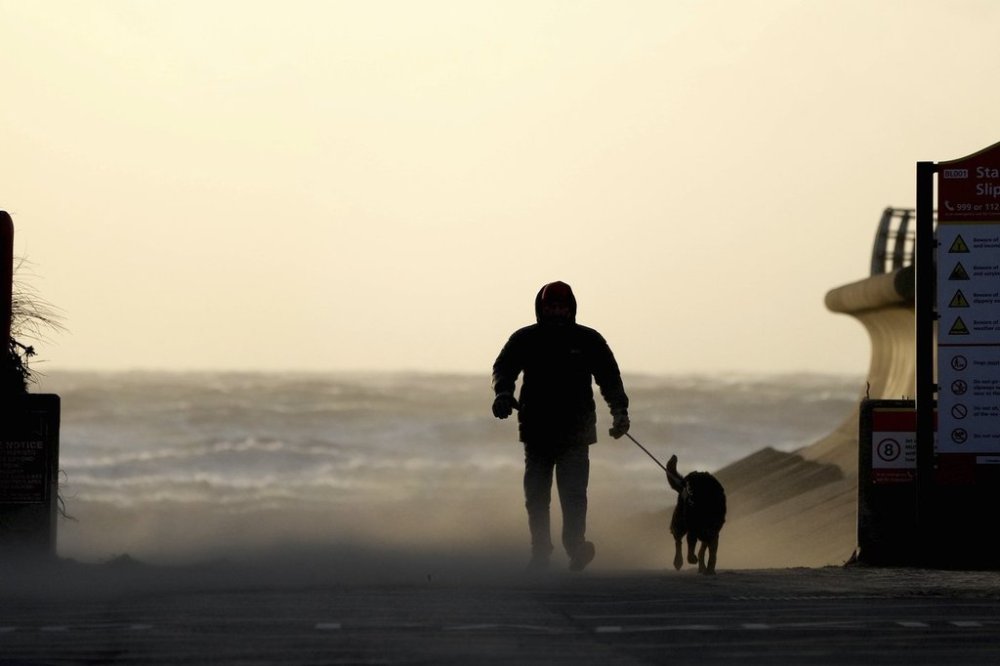
A man died after a tree fell on his car in County Donegal in northwest Ireland, local police said. They named the victim as 20-year-old Kacper Dudek.
Hundreds of thousands of homes and businesses in the Republic of Ireland, neighboring Northern Ireland and Scotland, remained without electricity on Saturday,
“The destruction caused by some of the strongest winds on record has been unprecedented,” said Irish Prime Minister Micheál Martin, adding that “every effort is being made to get high voltage transmission lines up and running, homes reconnected and water supplies secured.”

Schools were closed and trains, ferries and more than 1,100 flights were canceled Friday in the Republic of Ireland and the U.K. City centers in Dublin, Belfast and Glasgow were eerily quiet as people heeded government advice to stay home.
Part of the storm’s energy originated with the system that brought historic snowfall along the Gulf Coast of the U.S., said Jason Nicholls, lead international forecaster at the private weather company AccuWeather.
Éowyn became a bomb cyclone, which happens when a storm’s pressure drops 24 millibars in 24 hours and strengthens rapidly. The storm was so powerful that meteorologists say a sting jet developed, meaning Éowyn tapped into exceptionally strong winds higher up in the atmosphere. A sting jet is a narrow area of winds moving 100 mph (161 kph) or faster that is drawn down to the Earth’s surface from the mid-troposphere and lasts for a few hours.
Scientists say pinpointing the exact influence of climate change on a storm is challenging, but all storms are happening in an atmosphere that is warming abnormally fast due to human-released pollutants like carbon dioxide and methane.
“As the climate gets warmer, we can expect these storms to become even more intense, with greater damages,” said Hayley Fowler, a professor of climate change impacts at Newcastle University.